
A fatal collision involving an employee’s own car can bring an organisation’s safety management under scrutiny, not only the driver’s actions. A grey fleet consists of employees’ privately owned vehicles used for business, and the Corporate Manslaughter and Corporate Homicide Act 2007 makes no distinction between these journeys and work trips in company vehicles. The link between the Corporate Manslaughter Act and grey fleet compliance becomes critical where a death follows a gross breach of a relevant duty of care.
It is easy to assume that a privately owned vehicle falls outside an employer’s responsibility. The key issue is whether the journey is for work and how its risks are managed. Business travel can carry legal and safety responsibilities even when the employee owns the car.
This article explains which vehicles and journeys count as grey fleet use, what employers need to consider about driver, vehicle and journey risks, and when a fatal collision may lead to corporate manslaughter liability. It also explains how grey fleet management and mileage capture can support clearer oversight of business travel.
Key Takeaways
- Identify when an employee’s privately owned vehicle and business journey fall within grey fleet use.
- Understand how employers’ risk assessment duties apply to work travel, regardless of who owns the vehicle.
- Recognise how weak safety management could increase financial and reputational exposure after a serious collision.
- See how grey fleet management can support better oversight of vehicles, drivers and business mileage.
What is a Grey Fleet and Why Does It Matter?
A grey fleet comprises employees’ privately owned vehicles used for work journeys. Although ownership differs from a company car, the work-related journey still involves safety responsibilities.
Employee Vehicle Responsibilities
Employees using private vehicles for work need suitable insurance and a roadworthy vehicle. A policy that covers commuting alone may not cover business journeys, so check that it includes appropriate business use.
Drivers should keep their vehicles in safe condition and tell their employer about problems that could affect a work journey. Worn tyres or a known defect, for example, can make a vehicle unsuitable for business use. Clear reporting arrangements help employees know when to raise concerns, so personal ownership does not become a reason to overlook vehicle safety.
Employer Duties for Work-Related Driving
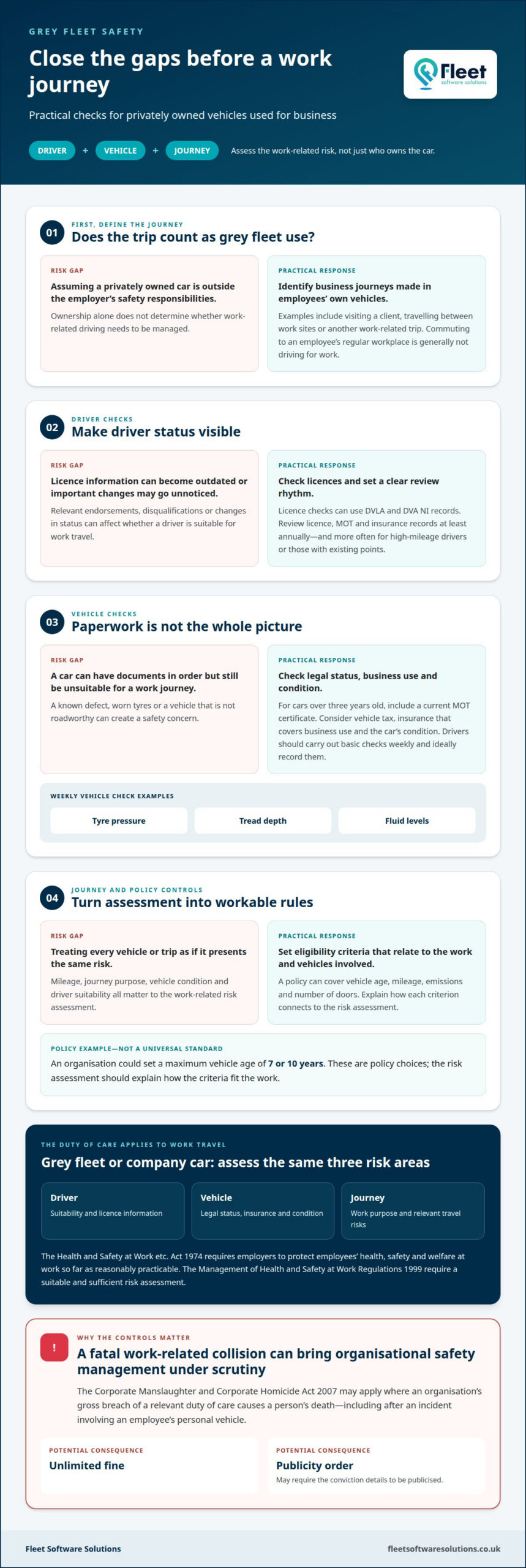
Employers must manage work-related driving risks, including those involving grey fleet drivers. The Health and Safety at Work etc. Act 1974 requires employers to protect employees’ health, safety and welfare at work, so far as reasonably practicable.
According to UK legislation, the Management of Health and Safety at Work Regulations 1999 require UK employers to carry out a suitable and sufficient risk assessment. This answers what legal duties apply when staff use their own cars: employers must assess and manage relevant work risks, while employees remain responsible for providing accurate information about their vehicles and insurance. The assessment should consider the journey, driver and vehicle, not ownership alone.
Grey Fleet and Company Car Compliance
Grey fleet compliance covers privately owned vehicles used for work, while company car compliance concerns vehicles supplied by the employer. In practice, employers need a reliable way to establish relevant driver and vehicle information for personal cars. Company-car arrangements give the employer more direct control over the vehicle.
In both cases, the employer’s work-related duty of care remains relevant. Insurance, roadworthiness and driver suitability can be less visible on grey fleet journeys unless responsibilities and records are managed clearly. With a company car, the employer can oversee the vehicle directly, but must still consider the driver and journey. This distinction helps employers set proportionate controls for each type of fleet.
What qualifies as a grey fleet vehicle and business journey
A grey fleet journey is work-related driving in a vehicle owned by an employee, rather than supplied by the employer. Examples include visiting a client, travelling between work sites or making another work-related trip. Commuting to an employee’s regular workplace is generally not classed as driving for work.
HSE guidance says vehicles used for work should be fit for purpose, regardless of ownership. Employers can use that principle alongside the Management of Health and Safety at Work Regulations 1999 when shaping a policy and risk assessment. The assessment should consider the driver, vehicle and journey, then set practical eligibility criteria and review arrangements.
Checks should cover the employee’s driving licence and the vehicle’s legal and roadworthy status. Employers can check licences against DVLA and DVA NI records, including relevant endorsements, disqualifications or status changes. Review licence, MOT and insurance records at least annually, and more often for high-mileage drivers or those with existing points.
For cars over three years old, grey fleet checks should include a current MOT certificate. Employers should also consider vehicle tax, business-use insurance and the vehicle’s condition. A defect can make a car unsuitable for a work journey even when its paperwork is in order. Drivers should carry out basic checks weekly and ideally record them, including tyre pressure, tread depth and fluid levels.
A grey fleet policy can define vehicle age, mileage, emissions and number of doors as eligibility criteria. For example, an organisation could set a maximum vehicle age of 7 or 10 years. These are policy choices, not universal standards; the risk assessment should explain how the criteria relate to the work and vehicles involved.
To make these requirements workable, grey fleet compliance controls can help organise driver and vehicle records around the checks the policy requires.
Financial and reputational risks
Grey fleet exposure can affect an organisation’s finances, reputation and health and safety responsibilities. The Corporate Manslaughter and Corporate Homicide Act 2007 is relevant where a death follows a gross breach of a duty of care. Corporate manslaughter liability and grey fleet compliance are therefore closely linked.
Balancing Fleet Costs and Risks
Balancing fleet costs and risks means weighing travel spending against effective oversight of business journeys.
Reducing mileage claims alone will not address risks involving drivers, vehicles or journeys. Organisations can review whether travel is necessary while keeping controls in place for essential trips. Recording licence, vehicle and journey information connects spending decisions with health and safety oversight. Effective grey fleet compliance also helps managers identify gaps without treating lower travel spending as the only measure of success.
The Corporate Manslaughter and Corporate Homicide Act
The Corporate Manslaughter and Corporate Homicide Act 2007 establishes an offence where an organisation’s gross breach of a relevant duty of care causes a person’s death. It may apply following a fatal work-related driving incident, including one involving an employee’s personal vehicle.
A conviction can result in an unlimited fine, and a publicity order can require the conviction details to be publicised. These consequences may affect finances and reputation, while the organisation’s safety management comes under scrutiny. Records of mileage, driving responsibilities and decisions about work journeys help show how relevant risks were managed. A practical approach to corporate manslaughter and grey fleet compliance links documented controls with action on identified concerns.
Corporate manslaughter liability following a fatal grey fleet collision
A fatal collision involving grey fleet vehicles does not automatically make an organisation guilty of corporate manslaughter. Under the Corporate Manslaughter and Corporate Homicide Act 2007, prosecution may follow where a death results from a gross breach of a relevant duty of care. Serious failures in how the organisation manages safety at work are central to that assessment.
Work-related driving can bring an organisation’s systems under scrutiny, even when an employee owns the car. Investigators may examine whether a known vehicle defect was ignored, whether a driver was allowed to continue driving or whether working hours left too little opportunity for rest. These examples concern decisions and controls around driving for work, not simply who owns the vehicle.
The question is whether serious management failures contributed to the death and amounted to a gross breach of duty. A company can face prosecution, but liability is not established simply because an employee was involved in a fatal incident. The vehicle’s condition, the journey, the driver’s circumstances and the organisation’s response to known risks may all help show how safety was managed.
Effective grey fleet management connects policy with action. A documented defect-reporting process, clear driver rules and follow-up can help prevent known risks from being overlooked. If a client journey involves a vehicle issue or fatigue concern, staff need a clear way to report it and stop unsafe travel. Records should show how the organisation handled concerns and put its controls into practice.
After a fatal collision, the distinction between a personal car and a company car does not remove scrutiny of work-related safety management. The organisation’s approach to risk, including whether it acted on warning signs, may be relevant to whether its duty was grossly breached. A conviction can result in an unlimited fine and a publicity order.
Strengthen oversight of work-related journeys with grey fleet management support that helps organise driver and vehicle information.
Fleet Software Solutions: Grey Fleet Management
Fleet Software Solutions provides Grey Fleet Management to help organisations structure their oversight of employee vehicles used for work. This can help when driver, vehicle and business mileage records are spread across separate processes, making it harder to maintain a consistent view of grey fleet activity.
Bringing grey fleet requirements into a managed process can support clearer administration of work-related vehicle use. This approach should complement, not replace, an employer’s risk assessment, policy or responsibility to manage safety at work. Fleet Software Solutions also provides DVS Compliance Solutions, Vehicle Tracking and Vehicle Cameras for related fleet needs.
Contact Fleet Software Solutions to discuss managing your organisation’s grey fleet.
Make safer work-related travel part of your next review
Use your next fleet-policy review to connect day-to-day practice with the risks your organisation has identified. A clear process for recording concerns, assigning responsibility and reviewing decisions helps keep safety visible as business travel changes. It also gives managers a practical basis for improving oversight, rather than relying on assumptions about who owns each vehicle.
A considered approach to grey fleet compliance under the Corporate Manslaughter and Corporate Homicide Act 2007 starts with consistent management of work-related driving risks. Fleet Software Solutions offers Vehicle Tracking and Vehicle Cameras alongside Grey Fleet Management, supporting organisations looking to strengthen oversight of their fleet operations.
If you’re ready to discuss a more structured approach, contact Fleet Software Solutions. A clear next step can help your organisation build more informed, safety-conscious travel practices.
Frequently Asked Questions
What is grey mileage?
Grey mileage is the business mileage an employee drives in their personal vehicle, for which the employer may reimburse them. For example, a worker using their own car to travel between work sites records grey mileage for that journey, not for ordinary commuting. Keeping mileage records separate from other travel helps organisations understand business travel and administer claims accurately.
How does the Corporate Manslaughter Act apply to grey fleet vehicles in the UK?
The Corporate Manslaughter and Corporate Homicide Act 2007 can apply after a fatal work-related collision if a gross breach of a relevant duty of care caused the death. The fact that the employee owned the car does not, by itself, remove the organisation’s responsibilities for managing work-related safety. The key issue is whether serious failures in the organisation’s safety management contributed to the fatality.
What checks should employers carry out on grey fleet drivers, vehicles, insurance and MOT?
Employers should establish that drivers are authorised and suitably insured for business journeys, and that their vehicles are roadworthy and have a current MOT when required. Keep records of checks and set a process for reporting changes, such as a licence endorsement, insurance renewal or vehicle defect. For example, a new concern about a tyre should be reported before the vehicle is used for another work trip.
What are the penalties and risks for employers after a grey fleet road death?
If an organisation is convicted under the Corporate Manslaughter and Corporate Homicide Act 2007, it can receive an unlimited fine; a court may also make a publicity order requiring conviction details to be publicised. A fatal incident can bring scrutiny of how the organisation managed driving for work, including known risks and safety decisions. The potential consequences therefore include both financial penalties and reputational damage.
How often should employers check grey fleet driving licences, MOT and insurance?
Check licences, MOTs and insurance certificates at least annually, and more often for high-mileage drivers or those with existing points. A policy can also require checks before an employee’s first business journey and explain how to report changes between reviews. Basic vehicle condition checks are a separate routine: grey fleet drivers should carry them out weekly and ideally record them, including tyre condition and fluid levels.