

Accurate mileage records don’t necessarily show which employees drive for work or whether the right checks are in place. A greyfleet process needs to address both: recording business miles and setting consistent controls for work journeys in employees’ own vehicles.
If you’re unsure where business use begins, which checks are appropriate or how to record mileage without intruding on employees’ privacy, you’re not alone. Personal vehicle use may be spread across teams and recorded in different ways, making oversight difficult. Private ownership doesn’t remove the need to consider how your organisation manages work-related driving risks.
This guide explains what counts as grey fleet use, how to approach employer responsibilities and how to build a practical process for driver and vehicle checks. It also covers mileage capture, employee and manager responsibilities, and proportionate data handling. Centralised fleet management software can help organise records, but mileage capture is only one part of the wider process.
Greyfleet management in practice
Start by defining which journeys your organisation treats as business travel. Then document the checks, records and approvals required for those journeys. This gives employees and managers a consistent process to follow, whether claims are recorded manually or through digital mileage capture.
Key Takeaways
- Set a clear policy for which work journeys and personal vehicles fall within your grey fleet, including how you treat journeys that may sit between business travel and commuting.
- Assess driver suitability, vehicle condition, insurance suitability and business-use records. Check current UK guidance to distinguish good practice from specific duties.
- Choose mileage-recording methods that suit your organisation, and collect only the information needed for legitimate business processes.
- Assign responsibilities across relevant teams, then review the process to identify gaps and improve consistency.
- Consider whether centralised fleet management software and mileage capture could support oversight and reduce manual administration, alongside a clear policy.
What is a grey fleet, and which work journeys count?
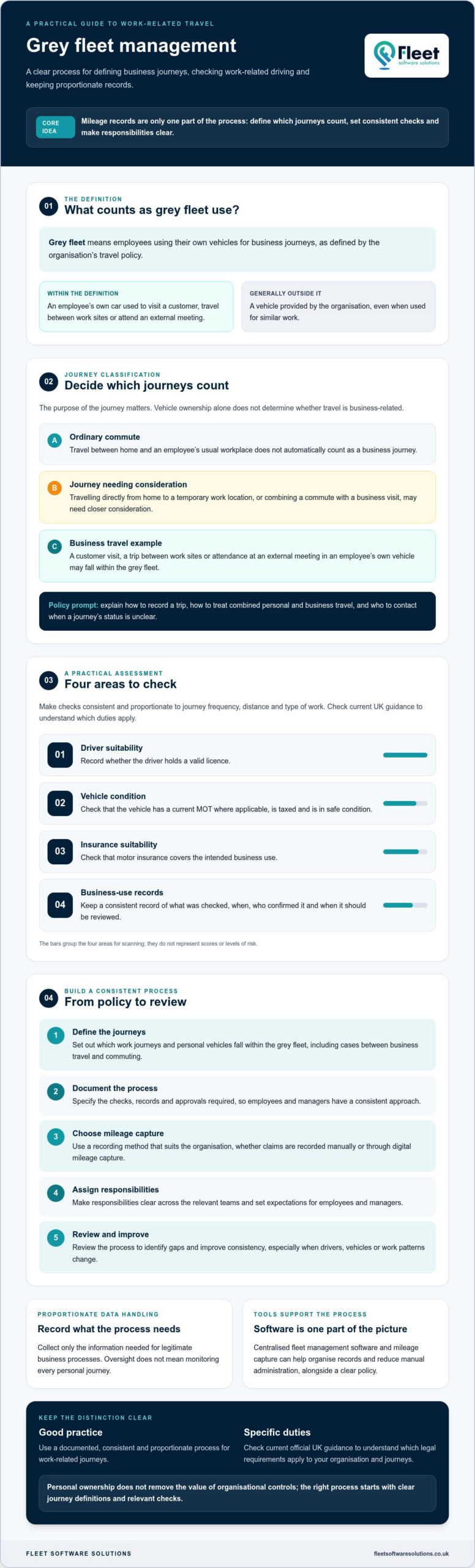
A grey fleet is the use of employees’ own vehicles for business journeys, as defined by an organisation’s travel policy. This differs from using a company-owned, leased or otherwise organisation-provided vehicle, even if the employee uses it for similar work. In the wider context of fleet management, grey fleet arrangements bring privately owned vehicles into an organisation’s work-related travel process.
An ordinary commute between home and an employee’s usual workplace doesn’t automatically count as a business journey. Travelling directly from home to a temporary work location, or combining a commute with a business visit, may need closer consideration. Check current guidance and explain in your policy how you treat these cases, rather than assuming every journey connected with work is business travel.
Which journeys and vehicles may fall within a grey fleet?
Potential grey fleet journeys include visiting a customer, travelling between work sites or attending an external meeting in an employee’s own car. The purpose of the journey matters: vehicle ownership alone doesn’t determine whether it is business-related. An employee may use a personal vehicle for both commuting and work travel, while a vehicle provided by the organisation would generally sit outside the grey fleet definition.
Set out journey categories in your travel policy so employees and managers can apply them consistently. Explain how to record a trip, what to do when personal and business travel are combined, and who to contact if a journey’s status is unclear. Clear categories give mileage records a more reliable basis and help avoid resolving the same uncertainty each time a claim is submitted.
Why grey fleet oversight matters to employers
Personal vehicle use can be less visible than travel in organisation-provided vehicles, particularly when employees arrange journeys independently and submit mileage later. Without a consistent process, it may be harder to see who is driving for work, distinguish business mileage from commuting, or reconcile records across teams. This can create avoidable administration and leave gaps in the information used to manage work-related travel.
That doesn’t mean employers need to monitor every personal journey. Proportionate oversight starts with defining which trips count, recording only information needed for the business process, and setting clear expectations for employees and managers. Personal ownership doesn’t remove the value of organisational controls, but specific legal duties should be checked against current UK guidance rather than assumed from a general definition of grey fleet.
What grey fleet risks and employer responsibilities should you assess?
Consistent checks give employers a clearer view of grey fleet use and make work-related driving processes easier to manage. A practical assessment can cover four areas: whether the driver is suitable for the journey, whether the vehicle is safe to use, whether insurance covers the business use, and whether relevant records are complete.
Distinguish sensible organisational controls from specific legal requirements. The Health and Safety Executive (HSE) guidance explains how employers should manage work-related road safety. Check current official guidance to understand how it applies to your organisation and journeys. Make checks proportionate to factors such as journey frequency, distance and type of work, and consistent with your travel policy.
What should a grey fleet driver and vehicle check cover?
As part of a documented process, employers can record whether they’ve checked that a driver holds a valid licence, the vehicle has a current MOT where applicable, it is taxed and in safe condition, and the motor insurance covers the intended business use. These are practical areas to assess, not a substitute for checking which legal requirements apply to a particular vehicle or situation.
Use DVLA services and current government guidance to confirm relevant checks and process details. Keep a consistent record of what was checked, when it was completed, who confirmed it and when it should be reviewed. A review schedule helps avoid relying on an old declaration if a driver, vehicle or work pattern has changed.
How should employers think about safety and insurance?
Personal motor insurance terms vary, so don’t assume that cover for ordinary social, domestic and commuting use includes every business journey. Ask employees to confirm that their policy covers the work use they’ll undertake, and explain what evidence or confirmation your organisation requires. If an individual’s cover is unclear, they should check directly with their insurer.
Set expectations for vehicle condition and driver fitness in a written policy. For example, explain how employees should raise concerns about a vehicle’s roadworthiness or report if they’re not fit to drive. Avoid making assumptions about an employer’s legal duties: check current UK requirements and seek suitable professional advice where the application is unclear. Software can help organise information, but it doesn’t replace insurance, statutory checks or professional judgement.
Clear responsibilities and consistent records can make gaps easier to identify without unnecessary oversight of personal use. Organisations reviewing their processes can consider grey fleet management support alongside their own policy and checks.
How do grey fleet policies, mileage records and privacy fit together?
A clear policy sets the rules; consistent mileage records show how they’re being followed. Together, they help an organisation understand work-related travel without treating an employee’s personal vehicle as something to monitor continuously. Record what is needed for defined purposes, such as reviewing business mileage or approving a claim, and avoid collecting unrelated personal journey data.
What should a grey fleet policy explain?
Keep the policy accessible and specific. Explain who may drive for work, which journey types must be recorded, what checks employees need to complete, and how mileage is submitted and approved. Set out employee and manager responsibilities, how to report exceptions such as a change of vehicle, and when records or checks are reviewed. Apply the same principles consistently across relevant teams.
How can mileage capture support oversight without over-collecting data?
A useful record might include the journey date, business purpose, distance and approval status. The detail needed will depend on your organisation’s process. These records help managers and finance teams review claims and identify incomplete entries. Business mileage records are different from continuous tracking of an employee’s personal journeys, so define what is collected and explain the distinction clearly. For a fuller walkthrough of journey details and claim handling, see this practical guide to mileage capture.
Organisations handling identifiable journey information should consider their responsibilities under the UK GDPR and the Data Protection Act 2018. Requirements depend on the processing, so check current Information Commissioner’s Office (ICO) guidance and seek appropriate advice where needed. Explain why data is collected, who can access it, how long it is retained and how employees can exercise their rights.
| Method | Effort, consistency and oversight |
|---|---|
| Manual declarations | Can be straightforward for occasional claims, but relies on employees entering details correctly and may require more manual checking. |
| Periodic forms | Bring information together at set intervals, although journeys may be harder to recall and review promptly. |
| Digital mileage capture | Can provide a more structured way to record and review mileage, depending on the system and process. Make clear what journey data is collected and how it’s used. |
No method guarantees accuracy on its own. Choose an approach that fits journey frequency and administrative capacity, then explain how to correct errors and handle exceptions. Mileage capture works best as one part of grey fleet management, supported by a clear policy and proportionate data practices.
How can you introduce a grey fleet management process step by step?
A workable process doesn’t need to start with new technology. First establish how employees use personal vehicles for work, then agree practical controls, responsibilities and review arrangements. A staged approach helps you address real gaps without adding steps that don’t suit your organisation.
How should an organisation establish a baseline?
Identify the roles and teams whose work may involve business journeys in personal vehicles. Compare that picture with existing travel policies, mileage records and driver or vehicle checks. Note where information is missing or inconsistent, then prioritise gaps according to operational relevance rather than assuming one type of journey is automatically higher risk.
- Step 1: Define the scope. Confirm which journey types and employees fall within the process, including how your policy treats less straightforward journeys.
- Step 2: Map the current process. Find out how work journeys are authorised, recorded and reviewed, and where information currently sits.
- Step 3: Set responsibilities. Assign an owner for the overall process. Fleet, HR, finance and line managers may each have a role, such as maintaining records, communicating expectations or reviewing claims.
- Step 4: Agree the minimum information and checks. Specify what employees need to submit, how managers approve it, and how missing or changed information is handled.
- Step 5: Pilot and refine. Test the process with a small, representative group before a wider rollout. Ask participants and managers about workload, clarity, usability and privacy concerns, then adjust the approach.
- Step 6: Review and improve. Set review intervals, monitor recurring gaps and update the process when travel patterns or organisational needs change.
How can the process stay practical over time?
Make the process easy to follow before introducing a new form or system. Explain why information is needed, what employees and managers must do, and where to raise questions. Give managers a clear route for escalating missing records or exceptions, rather than leaving each team to resolve them differently.
Broader fleet visibility can also help you consider how work travel fits alongside organisation-provided vehicles. This business vehicle tracking guide provides related context, while grey fleet arrangements still need controls suited to personal vehicles and your own policy.
Once the process is clear, centralised software and mileage capture may help organise oversight and reduce manual administration. As part of wider process planning, review grey fleet management support.
How can grey fleet software support consistent management?
Centralised fleet management software can bring grey fleet records and mileage capture into a more organised process. This can help relevant teams review information without relying solely on forms or scattered spreadsheets. Software supports administration and oversight, but it doesn’t set policy, decide which journeys qualify or replace the organisation’s checks. Those responsibilities still need clear procedures and assigned owners.
A digital process may be useful when journey volumes increase, teams are spread across locations or manual mileage records are inconsistent. Before changing systems, compare the time spent gathering and reconciling information with how promptly managers need to review it. Broader operational considerations are covered in this construction asset tracking guide.
When should an organisation consider digital grey fleet management?
Look for practical signs that the current approach is difficult to maintain: mileage submissions arrive in different formats, records need repeated follow-up, or managers can’t readily see which information is outstanding. Dispersed teams may also find a shared process easier to access than separate local records. These are prompts to assess suitability, not proof that every organisation needs new software.
Fleet Software Solutions offers grey fleet management and mileage capture through fleet management software. A centralised process can support oversight and help organise mileage information, while policy decisions and responsibilities remain with the organisation.
What should you ask when evaluating a software approach?
Assess the process as well as the system. Useful questions include:
- How is mileage information captured, checked and made available to appropriate users?
- Can the approach reflect your journey categories, approval steps and exception process?
- Is it straightforward for employees and managers to use, and what support or training would implementation require?
- How is personal information handled, and can access and retention align with your organisation’s policies?
- How would it fit with existing processes, and what administration would remain manual?
Ask for a clear explanation of how the proposed approach works in practice, then compare it with your requirements before deciding. A useful digital process should make records easier to manage without encouraging unnecessary collection of personal journey data or implying a compliance guarantee.
If you’re assessing options, you can discuss grey fleet management with Fleet Software Solutions and consider how mileage capture could fit within your organisation’s existing process.
Build a clearer, more manageable grey fleet process
Effective grey fleet management starts with knowing which work journeys count and setting clear expectations for employees and managers. Proportionate checks, consistent mileage records and careful handling of employee data support oversight without unnecessary monitoring. The aim is to establish a practical process that teams can follow and review, not to add complexity.
A staged approach can make improvements easier to sustain: identify where personal vehicles are used for work, clarify responsibilities, test the process and refine it using feedback. A centralised system may help organise records, but it works best alongside a clear policy and appropriate checks. Mileage capture is one part of the wider picture, not a substitute for it.
Fleet Software Solutions offers grey fleet management and mileage capture. If you’re considering how these could support your organisation’s approach, discuss a practical grey fleet management approach. Clear ownership and a process suited to your needs can make greyfleet oversight more consistent and manageable.
Frequently Asked Questions
What is a grey fleet?
A grey fleet generally consists of employees’ own vehicles used for business journeys. The term helps employers distinguish these vehicles from company-provided vehicles and decide which policies, checks and records apply. For example, driving a personal car to visit a customer may count as business use under an organisation’s policy. An ordinary commute to a usual workplace doesn’t automatically qualify, so define journey categories clearly and check uncertain cases against current guidance.
Is an employer responsible for an employee’s car used for work?
Employers should establish appropriate processes for work-related driving, but specific legal duties depend on current UK law and the circumstances. A practical approach can set out responsibilities and record relevant driver, vehicle and insurance information. Check current official guidance, including Health and Safety Executive advice, before describing legal obligations or applying them to your organisation. If the position is unclear for your working arrangements, seek qualified advice rather than relying on a general checklist.
Does business car insurance cover grey fleet journeys?
It depends on the individual policy, so don’t assume personal motor insurance covers every business journey. An employer can ask employees to confirm that their cover is suitable for the work journeys they undertake and record that check in line with its policy. The driver should confirm the terms directly with their insurer or a qualified adviser. A completed declaration or checklist isn’t itself confirmation that a particular policy provides the required cover.
How should employers record grey fleet mileage?
Set a consistent process for recording relevant business journeys, capturing information needed for administration and reporting, such as journey purpose and distance. Manual declarations may suit occasional claims, while digital mileage capture can help structure records where a more centralised process is useful. Explain why information is collected and set appropriate access and retention arrangements. Check current HMRC guidance before using mileage rates or explaining tax treatment, as these details can change.
Can grey fleet management involve tracking an employee’s personal car?
Managing work journeys doesn’t automatically require continuous tracking of an employee’s personal car. Decide what information is necessary for defined business purposes, and explain what you collect and how it will be used. If considering monitoring, assess the privacy implications and consult current UK data protection guidance, including guidance relevant to the UK GDPR and Data Protection Act 2018. Limiting collection to what’s needed can help maintain transparency and employee trust.
How can a small business manage a grey fleet?
A small business can start by identifying who uses personal vehicles for work, then setting out which journeys must be recorded and what checks its policy requires. Assign someone to review information and explain expectations clearly to employees. Keep the process proportionate to journey patterns and existing administrative capacity. If manual records become difficult to manage, consider whether digital mileage capture could help, taking account of usability, data handling and how it fits existing processes.