

A mileage claim may show the correct distance but still be difficult to review if it leaves out the journey’s purpose, date or start and end points. Effective mileage capture is more than a last-minute task: a consistent process helps businesses keep useful records and understand how employees use their own vehicles for work.
Manual logs and claims take time to complete, check and follow up, particularly when employees record journeys in different ways. A clear routine, supported by suitable fleet software, can make the information easier to organise and review while keeping oversight in place.
This guide explains how to record business mileage, organise records and choose an approach that suits your fleet. It covers the journey details to capture, ways to manage claims and how mileage records can support wider grey fleet oversight, helping you establish a process that works across your organisation.
Key Takeaways
- Set out a clear process for recording, submitting, reviewing and retaining business journey details.
- Use a written mileage policy so employees and reviewers have consistent expectations.
- Compare manual logs, expense apps and fleet-management software against your needs, including grey fleet oversight.
- Build a practical mileage capture routine around existing processes, clear responsibilities and regular checks on record quality.
- Consider how centrally managed fleet software can organise mileage administration alongside wider fleet oversight.
What is mileage capture, and why does it matter to UK businesses?
Mileage capture is the process of recording and managing journeys made for business purposes. It gives employees and managers a consistent account of where and why travel took place, how far the journey covered and how the information was reviewed. Without those details, a mileage claim can be harder to check and internal reporting less useful.
The process matters whether employees drive company vehicles or use their own cars for work. For grey fleet journeys, clear records help an organisation understand business use of privately owned vehicles alongside other fleet activity. They can also make claims administration more orderly, although a mileage record alone does not determine whether a journey qualifies for tax relief or how it should be reimbursed.
Which journeys should a business mileage process record?
A business process should distinguish work-related journeys from ordinary commuting and personal travel. Under HMRC guidance, travel between home and a permanent workplace is generally ordinary commuting rather than business travel. Rules can differ in particular circumstances, such as travel to a temporary workplace. Record the journey’s purpose and destination so a reviewer can understand its context, and apply current HMRC guidance when considering its tax treatment.
Tax outcomes depend on the relevant rules and individual circumstances. The UK tax law framework includes provisions relevant to employment income and mileage allowances, but businesses should refer to current HMRC guidance when assessing a specific claim.
What information makes a mileage record useful?
A useful record should explain the journey without requiring repeated follow-up. Use a consistent format to capture the date, start and end points, business purpose and distance travelled. These details help employees submit claims consistently and allow managers to review them against the organisation’s policy.
- Date: when the journey took place.
- Start and end points: where the business journey began and finished.
- Purpose: the work-related reason for travelling.
- Distance: the miles travelled for the journey.
Keep the distinction clear: mileage capture records and organises business journeys; mileage reimbursement is the payment an employer may make for eligible travel. They are related, but recording a journey does not by itself establish the amount payable or its tax treatment. A repeatable record format gives the next stage of the process clearer information to assess.
How to capture business mileage accurately: a repeatable workflow
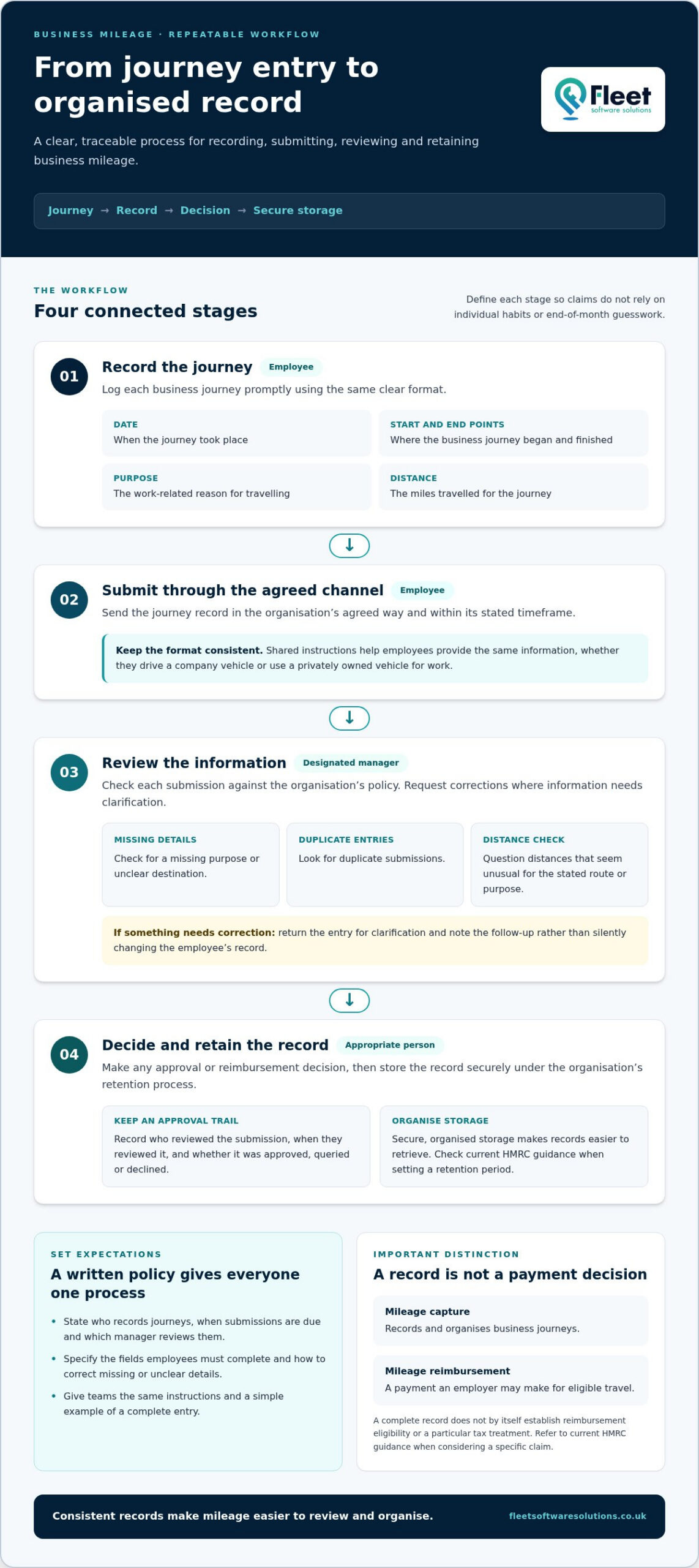
A reliable mileage capture process should make each journey traceable, from the employee’s initial entry to the manager’s decision and secure storage of the record. Define each stage so claims do not depend on individual habits or end-of-month guesswork.
A practical workflow is:
- Record: employees log each business journey promptly, including all required details.
- Submit: they send records through the agreed channel and within the organisation’s stated timeframe.
- Review: a designated manager checks the information, requests corrections where needed and records the outcome.
- Decide and retain: the appropriate person makes any approval or reimbursement decision, then stores the record securely under the organisation’s retention process.
Keep evidence collection separate from approval. A complete record describes the journey; it does not automatically establish that the journey qualifies for reimbursement or a particular tax treatment. Explain this distinction in your process, using HMRC rules for business mileage as a reference when preparing guidance for employees and reviewers.
Set up a clear mileage-capture policy
Write down who records journeys, when submissions are due and which manager reviews them. Specify the fields employees must complete and explain how to correct a missing purpose, unclear destination or distance that needs checking. Give each team the same instructions, along with a simple example of a complete entry, so employees know what information to provide.
Consistency matters. A shared policy gives employees one process to follow and reviewers a common standard, whether journeys are made in company vehicles or privately owned vehicles used for work. Organisations reviewing responsibilities across grey fleets can also consult this guide to grey fleet management.
Review, approve and retain mileage records
Make review checks specific and repeatable. Look for missing journey details, duplicate submissions and distances that seem unusual for the stated route or purpose. If information needs clarification, return the entry for correction and note the follow-up rather than silently changing the employee’s record.
Record who reviewed each submission, when they did so and whether it was approved, queried or declined. This approval trail supports consistent internal administration, while secure, organised storage makes records easier to retrieve. Retention requirements can depend on the record and its purpose, so check current HMRC guidance before setting a retention period.
For organisations organising this process alongside wider fleet oversight, mileage capture and fleet management software can support a centrally managed approach to mileage administration.
Manual logs, apps or fleet software: which mileage-capture method fits?
The right method depends on how journeys are recorded, who needs to review them and whether your organisation needs visibility across company and privately owned vehicles. A tool can make information easier to organise, but it does not replace clear records or a manager’s judgement when reviewing a claim.
| Method | Employee effort | Review and reporting | Grey fleet suitability |
|---|---|---|---|
| Manual log or spreadsheet | Employees enter each journey themselves. | Reviewers may need to check entries individually and reconcile different formats. | Can work where journeys are limited and information is recorded consistently. |
| General expense app | Digital submission can make it more convenient to send claims. | May bring claims and approvals into a shared process, depending on the app. | Useful for submitting expenses, though fleet-wide mileage oversight may be limited. |
| Fleet-management software | Provides a central digital process for mileage administration. | Can support organised review and reporting across fleet activity. | May suit organisations that need mileage records alongside wider grey fleet oversight. |
Vehicle tracking and mileage records are related, but they serve different purposes. Tracking can provide information about vehicle movement; it does not, by itself, establish why a journey took place or whether it qualifies for a mileage claim. For more on the distinction, see this guide to business vehicle tracking. When assessing reimbursements, also distinguish your internal process from the rules for Approved Mileage Allowance Payments.
When can a spreadsheet or manual log be sufficient?
A simple log may be practical when journey volumes are low, a small team follows the same procedure and a reviewer can check entries without substantial follow-up. Its limitations tend to show when people use different formats, submit details late or leave gaps that need manual correction. Organisation size alone does not determine whether records meet relevant requirements; record quality and applicable rules matter.
When does mileage-capture software become more useful?
Centralised digital records can give employees a consistent submission route and help managers review information in one place, particularly when journeys span teams or include grey fleet vehicles. Consider whether you need mileage administration alone or fleet-wide visibility as well. Manual logs are simple but require more hands-on checking; expense apps organise claims, while fleet software can bring mileage administration into broader oversight. The right fit depends on reporting needs, reviewer workload and grey fleet scope.
How to implement mileage capture without creating extra admin
Start with the processes your organisation already uses. Map how employees record journeys, submit claims and resolve queries, then identify where details are often missing or duplicated. Use what you find to decide what the process needs to achieve, such as consistent records across company and privately owned vehicles, a clear review route or more useful management information.
Keep the new workflow proportionate. A short checklist can help you plan the change:
- Review current practice: note existing forms, submission routes, review steps and recurring problems.
- Set requirements: agree which journey details are needed, who submits them and how often.
- Assign responsibilities: identify who answers employee queries, requests corrections and makes approval decisions.
- Choose the process: adapt existing tools or consider centralised fleet systems if wider oversight is needed.
- Review the results: check record quality and administrative effort after employees have had time to use the process.
If mileage records need to sit alongside broader fleet administration, a wider fleet-management software approach may be useful. Choose a system that supports the agreed process rather than adding steps employees and managers do not need.
Prepare employees and managers for a new process
Explain in plain language what employees need to record, when to submit it and what happens if an entry is incomplete. For example: “12 June, office to client site, client meeting, 18 miles.” Tell employees where to send corrections and queries, and make clear which manager reviews submissions and who makes the approval decision. Give every team the same instructions, using a brief worked example to show the expected level of detail.
Measure record quality and administrative effort
Set a review schedule that fits your submission cycle, then track incomplete entries, how often records need correction and the time managers spend reviewing them. These measures help show whether the process is clear and usable, not just whether claims are arriving.
Look for patterns. If several employees omit the journey purpose, improve the guidance or make that field more prominent on the form. If queries arise about who approves a claim, clarify responsibilities. Compare results over time, but do not assume a particular time saving: establish your own baseline and assess any changes against it.
To organise mileage capture as part of your wider process, explore mileage capture and fleet management software.
How Fleet Software Solutions supports more organised mileage capture
Choosing a process is only part of the task. Records also need to fit the way your organisation manages vehicles, business journeys and grey fleet activity. Fleet Software Solutions provides business-focused mileage capture and fleet-management software, including tools for grey fleet oversight. A centrally managed approach helps bring mileage information into a consistent process instead of leaving it spread across disconnected records and workflows.
The aim is not to add technology for its own sake. It is to support a process employees can use and managers can review, while giving the organisation a clearer view of business mileage alongside wider fleet activity. The right approach depends on who makes journeys, how information is reviewed and what level of oversight is useful.
Bring mileage records into wider fleet oversight
For employers with grey fleet journeys, mileage records are one part of understanding how employee-owned vehicles are used for work. Bringing mileage administration into a wider fleet-management process can help relevant teams work from a more consistent view, while keeping journey information separate from decisions about reimbursement or tax treatment. The value is in clearer organisation and oversight, not in assuming that a mileage record proves every aspect of a journey.
Choose a process that can develop with the organisation
Review the process against journey volumes, the people who submit or check records and the oversight your organisation needs. Consider usability, record quality and reporting together: a process that is straightforward for employees but difficult to review may simply shift the administrative burden. As teams or fleet requirements change, revisit the workflow and adjust it to keep the information useful and manageable.
Fleet Software Solutions brings mileage capture together with fleet-management software and grey fleet oversight, supporting a centrally managed approach to mileage administration. A practical discussion can focus on how your current records, review responsibilities and fleet needs fit together.
Explore Fleet Software Solutions and discuss your fleet requirements to consider a more organised approach for your business.
Build a mileage process your team can rely on
Accurate mileage records depend on a repeatable process. Employees need to know what to record and when, while reviewers need clear steps for checking entries and handling queries. Choose a method that fits your journey volumes and oversight needs, then use recurring gaps or corrections to improve the workflow.
For organisations managing company vehicles and grey fleet journeys, organised mileage capture can support clearer administration and a more consistent view of business travel. Fleet Software Solutions provides mileage capture and fleet-management software that includes grey fleet oversight.
To organise mileage records within your wider fleet process, explore Fleet Software Solutions and discuss your fleet requirements. A process suited to your organisation provides a practical foundation for clearer records and steadier oversight.
Frequently Asked Questions
What is mileage capture?
Mileage capture is the recording and organisation of journeys made for business purposes. It creates a usable record of each trip for employees to submit and managers to review as part of the organisation’s process. It applies to business journeys in company vehicles and employee-owned vehicles used for work. Capturing a journey does not itself decide whether it qualifies for reimbursement or tax relief; those decisions depend on the relevant policy and current rules.
What information should a business mileage record include?
A useful record identifies when the journey took place, where it began and ended, why it was made and the distance travelled. For example, an entry might include the date, “office to client site”, “client meeting” and the miles driven. A consistent format makes it easier for employees to submit complete information and for managers to review it. Your organisation can define a process for correcting missing or unclear details.
Is GPS tracking enough to prove business mileage?
No. GPS or vehicle tracking may show movement or a route, but it does not necessarily establish the purpose of a journey or whether it qualifies as business travel under the applicable rules. A complete mileage record should include context, such as the business reason, alongside the date, locations and distance. Keep tracking information distinct from a submitted claim, and review journey details against your organisation’s policy.
Can employees record business mileage in a spreadsheet?
Yes. A spreadsheet can be a practical way to record journeys, particularly when employees can enter consistent details and reviewers can check them reliably. Include fields for the date, start and end points, journey purpose and distance, and explain how to submit and correct entries. The format alone does not determine whether a claim is treated correctly. Apply current HMRC guidance and your organisation’s process, and keep records organised for review.
How does mileage capture support grey fleet management?
Recording employee journeys in privately owned vehicles helps an organisation understand where business mileage arises and gives reviewers information to organise and assess claims. With a consistent format, relevant fleet and administrative teams can work from a clearer view of grey fleet activity. Mileage information is one part of oversight, not a complete picture of every employer responsibility. A defined process helps connect journey records with broader fleet administration.
Do mileage records need to follow HMRC rules?
Records used to support mileage claims and their tax treatment should be managed with current HMRC guidance in mind. Applicable rules can depend on the type of journey, vehicle and circumstances, so do not assume every trip qualifies simply because it has been recorded. Distinguish ordinary commuting from business travel, retain clear journey details and check HMRC guidance when setting your policy or reviewing a particular claim.
What is the difference between mileage capture and mileage reimbursement?
Mileage capture records and organises business journeys; mileage reimbursement is a payment an employer makes for eligible business travel. The record can provide information needed to assess a claim, but it does not itself approve payment or establish the correct tax treatment. Keep these stages distinct: employees submit journey information, a reviewer checks it, and the appropriate person makes the reimbursement decision in line with policy and relevant rules.