
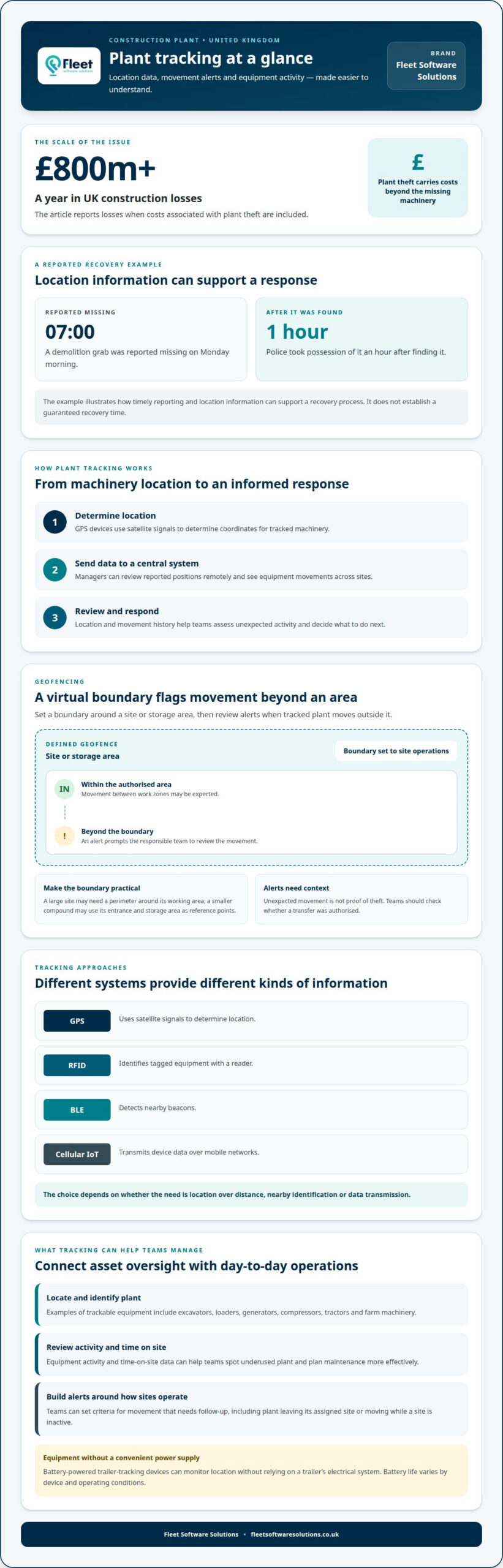
UK construction businesses lose over £800 million a year when costs associated with plant theft are included. Industrial plant tracking solutions in the UK help businesses monitor machinery by using satellite signals to determine its location and send that data to a central system. This makes it easier to review equipment movements, set alerts for machinery leaving defined areas and understand how effectively plant is being used.
Keeping track of equipment across changing sites is difficult, especially when machinery is left unattended or moved between jobs. Tracking cannot prevent every theft, but location and movement information can help teams respond sooner and make better-informed decisions about where equipment is needed.
This guide explains how plant tracking works, how geofence alerts can flag unexpected movement and how usage data can support fleet utilisation and maintenance planning. It also outlines how tracking can fit into a practical approach to managing construction plant across the UK.
Key Takeaways
- Prioritise tracking for high-value machinery so teams can make informed decisions about equipment oversight across sites.
- Use movement alerts to bring unexpected activity to your attention and support a prompt response.
- Set virtual boundaries around sites or storage areas to identify when tracked plant moves beyond them.
- Use equipment activity and time-on-site data to spot underused plant and plan maintenance more effectively.
What benefits does plant tracking offer for construction businesses?
Industrial plant tracking solutions in the UK can give construction teams a clearer view of machinery locations and movements. GPS devices use satellite signals to determine coordinates and send location data to a central system, helping managers make informed decisions about equipment across sites.
GPS Location Monitoring
For high-value machinery, location records can help teams see whether an excavator is at its assigned site or has moved elsewhere. Industrial plant tracking solutions in the UK can make this information available remotely, so managers can review reported positions without travelling to each location. When assessing a system, consider whether its location data supports the decisions your operation needs to make.
Trackable Plant and Machinery
Trackable equipment can include excavators, loaders, generators and compressors, as well as tractors and farm machinery. The right approach depends on where each asset works and whether teams need to monitor it across sites or identify it nearby. A tractor moving between fields, for example, has different monitoring needs from a generator kept at a construction site.
What are the leading industrial plant tracking solutions available in the UK? Common approaches include GPS, radio-frequency tracking and systems using RFID, BLE or cellular IoT. The right option depends on whether you need location over distance, nearby identification or data transmission.
How do GPS, RFID, BLE and cellular IoT plant tracking systems compare? GPS uses satellite signals to determine location. RFID identifies tagged equipment with a reader, while BLE detects nearby beacons. Cellular IoT transmits device data over mobile networks.
Which UK providers offer plant tracking, and what do their reviews and support cover? UK fleet and asset-tracking providers offer plant tracking. Reviews can cover installation, platform usability and support, including assistance with device setup or technical questions.
What types of industrial plant and equipment can tracking solutions monitor? They can monitor mobile machinery such as excavators, loaders and tractors, as well as equipment moved between construction sites or farm locations.
Theft alerts and unauthorised movement monitoring
Movement alerts can help teams spot unexpected activity, while location records give fleet managers information to guide their response.
Theft and Unauthorised-Use Alerts
If a tracked asset moves from a construction site outside its authorised operating period, the system can trigger an alert for review. Teams can use the platform to locate the machine and focus their attention instead of searching for it among several assets. Set clear criteria for movements that need follow-up, such as an excavator leaving its assigned site or equipment moving while a site is inactive. This helps staff distinguish expected transfers from unusual activity.
Location History and Asset Recovery
Location history can show where equipment travelled before its latest recorded position, giving teams information to share when responding to a suspected theft. In one customer review, a demolition grab was reported missing at 0700 on Monday morning; police took possession of it an hour after finding it. This example shows how timely reporting and location information can support a recovery process.
A practical response starts with identifying the missing asset, reviewing its recorded location and movement history, then sharing relevant details with the appropriate authorities. Keeping asset identifiers and site records organised helps teams act without first having to establish which machine is missing.
Alerts can also help reduce operational disruption by bringing unexpected movement to the attention of people responsible for the site. For example, a plant manager can review an alert, establish whether a transfer was authorised and coordinate the next response. To connect location monitoring with day-to-day plant asset tracking, consider how alerts and movement records can fit into your fleet management process.
Geofencing and movement alerts
A geofence is a virtual boundary around a defined location, such as a construction site or storage yard. Plant tracking systems can alert users when tracked machinery moves beyond that boundary. Set the perimeter to match the area where equipment is authorised to remain, then use movement alerts to flag departures for review.
Boundaries should reflect how each site operates. A large site may need a perimeter around its working area, while a smaller compound may use its entrance and storage area as reference points. Clear boundaries make alerts more useful: movement between work zones may be expected, while plant leaving the site could need attention.
Movement alerts can be considered alongside ignition or motion information when a tracking device supports those inputs. An ignition event may help explain why a vehicle moved, while motion detection can indicate activity without the engine starting. These signals add context, but teams still need to assess whether the movement was authorised.
Rules can flag movement outside normal site hours, including overnight activity. An alert prompts the responsible team to review the asset’s recorded location and decide how to respond. It does not prove that theft has occurred. Assign notifications to the people responsible for site equipment so the information reaches the right person.
Battery choice matters for equipment without a convenient power supply. Battery-powered trailer-tracking devices can monitor location without relying on a trailer’s electrical system. Battery life varies by device and operating conditions, so do not assume the same service interval applies to every asset.
If a tracker reports battery status, a low-battery alert can prompt maintenance before tracking is interrupted. Battery status gives teams another operational signal to review alongside movement, location and any relevant ignition activity.
Plant fleet utilisation and operational efficiency
Usage records help show whether plant is supporting its assigned work. Time-on-site data, for example, can inform maintenance planning, while movement records help managers review how equipment is distributed between projects.
Compare equipment activity with upcoming job requirements before reallocating machinery. If a valuable excavator is idle at one depot while another site needs similar equipment, location and usage information can support a better-informed transfer decision. This may reduce avoidable downtime and help teams make more effective use of existing assets.
Look for a tracking system that brings relevant information together in a clear platform. Viewing vehicle tracking and camera information alongside plant records can give managers a broader operational picture. Treat these as complementary data sources, not proof that a machine was stolen or used without authorisation.
Useful software features include searchable asset records, location history, movement alerts and reports on equipment activity. A mobile app can help staff review an asset away from a desk, while a dashboard can help managers compare plant across sites. Check that the devices and reporting suit the machinery and decisions involved.
For UK businesses, employee-linked tracking records raise data-protection considerations. Define why staff-related location data is collected, explain the monitoring clearly, restrict access and set appropriate retention controls.
Across multiple sites and depots, start with a consistent asset register and site names. Install devices on the selected equipment, assign each asset to its usual location and establish who reviews alerts and usage reports. Give staff a clear process for recording transfers so the platform reflects where plant is actually working.
To put tracking data to work across vehicles, equipment and operations, explore fleet management software for your business.
Fleet Software Solutions: Vehicle Tracking
Fleet Software Solutions provides Vehicle Tracking to help UK businesses include vehicle location information in day-to-day fleet oversight. It can support construction operations that need clearer visibility of road vehicles working alongside site plant.
For wider fleet coordination, Vehicle Cameras, Grey Fleet Management and Mileage Capture address other parts of vehicle operations. The right combination depends on what your business needs to monitor, whether that is company vehicles, grey fleet activity or business mileage. Bringing these requirements together can help managers make better-informed operational decisions.
If you’re considering how vehicle tracking could support your construction fleet, contact Fleet Software Solutions to discuss your requirements.
Make tracking part of your operating plan
The next step is to decide how tracking information will guide everyday decisions. Identify which plant movements need review, who is responsible for responding and how records should inform equipment allocation. This makes industrial plant tracking solutions in the UK a practical part of site coordination, rather than simply a monitoring tool.
Start with a clear operational priority, such as improving oversight between depots or checking plant availability before scheduling work. Agreeing how teams will use the information keeps attention on relevant activity and makes it easier to refine the process as business needs change.
Fleet Software Solutions can help businesses consider how Plant & Machinery Tracking fits their fleet management needs. If you’re ready to discuss a suitable approach for your operation, contact Fleet Software Solutions. A considered first step can help your team build clearer oversight into its working routine.
Frequently Asked Questions
How does asset tracking work?
Asset tracking connects equipment to a tracking device and a record in a central platform. A business can, for example, associate a machine’s identifier with its usual depot, then review its reported position when planning a transfer. Connecting the physical asset to its digital record helps teams manage equipment across projects without relying only on informal handover notes.
Can I see which trailers are being used and which are idle?
Trailer location records can show whether a trailer is at a work site, depot or elsewhere, helping teams decide how to allocate it. Location alone does not confirm whether a trailer is in use, so compare its recorded position with job schedules and operational records. This gives fleet teams a clearer picture of availability before arranging another trailer or moving one between projects.
How can plant tracking reduce operating costs?
Plant tracking can support cost control by helping managers make better use of equipment they already own. If records show a suitable machine is available at one depot, a team can consider reallocating it before arranging another hire. Usage information can also inform maintenance planning, while movement records help teams investigate unexpected activity. Any savings depend on how the business uses this information.
What questions should I ask about machinery tracking?
Start by identifying which machinery needs monitoring and what decisions the information should support. Consider whether equipment works across sites, stays at a depot or moves between construction and agricultural settings. Ask how asset records will be organised, how staff will access tracking information and how transfers will be recorded. These practical questions help match the approach to the equipment and daily workflow.
What type of data can I access?
Tracking information may include an asset’s reported location, movement records and usage details such as time on site. A fleet platform can present relevant information through reports or dashboards, helping managers review equipment against operational needs. The data available depends on the devices and system in use: location records show where an asset is reported to be, while usage information can support planning.
How accurate and reliable is plant tracking in indoor sites and remote UK locations?
Tracking performance depends on location signals and the ability to transmit updates. GPS may have difficulty determining a position indoors when satellite signals are obstructed, while mobile network coverage can affect data transmission in remote areas. Interpret a recorded position in context, including the asset’s environment and when the system last received an update.