
What if your fleet’s biggest compliance risk isn’t a missing document, but the gap between paperwork, vehicle data and driver behaviour? Commercial fleet safety and compliance tools can help bring these elements together, giving you clearer oversight while reducing the administrative load of manual checks.
If you’re responsible for commercial vehicles, you already know that protecting drivers and meeting requirements such as Direct Vision Standard (DVS) rules and grey fleet checks takes consistent attention. Yet fragmented records can make it difficult to see what’s been verified, identify emerging risks or present reliable safety data to insurers.
This guide explains how to assess and implement the tools that can support a more streamlined, evidence-led approach, from vehicle tracking and cameras to grey fleet management, mileage capture and fleet management software. You’ll also learn what to consider for mixed fleets that include plant and machinery, and how to connect technology with practical driver support. The aim is a clearer compliance process, better visibility of risk and a stronger basis for measuring efficiency and potential insurance benefits.
Key Takeaways
- Assess commercial fleet safety and compliance tools as an integrated system, so hardware and software provide a clearer view of risk and compliance needs.
- Consider how vehicle cameras and tracking can improve visibility of vehicle activity and support informed safety decisions.
- Identify how fleet management software and grey fleet management could help organise checks and records for employees using personal vehicles for work.
- Use a step-by-step assessment of your fleet’s needs to choose technology that can scale as your operations change.
- For mixed fleets, consider how vehicle, plant and machinery tracking can bring more operational oversight into one approach.
Understanding the Modern Landscape of Commercial Fleet Safety and Compliance Tools
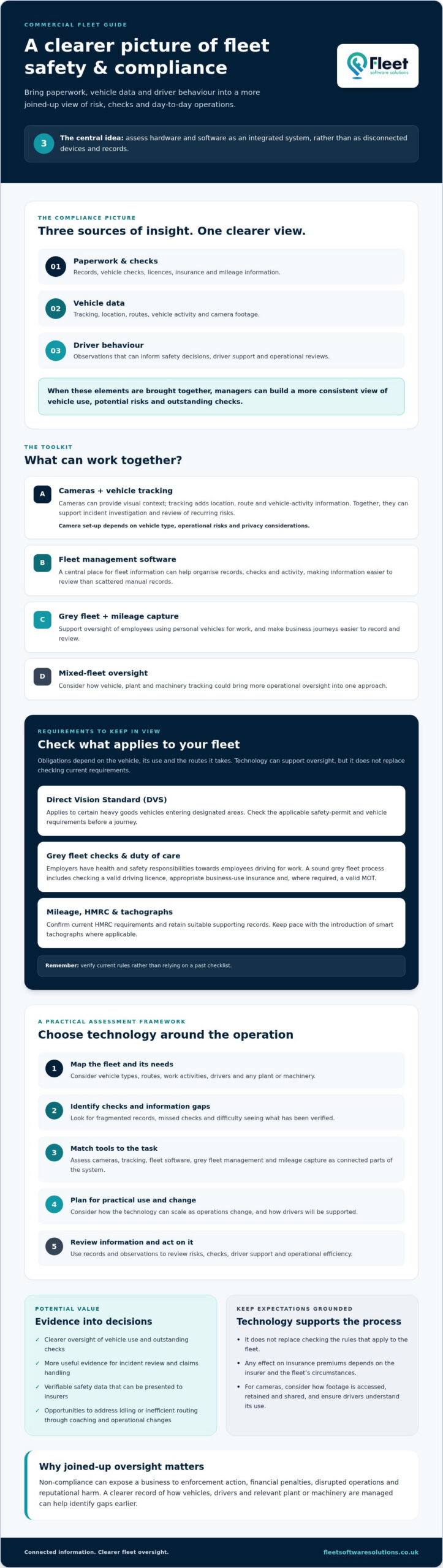
Commercial fleet safety and compliance tools are not a single device or checklist. They’re an ecosystem that combines hardware, such as vehicle cameras and tracking, with software for managing fleet information, grey fleet activity and mileage. Used together, these tools can help managers move from scattered records to a more consistent view of vehicle use, potential risks and outstanding checks. The wider fleet management picture also includes areas such as driver management and regulatory compliance, which is why technology should be assessed against the operation as a whole.
In 2026, UK operators need to keep pace with requirements and schemes that may affect different vehicles and activities, including Direct Vision Standard (DVS) rules and the introduction of smart tachographs where applicable. The exact obligations depend on the vehicle, its use and the routes it takes, so fleet managers should verify current requirements rather than rely on a past checklist. A technology platform can support oversight, but it doesn’t replace checking the rules that apply to your fleet.
The Legal Pillars: DVS, HMRC, and Duty of Care
DVS requirements apply to certain heavy goods vehicles entering designated areas, with operators needing to check the applicable safety-permit and vehicle requirements before a journey. Separately, employers have health and safety responsibilities towards employees driving for work, an area where digital health and safety systems from providers such as Be-Safe Technologies Ltd can help reinforce duty-of-care compliance. For grey fleet vehicles, a sound process includes checking that the driver has a valid licence and that the vehicle has appropriate business-use insurance and, where required, a valid MOT. Automated mileage capture can make business journeys easier to record and review, but businesses should confirm current HMRC requirements and retain appropriate supporting records.
The Business Case for Safety-First Telematics
Manual processes can leave managers chasing forms, reconciling mileage and spotting missed checks only after a problem arises. Tracking, cameras and fleet management software can centralise useful evidence and make patterns easier to review. That information may support clearer claims handling and provide insurers with verifiable safety data, although any effect on premiums depends on the insurer and the fleet’s circumstances. Reviewing driving behaviour can also help identify practices such as unnecessary idling or inefficient routing, creating opportunities to improve fuel use through coaching and operational changes.
Compliance tools are the bridge between raw fleet data and actionable business intelligence, helping managers turn records and observations into informed decisions about risk, driver support and operational efficiency.
Non-compliance can expose a business to enforcement action, financial penalties, disrupted operations and reputational harm; directors should understand their responsibilities and ensure that suitable processes are in place. A joined-up approach, including oversight of vehicles, drivers and relevant plant or machinery, can make it easier to identify gaps early and maintain a clearer record of how the fleet is managed.
Essential Hardware: Integrating Vehicle Cameras and Tracking for Maximum Visibility
Vehicle cameras and GPS tracking can give fleet managers a stronger view of what happens on the road, but their value depends on how well they work together. Cameras provide visual context; tracking adds location, route and vehicle-activity information. Connected through fleet management software, these sources can help managers investigate incidents, identify recurring risks and review operations using a clearer evidence trail. They’re most useful as part of an integrated system, not as standalone devices that produce separate records.
Camera systems are increasingly central to commercial fleet safety because footage can help clarify an incident and support constructive driver conversations. A forward-facing camera may show the road ahead, whilst side-view, rear-view or driver-facing cameras can provide additional context where appropriate. The right configuration depends on vehicle type, operational risks and privacy considerations. Check how footage is accessed, retained and shared, and make sure drivers understand how the system is used.
Multi-Channel Cameras and Driver Alerts
Some camera systems use AI-enabled features to flag potential behaviours such as distraction, tailgating or signs of fatigue. Treat alerts as prompts for review, not definitive conclusions: context matters, and a consistent process for checking footage helps avoid unfair assumptions. After an incident, timely access to relevant video can support first notification of loss (FNOL), the initial report to an insurer, by helping the business assemble an accurate account. Camera evidence doesn’t determine liability on its own.
Vehicle Tracking and Asset Security
Live GPS tracking can show where vehicles are and how they’re moving, supporting operational oversight and helping teams review routes or investigate unexpected delays. For mixed fleets, plant and machinery tracking can extend visibility beyond road vehicles, helping businesses keep track of valuable equipment as well as the vehicles transporting it. Geofencing may also alert managers when a tracked asset crosses a defined boundary, subject to the system’s capabilities and configuration.
Integration makes the difference. If an incident report, vehicle location and camera footage can be reviewed together, managers have more context than any one data source provides. Tracking records can also help organise evidence for internal reviews and compliance audits, although the technology doesn’t replace legal checks or accurate record-keeping. UK operators should verify the requirements that apply to their vehicles and activities, then consider how connected camera and tracking data can support their processes.
When evaluating commercial fleet safety and compliance tools, ask how cameras, vehicle tracking and plant and machinery tracking fit into your existing processes, and how managers will act on the information. Fleet Software Solutions offers vehicle cameras, vehicle tracking and plant and machinery tracking; businesses assessing an integrated approach can explore its fleet technology solutions.
Evaluating Software Solutions for Regulatory Adherence and Grey Fleet Oversight
Fleet management software can bring vehicle, mileage and compliance information into a more organised view, helping teams see which tasks are complete and where follow-up may be needed. During evaluation, ask how the platform handles reminders, evidence and user permissions, and whether managers can identify overdue actions without searching across separate files. Software supports a compliance process, but it doesn’t replace clear responsibilities or checking which requirements apply to your operation.
Automated Mileage Capture and HMRC Compliance
Manual mileage logs depend on drivers recording journeys consistently and administrators reviewing submissions, so missing details can complicate expense checks or a response to an HMRC query. Digital mileage capture can simplify recording and make journey information easier to review. Check how a system identifies business journeys, lets drivers correct or confirm records, and separates private travel in a way that respects privacy. Confirm current HMRC requirements for your circumstances before relying on any particular process.
Accurate records can also help finance teams assess expense claims against company policy. Set out who checks submissions and how exceptions are handled, so automation reduces routine administration without removing appropriate oversight.
Managing Grey Fleet and Lone Worker Risks
A grey fleet comprises employees’ privately owned vehicles used for work journeys. Because the employer doesn’t manage these vehicles directly, it needs a defined process for reviewing relevant driver and vehicle information. Depending on the journey and your policy, checks may include a valid driving licence, suitable business-use insurance and MOT status where required. When assessing software, ask whether it can record evidence, flag review dates and show outstanding actions. Treat service history as an internal check only where it is relevant to your policy.
For mileage and privacy, check what journey data is collected, who can view it and how private use is handled. Explain these arrangements to employees, and make sure records are retained and reviewed consistently.
Lone worker protection addresses risks for employees working alone or away from colleagues, adding a people-safety consideration alongside vehicle records. Fleet Software Solutions offers grey fleet management and lone worker protection. When comparing commercial fleet safety and compliance tools, consider how the information and alerts fit your existing review process, and define who is responsible for acting on them.
A Pragmatic Framework for Selecting Your Fleet Management Technology Stack
The best technology stack is the one that addresses your actual risks and fits the way your teams work. Before comparing providers, map your vehicles, grey fleet activity, plant and machinery, current checks and record-keeping processes. Then use that picture to set priorities, define what success should look like and identify what the system must connect to. This makes it easier to assess commercial fleet safety and compliance tools on practical value rather than a long list of features.
Step 1: Audit Your Compliance Gaps
Review a sample of existing records and note where evidence is incomplete, hard to find or dependent on manual reminders. Missing licence checks, out-of-date vehicle documents or mileage submissions that are difficult to reconcile can point to process gaps. Rank them by operational risk: an HGV subject to DVS requirements may need a different priority from a car used for business mileage. Ask drivers which processes cause friction and explain how monitoring will be used; their feedback can improve adoption and help frame technology as a safety support, not simply surveillance.
Turn the audit into a short requirements list: what must be recorded, who reviews it, what needs an alert and what evidence should be available for an internal review. This creates a clear basis for comparing potential systems.
Step 2: Check Integration and Reporting
A central platform may reduce the effort of switching between disconnected applications, but “all-in-one” should still mean suitable for your workflows. Ask providers to demonstrate how vehicle, camera, mileage, grey fleet and, where relevant, plant tracking information can be viewed together. If HR or payroll links matter, confirm whether APIs or other integrations are available, what data can be exchanged and whether implementation requires additional work.
Reporting should serve different users, not just produce a large volume of data. Check whether managers can see actionable summaries whilst authorised staff can access the detail needed to follow up a missing check or investigate an event. Request examples based on your own use cases.
Step 3: Test for Growth, Support and Security
Choose a solution that can accommodate changes in vehicle numbers, asset types and operational requirements without forcing a complete redesign. Before committing, use this checklist:
- Scalability: Can it support additional vehicles, grey fleet users or plant as needs change?
- Support: What onboarding, training and ongoing technical assistance are included, and through which channels?
- Data security: Ask how access is controlled, information is protected and retention or deletion is managed.
- Reporting: Can the system provide relevant views for operational teams and senior decision-makers?
- Practical fit: Can drivers and administrators complete the intended tasks without unnecessary steps?
A consultative provider should help clarify requirements and trade-offs rather than focus only on supplying hardware. To discuss a technology approach suited to your fleet’s needs, explore fleet management solutions.
Future-Proofing Your Operations with Fleet Software Solutions
Fleet technology is most valuable when it supports decisions over time, not simply when equipment is installed. As a UK-based provider of telematics, camera systems and compliance software, Fleet Software Solutions can help businesses consider how their operational needs fit together, from driver oversight to vehicles and equipment. The aim is a more coherent view of fleet activity, giving managers a stronger basis for reviewing risk and planning improvements as their operation changes.
That longer-term perspective matters in 2026, when requirements and working practices can evolve. Rather than treating each new concern as a separate purchase, consider how commercial fleet safety and compliance tools could support a joined-up approach to tracking, cameras, grey fleet management, mileage capture and DVS compliance. For mixed fleets, including plant and machinery, aligning the information gathered across different asset types can help reduce blind spots and support day-to-day oversight.
The Fleet Software Solutions Difference
Fleet Software Solutions offers vehicle tracking, vehicle cameras, DVS compliance solutions, grey fleet management and lone worker protection. Its integrated grey fleet and lone worker modules address areas that can be less visible than company-owned vehicles, helping businesses consider employee journeys and mobile workers as part of their overall risk picture. The right configuration will depend on your fleet and processes, so discuss which tools are relevant rather than assuming every organisation needs the same setup.
For a deeper look at tracking considerations, read the Ultimate Guide to Business Vehicle Tracking. It can help you frame questions about the visibility your operation needs and how tracking information may inform decisions.
From Data to Actionable Intelligence
Before adopting a system, clarify how information will be reviewed and acted upon. Ask what support is available during implementation and afterwards, how software updates are handled, and who is responsible for checking that hardware firmware remains current. These are important questions for any supplier; available support and update processes should be confirmed directly rather than assumed.
Professional, UK-based support can also help make technical options easier to assess in the context of UK operations. A consultative discussion should start with your fleet size, asset mix, existing processes and priority risks, then identify a suitable set of tools without adding complexity for its own sake. Treat fleet management as a strategic business asset: consistent oversight can support safer working practices, more organised records and better-informed operational decisions.
To discuss which tracking, camera or compliance options may fit your operation, Enquire about our compliance and safety solutions today.
Build a safer, more resilient fleet
Choosing commercial fleet safety and compliance tools is about more than adding technology. The strongest approach brings relevant tracking, camera and compliance information together, helping your team identify gaps, organise records and make better-informed decisions. Start with your highest-priority risks, then choose tools that fit your vehicles, drivers and wider operations.
Fleet Software Solutions offers specialist DVS compliance hardware alongside grey fleet and lone worker modules, supported by UK-based professional support. With a considered, consultative approach, you can assess what your fleet needs now and how those requirements may change, including where plant and machinery tracking is relevant. This helps make oversight a lasting part of responsible fleet management, rather than a one-off technology project.
Take the next step at your own pace. Explore our integrated fleet safety and compliance solutions to consider options for your operation. With clear priorities and the right support, you can build a more organised foundation for safer, more confident fleet management.
Frequently Asked Questions
What are the essential commercial fleet safety tools for UK businesses in 2026?
The right tools depend on your vehicles, routes and working practices. Common options include vehicle tracking for operational visibility, vehicle cameras for incident context, fleet management software for organising records, and mileage capture for business journeys. HGV operators may also need to consider DVS compliance solutions, whilst businesses using personal cars for work should assess grey fleet management. Add plant tracking or lone worker protection where those risks apply.
How does fleet compliance software help with DVS requirements?
Fleet compliance software can help organise relevant vehicle information, records and follow-up tasks, making it easier to see what needs attention. For DVS, confirm which requirements apply to each HGV and journey, then check that your chosen solution supports the evidence and processes you need. Software can assist with oversight, but it doesn’t itself grant a permit or guarantee compliance. Verify current requirements with the relevant authority.
Can vehicle tracking software reduce our fleet insurance premiums?
It may support conversations with an insurer by providing information about vehicle use and, depending on the system, driving behaviour. However, tracking doesn’t guarantee lower premiums: insurers assess risk using their own criteria, and any effect depends on your circumstances and policy. Ask your insurer what evidence it recognises, how it should be presented and whether it affects renewal decisions before treating a potential saving as part of your return-on-investment case.
What is the best way to manage grey fleet compliance for personal vehicles?
Set a clear process for checking employees and vehicles before work journeys, then keep evidence organised and review it at defined intervals. Depending on the vehicle and your policy, checks may include the driver’s licence, business-use insurance and MOT status where required. Grey fleet management software can help record information and flag follow-up tasks. Explain the process to employees, and confirm which checks apply to your circumstances.
Are AI dash cams worth the investment for small to medium fleets?
They can be worthwhile if the risks they address justify the cost and your team has a clear process for reviewing alerts and footage. Consider which camera views are useful, how potential AI alerts will be checked, and how drivers’ privacy will be handled. Compare those needs with simpler vehicle cameras and your existing incident procedures. The value depends on fleet use, implementation and whether the information leads to practical safety improvements.
How does automated mileage capture ensure HMRC compliance?
Automated mileage capture can make business journeys easier to record and review, reducing reliance on handwritten logs and helping finance teams check expense claims. It doesn’t automatically ensure HMRC compliance: businesses still need to follow the record-keeping rules that apply to them and retain suitable supporting information. Check how the system distinguishes business and private journeys, what drivers must confirm, and whether its records meet your organisation’s requirements.
What is lone worker protection and why is it part of fleet safety?
Lone worker protection refers to tools and processes that support employees who work alone or away from colleagues. It belongs in fleet safety planning because mobile workers may face risks that vehicle tracking or cameras alone don’t address. Consider how staff can raise an alert, who receives it and what response procedure follows. Fleet Software Solutions offers lone worker protection, which can be considered alongside its fleet management software.
How often should we conduct digital driver licence checks?
Set a documented, risk-based schedule and check applicable legal, insurer and organisational requirements, as there isn’t one interval that suits every fleet. A policy might include checks before an employee begins work-related driving, repeat reviews at planned intervals and follow-up if circumstances change. Define who reviews results and how issues are escalated. Digital processes can help track completion, but the employer remains responsible for applying its checks consistently.