

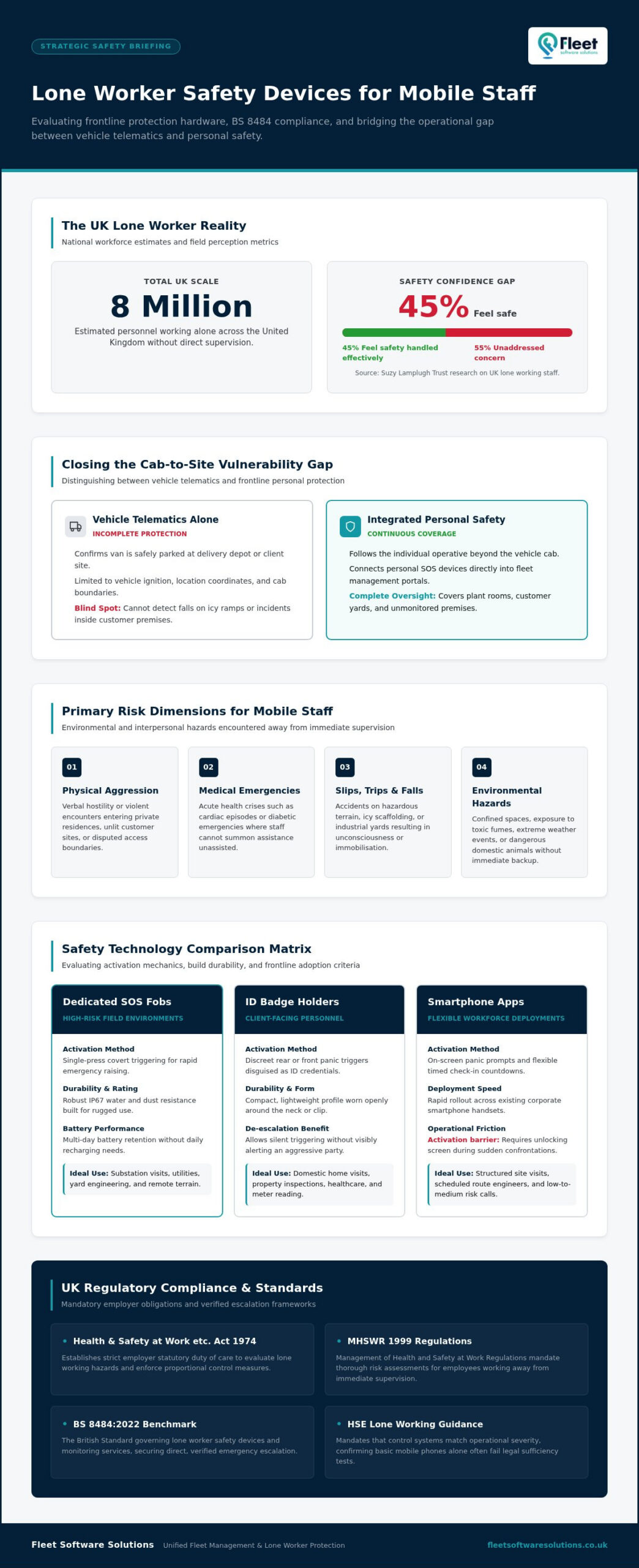
Whilst an estimated eight million people work alone across the UK, research cited by the Suzy Lamplugh Trust reveals that only 45% of lone workers feel their personal safety is handled effectively. When drivers and field engineers step out of their cabs to visit unmonitored sites, relying on disjointed safety protocols leaves unacceptable operational blind spots. Selecting reliable lone worker safety devices for mobile staff requires closing this critical gap without triggering employee privacy backlash or complicating everyday routines.
You likely already recognise the strain of balancing your statutory duty of care against employee tracking concerns, particularly when vehicle telematics and personal safety systems operate in isolated silos. In this guide, you will discover how to evaluate, select, and integrate compliant lone worker safety devices to safeguard your mobile workforce effectively. We explore the essential BS 8484 standards, evaluate frontline hardware criteria, and outline practical methods to unite remote personal protection directly with your wider fleet management workflows.
Key Takeaways
- Understand the distinct environmental and interpersonal hazards facing field personnel when operating away from immediate supervision or outside their vehicles.
- Compare dedicated wearable fobs, ID badge holders, and mobile applications to select lone worker safety devices for mobile staff that balance discreet activation with high frontline adoption.
- Ensure complete statutory compliance with Health and Safety Executive mandates and BS 8484:2022 benchmarks to secure verified emergency escalation.
- Eliminate operational silos by connecting personal safety monitoring directly into fleet management software for unified workforce visibility.
- Implement robust procurement policies that respect employee privacy expectations whilst establishing transparent procedures for rapid emergency response.
Understanding Lone Worker Risks for Modern Mobile Staff
Mobile lone workers operate away from immediate managerial oversight, conducting daily assignments without colleagues nearby to offer assistance during emergencies. While static employees face predictable physical environments, mobile personnel encounter shifting hazard profiles across multiple commercial, domestic, and transit locations every day. Under the Health and Safety at Work etc. Act 1974 and the Management of Health and Safety at Work Regulations 1999, UK employers bear a strict statutory duty to evaluate these hazards and implement proportional control measures. Relying on basic mobile phones often fails this legal test, making dedicated lone worker definitions and operational risks central to defining effective safety protocols. Introducing specialised lone worker safety devices for mobile staff provides the real-time operational oversight required to protect vulnerable personnel.
Mobile field personnel routinely face several primary risk dimensions that demand proactive intervention:
- Physical aggression: Heightened verbal hostility or violent encounters when entering private residences, unlit customer sites, or disputed access boundaries.
- Sudden medical emergencies: Acute health events, such as cardiac episodes or diabetic crises, where unassisted personnel cannot summon help independently.
- Slips, trips, and falls: Environmental accidents in hazardous terrain or industrial yards that result in unconsciousness or immobilisation.
- Environmental hazards: Working in confined spaces, encountering toxic fumes, or enduring severe weather events without immediate backup.
Dynamic Risk Environments Encountered by Field Personnel
Unlike factory or office workers protected by structured premises, field engineers and service technicians manage unstable work environments. A morning appointment might involve an isolated utility substation, while an afternoon call requires entering an unfamiliar private residence with hostile domestic animals. Unstable scaffolding, rural connectivity blackspots, and chemical storage areas compound these variables. Effective risk control demands continuous, responsive monitoring that adapts as an operative moves through disparate customer-facing and industrial environments.
The Crucial Difference Between Transit and On-Site Vulnerability
Fleet operators frequently confuse vehicle tracking with personal protection, overlooking the operational blind spot that begins the second an operative steps outside the vehicle cab. A telematics portal shows that a van has parked safely at a delivery depot or customer address, yet it cannot confirm whether the driver slipped on an icy ramp, met an aggressive trespasser, or became trapped inside an unmonitored plant room.
Equipping field personnel with lone worker safety devices for mobile staff closes this gap. By linking vehicle arrival events directly to portable personal protection, management teams eliminate unmonitored handover intervals and ensure safety cover follows the individual, not just the vehicle.
Comparing Lone Worker Safety Devices: Hardware vs Mobile Software
Procurement teams often debate whether to issue dedicated hardware or rely on smartphone applications across their mobile workforce. Both approaches offer distinct strengths, but your final decision must reflect the tangible risks identified during field audits rather than convenience alone. Official HSE lone working guidance mandates that control measures must match the severity of the operational environment. Selecting effective lone worker safety devices for mobile staff means evaluating device durability, activation mechanics, and day-to-day user friction.
To establish clarity before procuring safety technology, review this objective capability comparison:
- Dedicated SOS Fobs: Offer single-press covert triggering, robust IP67 water and dust resistance, and multi-day battery retention, making them ideal for high-risk industrial visits.
- ID Badge Holders: Provide discreet front-facing panic triggers disguised as standard credentials, suited to customer-facing home visits where overt technology might escalate tension.
- Smartphone Applications: Deliver rapid deployment across existing corporate handsets and flexible timed check-ins, but face real-world activation barriers during sudden confrontations.
Dedicated Wearable Hardware: Discreet SOS Fobs and ID Badges
Physical hardware excels when an employee needs to trigger an emergency call silently. Dedicated SOS fobs feature tactile buttons that an operative can press inside a coat pocket without alerting an aggressive individual. Built to withstand heavy rain, concrete drops, and harsh industrial environments, these devices utilise dedicated belt clips, lanyards, or wrist mounts to stay accessible even when heavy work gloves prevent phone interaction.
Smartphone Safety Applications: Strengths and Operational Limitations
Smartphone apps provide a practical entry point for lower-risk traveling personnel, enabling timed welfare intervals without requiring extra carrying gear. However, high-stress situations expose notable operational constraints. Biometric fingerprint scanners frequently fail in wet conditions, unlocking a touchscreen requires fine motor skills, and simultaneous GPS logging alongside navigation software rapidly drains handset batteries during lengthy field shifts.
Essential Hardware Capabilities: Fall Detection and Satellite Connectivity
When selecting lone worker safety devices for mobile staff, internal sensor architecture proves just as vital as physical construction. Advanced units utilise calibrated 3D accelerometers that monitor sudden drops followed by a lack of movement, distinguishing genuine falls from units casually placed on a desk. Additionally, integrated roaming multi-network SIMs connect to the strongest available UK mobile mast to maintain vital coverage across regional boundaries.
Organisations aiming to standardise safety across mixed operational teams can explore integrated lone worker protection systems that unite mobile devices alongside wider telematics platforms for seamless administration.
UK Regulatory Compliance and Emergency Response Standards
Operating a mobile workforce across the UK carries stringent legal responsibilities. Under the Health and Safety at Work etc. Act 1974, employers must safeguard their personnel by actively mitigating foreseeable workplace hazards. When staff operate independently off-site, proving compliance requires clear, auditable safety trails. Non-compliance exposes organisations to substantial corporate liability under the Corporate Manslaughter and Corporate Homicide Act 2007. Procurement teams must look beyond consumer-grade panic apps and ensure their chosen lone worker safety devices for mobile staff adhere to British standards, providing legally defensible audit logs alongside dependable response mechanisms.
The Role of BS 8484 in UK Lone Worker Protection
The definitive benchmark governing these systems is BS 8484:2022, the active code of practice that sets rigorous operational and technical rules for devices and monitoring centres. As detailed in the BSIA lone worker device and service standards, the specification mandates clear functional thresholds, such as requiring an emergency alert to connect to an Alarm Receiving Centre (ARC) within 30 seconds. Compliance also requires the ARC to conform to BS EN 50518 for structural resilience and BS 9518 for signal management, ensuring high-calibre audio handling and continuous operational integrity.
Emergency Escalation Workflows: From Alarm Trigger to Blue-Light Dispatch
Deploying compliant hardware establishes a verified chain of response when an operative faces an acute emergency:
- Instant Alert Initiation: Pressing the device SOS trigger initiates an automated voice and data link to the certified ARC within seconds.
- Silent Audio Verification: Specialist operators open a two-way silent audio channel, listening covertly to capture situational evidence and distinguish accidental presses from genuine hostility.
- Direct Police Escalation: When an emergency is verified, the ARC bypasses public 999 queuing by contacting regional police control rooms directly using a Unique Reference Number (URN) under National Police Chiefs’ Council (NPCC) policy. This secures an immediate Level 1 blue-light response.
- Internal Stakeholder Alerts: Parallel data notifications automatically alert designated fleet supervisors, updating management on the incident location and operational status.
Using uncertified lone worker safety devices for mobile staff strips away this critical police fast-track route. Without an accredited BS 8484 audit trail, incidents must route through standard public emergency channels, creating dangerous triage delays when seconds matter most.
Unifying Lone Worker Protection with Fleet Management Systems
Operating separate portals for vehicle telematics and personal safety creates severe administrative friction and dangerous visibility gaps. When an incident occurs, supervisors shouldn’t have to cross-reference timestamped vehicle data on one screen against standalone alarm notifications on another. Unifying lone worker safety devices for mobile staff within your core fleet operations eliminates duplicate data entry, streamlines user profiles, and delivers an uncompromised view of frontline activity.
Bridging Vehicle Telematics and Personal Safety Data
Connecting personal safety hardware with wider business vehicle tracking networks synchronises operational data streams in real time. For example, automated geofencing detects when a driver cuts the ignition at a designated delivery depot or customer site, automatically prompting a lone worker check-in timer or arming a wearable device. Dispatchers monitor a single live map displaying both van positions and disembarked personnel, which drastically reduces administrative fatigue and simplifies incident coordination.
Managing Grey Fleet and Subcontractor Lone Worker Vulnerabilities
Managing statutory duty of care becomes considerably more complex when staff or external contractors drive personal vehicles for business assignments. Disconnected mobile apps often struggle to balance worker privacy with essential oversight. An integrated approach resolves this friction by isolating tracking functions according to shift boundaries:
- Privacy-first monitoring: Activating GPS location recording only during logged working intervals or triggered emergency alerts, keeping personal driving completely private.
- Consolidated mileage capture: Marrying HMRC-compliant mileage logging with automated safety check-ins to simplify monthly operational reporting.
- Standardised safety protocols: Deploying lone worker safety devices for mobile staff across both company fleet operators and third-party contractors to maintain uniform corporate compliance.
Connecting vehicle intelligence directly with field safety transforms disjointed monitoring into an efficient compliance engine. To eliminate fragmented portals across your operations, explore unified fleet management software designed to consolidate personal safety and vehicle tracking within a single platform.
Procurement and Implementation Guide: Deploying Safety Devices Successfully
Successfully deploying safety technology requires bridging technical specifications with real-world user adoption. Rolling out lone worker safety devices for mobile staff without frontline consultation often provokes user scepticism or complete abandonment. Establishing a collaborative evaluation committee that brings together operations directors, health and safety leads, union representatives, and field personnel creates immediate operational trust while ensuring chosen devices align with daily working conditions.
Addressing Employee Privacy and Overcoming Adoption Resistance
Workforce pushback rarely stems from an unwillingness to be protected; it arises from fears of unmonitored digital surveillance. Organisations must draft transparent lone working policies that clearly define the parameters of location tracking. Reassure staff by clarifying that monitoring functions exclusively as a reactive safety mechanism during active shift hours. Explicitly outlining that location records remain inaccessible until an SOS trigger or expired timer occurs protects worker dignity. Involving field staff directly in hardware trials also allows them to evaluate carrying attachments, weight, and discreet operation before formal rollout.
Structuring an Actionable Implementation and Training Programme
A systematic implementation strategy prevents administrative bottlenecks and builds confidence across mobile teams:
- Phased pilot testing: Introduce devices to a small, representative sample of drivers and field engineers to validate battery life, cellular coverage, and alert routing before complete deployment.
- Hands-on simulation drills: Conduct realistic training exercises so employees develop instinctive muscle memory for covert alarm triggering and routine timer cancellations.
- Reassuring false alarm workflows: Establish a clear no-fault policy for accidental activations to eliminate operator anxiety, encouraging users to confirm accidental triggers promptly without fear of reprimand.
- Monthly telematics reviews: Examine safety dashboard analytics regularly to verify device charging compliance, software updates, and check-in consistency.
Taking a structured approach transforms mandatory compliance into an active safety culture that mobile teams embrace. To build an efficient rollout tailored to your operational demands, consult with Fleet Software Solutions to integrate compliant lone worker safety devices for mobile staff directly into your overarching transport strategy.
Transforming Mobile Staff Protection Across Your Fleet
Protecting vulnerable field teams requires more than handing out isolated alarms. Genuine peace of mind comes from matching audited site risks to resilient hardware, maintaining strict adherence to British Standards and Health and Safety Executive compliance requirements, and connecting personal welfare alerts directly with vehicle tracking. When you unify lone worker safety devices for mobile staff into a single operational system, you eliminate dangerous visibility gaps whilst easing administrative overhead.
Fleet Software Solutions brings proven national experience supporting transport, field engineering, and mobile service fleets across the UK. By centralising lone worker protection alongside vehicle tracking within comprehensive fleet management software, we help you satisfy your statutory duty of care without unnecessary complexity. Ready to strengthen your field safety protocols? Speak with our safety specialists to safeguard your mobile workforce today and ensure every team member operates with complete confidence.
Frequently Asked Questions
What constitutes a lone worker when staff are mobile between job sites?
A mobile lone worker is any employee operating without direct or immediate supervision once they leave a depot or step outside their vehicle. This classification includes service technicians, delivery drivers, community healthcare staff, and field surveyors visiting commercial sites or private residences. Under UK safety legislation, the moment an operative cannot be seen or heard by a colleague, they require proportional protective monitoring.
Can smartphones replace dedicated lone worker safety devices for mobile staff?
Smartphone apps serve lower-risk personnel effectively, but they don’t fully replace dedicated hardware in hazardous environments. While applications provide convenient welfare check-in timers, unlocking a touchscreen during an escalating physical confrontation proves difficult. Dedicated lone worker safety devices for mobile staff feature tactile, single-press SOS buttons that operatives can trigger discreetly inside a pocket, even while wearing heavy protective work gloves.
How does an Alarm Receiving Centre respond when a lone worker triggers an SOS?
An Alarm Receiving Centre responds by opening an immediate two-way audio channel within seconds to evaluate the worker’s situation silently. Trained operators listen covertly to verify genuine distress without alerting an aggressive third party. If danger is confirmed, operators use a Unique Reference Number to request an immediate Level 1 police dispatch directly, bypassing standard 999 queues whilst alerting nominated company supervisors.
What is BS 8484 certification and why is it essential for UK organisations?
BS 8484:2022 is the British Standard governing the technical reliability, device functionality, and monitoring protocols of lone worker safety systems. Certification is essential because UK police forces require it to authorise direct Level 1 emergency escalation via an Alarm Receiving Centre. Choosing non-certified systems forces incident notifications through general 999 public channels, introducing dangerous triage delays when vulnerable mobile employees need immediate assistance.
How do lone worker safety devices function in areas with poor mobile signal?
Compliant safety devices manage cellular blackspots by utilising unsteered roaming SIM cards that connect automatically to whichever UK mobile mast offers adequate coverage. In areas with zero reception, modern units store timed check-in sessions locally. If a field worker fails to confirm their safety before a predetermined countdown expires, the central system flags an overdue alert automatically to prompt supervisor follow-up.
Will deploying lone worker devices infringe on employee privacy or GDPR compliance?
Deploying lone worker devices doesn’t infringe on employee privacy when configured with clear operational boundaries and transparent data governance. Professional systems focus strictly on personal protection, capturing precise GPS locations only during active work shifts or when an emergency alert triggers. Establishing clear corporate policies guarantees that location records remain private and are never accessed for off-shift surveillance or routine micromanagement.
Can lone worker protection software integrate with existing business vehicle tracking?
Modern lone worker protection software integrates directly alongside business vehicle tracking within a single telematics platform. Unifying personal alarms with telematics eliminates disconnected portals, so fleet managers don’t have to cross-reference multiple screens when an operative leaves the cab. Introducing connected lone worker safety devices for mobile staff simplifies driver management, links geofenced site arrivals to welfare timers, and streamlines duty of care administration.