

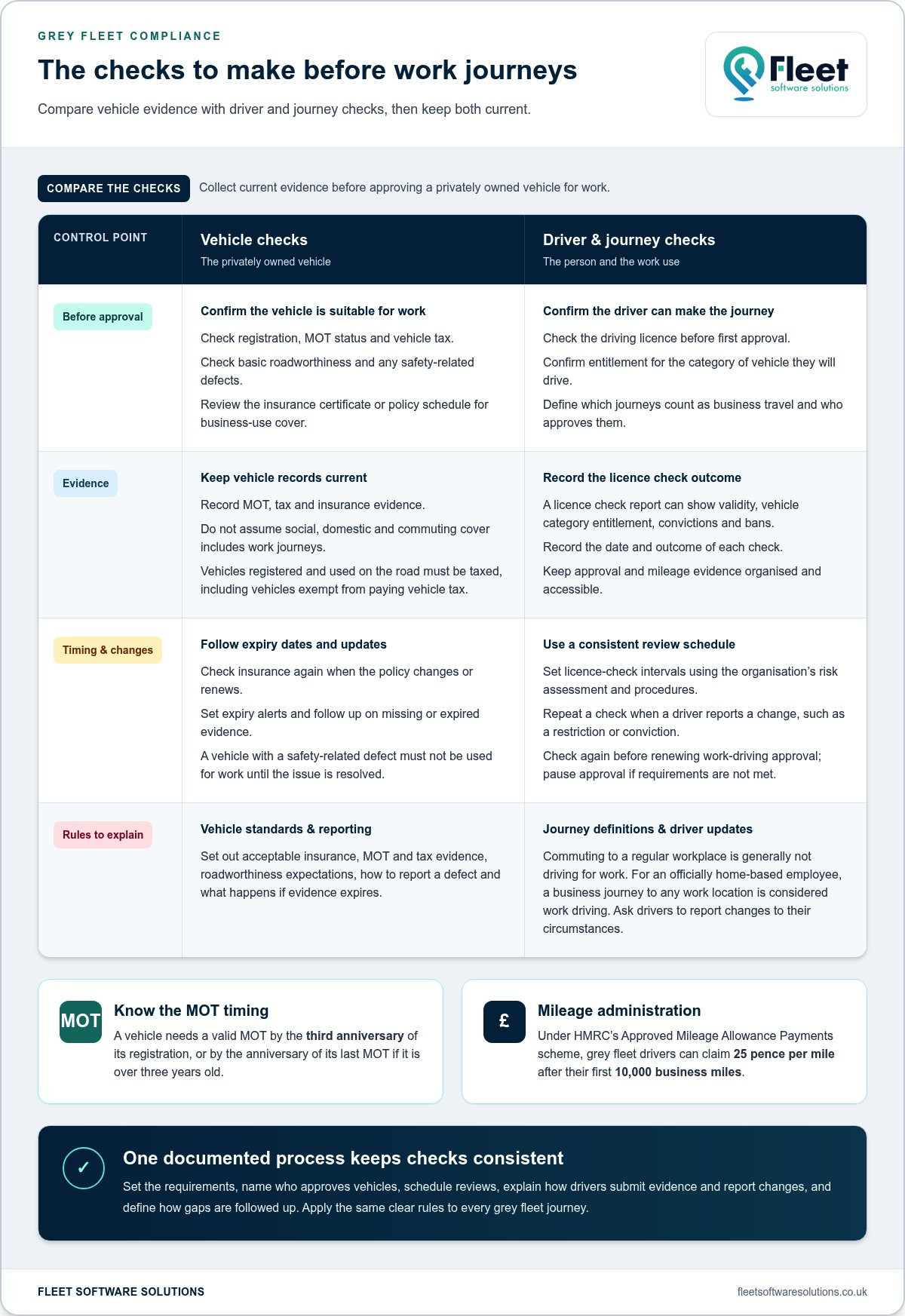
Grey fleet vehicle compliance checks should verify that an employee’s vehicle is roadworthy, taxed and insured for business use, regardless of how far or how often it is driven for work. According to the Driver and Vehicle Standards Agency, a vehicle must have a valid MOT by the third anniversary of its registration, or by the anniversary of its last MOT if it is over three years old. A standard personal motor insurance policy may not cover business journeys, so checking the policy’s business-use cover is essential.
An MOT certificate or a driver’s assurance is not enough to provide a complete, ongoing picture of compliance. A clear checking process sets out what evidence to collect, how to keep records current and when to follow up on an expiry or change. This guide explains the checks involved, how UK employers can meet their duty of care, and how alerts, record keeping and compliance software can make oversight more consistent and manageable.
Key Takeaways
- Build a consistent check process covering business-use insurance, MOT status, vehicle tax and basic roadworthiness.
- Set clear rules for who may use a privately owned vehicle for work and what drivers must report when circumstances change.
- Use alerts to flag upcoming expiries and gaps, so follow-up becomes part of routine fleet administration.
- Keep approval, mileage and compliance evidence organised, current and accessible for reviews or incident investigations.
- Choose management software that brings checks and records together, making oversight easier as your grey fleet changes.
What does the grey fleet checking process involve?
Grey fleet vehicle compliance checks bring together vehicle, insurance and driver checks before an employee uses a privately owned vehicle for work. The process should also set clear rules for business travel, approvals and ongoing updates.
MOT, road tax and insurance checks
A grey fleet vehicle is privately owned by an employee and used for business purposes. In the UK, grey fleet miles are driven in vehicles not registered as being used for business purposes. Before approving work journeys, check the registration, MOT status, road tax and insurance.
The Driver and Vehicle Standards Agency says a vehicle needs a valid MOT by the third anniversary of registration, or the anniversary of its last MOT if it is over three years old. Vehicles registered and used on the road must be taxed, including those exempt from paying vehicle tax.
The main difference from company car checks is ownership: the employee owns the grey fleet vehicle, so the employer must collect current evidence from the driver. In both cases, check that the vehicle is suitable for work and the driver is authorised.
Check the insurance certificate or policy schedule for business-use cover. Do not assume social, domestic and commuting cover includes work journeys. Employees using their own cars are responsible for ensuring their insurance covers business use beyond commuting. Ask drivers to provide updated evidence when their policy changes or renews.
Under HMRC’s Approved Mileage Allowance Payments scheme, grey fleet drivers can claim 25 pence per mile after their first 10,000 business miles, according to HM Revenue & Customs.
Licence check frequency
There is no single checking interval for every grey fleet driver, so set a regular schedule and apply it consistently. Check a licence before first approval, then repeat checks at intervals set by the organisation’s risk assessment and procedures.
A driving licence check report can show licence validity, vehicle category entitlement, driving convictions and bans. Compare the category entitlement with the vehicle the employee will drive, and record the date and outcome of each check.
Repeat a check when a driver reports a change, such as a new restriction or conviction, and before renewing work-driving approval. This keeps the process responsive to changes instead of relying only on an earlier record.
Setting up a compliance policy
Start by defining which journeys count as business travel. Commuting to a regular workplace is generally not driving for work, while a business journey by an officially home-based employee to any work location is considered work driving.
Next, specify vehicle and driver requirements, including acceptable insurance cover, MOT and tax evidence, roadworthiness expectations and licence checks. Set out who approves vehicles, how often records are reviewed and what drivers must report when their circumstances change.
Finally, explain how mileage is recorded, how missing or expired evidence is followed up, and how approval is suspended if requirements are not met. Give employees a clear process for submitting documents and reporting changes, so every grey fleet journey follows the same documented rules.
Employer duty of care under UK health and safety law
Work-related driving brings grey fleet vehicles within an employer’s health and safety responsibilities. A practical approach combines risk assessment, clear employee instructions and evidence that driving arrangements are being managed.
Work-related driving responsibilities
The Health and Safety at Work Act 1974 places a duty of care on employers towards employees at work and other people who may be affected by their business activities, according to The National Archives. The Management of Health and Safety at Work Regulations 1999 require employers to assess and manage risks, according to The National Archives.
For driving, assess risks linked to the journey, driver and vehicle, then set proportionate controls. A driver travelling between work locations faces different demands from someone commuting to a regular workplace. Commuting to a regular place of work is generally not classified as driving for work, while a business journey by an officially home-based employee to any work location is considered work-related driving.
Communicate the rules before employees use personal vehicles for business travel. Explain approval requirements, vehicle and driver standards, how to report a defect and what happens if evidence expires. Include part-time and freelance drivers using their own vehicles, as the same grey fleet risk-assessment and compliance responsibilities apply.
Employer liability for drivers
The Road Traffic Act 1988 creates offences for using, causing or permitting a motor vehicle with a defect to be on the road, according to The National Archives. Employers should therefore make clear that a vehicle with a safety-related defect must not be used for work until the issue is resolved.
In Great Britain, section 87(2) of the Road Traffic Act makes an employer liable if it encourages or permits an employee to drive without the correct licence. A documented authorisation process helps prevent this: check entitlement for the relevant vehicle category, record approval, and pause work-driving permission if the licence becomes invalid.
The Corporate Manslaughter Act of 2007 allows criminal prosecution of businesses responsible for a motorist’s death resulting from work-related travel. This makes clear procedures, risk assessments and records important parts of managing driving risks, not simply administrative tasks.
Give employees a written policy with clear responsibilities for reporting vehicle changes, licence restrictions and defects. Ask managers to apply the same approval rules across teams, and keep a record of communications and decisions. These steps help show how the organisation identified risks and acted on them.
Where manual oversight makes approvals and follow-up difficult, grey fleet management tools can help organise the process and its records.
Automated compliance alerts and record keeping
Automated workflows help organisations track grey fleet approvals, mileage and changing compliance evidence. Clear alert rules assign each issue an owner and a recorded next step, keeping follow-up visible as responsibilities change.
Automated compliance alerts
Start by listing the records that need review, such as insurance evidence, vehicle tax, MOT status and driving licence details. Set reminders around relevant expiry or review dates, then assign each alert to a responsible manager. This helps prevent an approaching deadline from disappearing in an inbox. Automated reminders keep grey fleet vehicle compliance checks moving by prompting action before a record needs attention.
Grey fleet management software can support compliance tracking, validate business-use insurance, check spouse and partner cover, review Road Fund Licence status and conduct weekly MOT checks. Define what happens after an alert, including who follows up with the driver and how the result is recorded.
Use a consistent status for each vehicle, such as awaiting evidence, approved or action required. For example, an insurance alert should prompt a request for current evidence, followed by a recorded approval or restriction. A driving licence alert should prompt the assigned reviewer to assess the information and update the driver’s authorisation record.
Set alerts to match the organisation’s process rather than relying on one general reminder. A manager can review open alerts, overdue actions and recently updated records together, then prioritise cases affecting planned business travel. Keep an audit note of decisions and employee communications, so the sequence remains clear.
Audit reports and inspection records
Record each grey fleet approval with the driver, vehicle, decision date and evidence considered. Include mileage monitoring in the same management process, so reported travel can be linked to the relevant driver and vehicle. Consistent fields make it easier to identify missing information and prepare an internal review.
For inspections, keep the report with the vehicle record and note any defect, action taken and follow-up outcome. A fleet inspection report is submitted within 24 hours of an inspection. Recording the inspection date alongside its findings helps reviewers understand when the vehicle was assessed and what required attention.
Audit reporting should show outstanding actions, recent approvals and changes to driver or vehicle records. For example, a reviewer can trace an insurance update from receipt through assessment to approval. A well-configured process makes grey fleet vehicle compliance checks easier to audit by linking decisions to their supporting records.
Review records regularly for incomplete entries, duplicated vehicle details and unresolved alerts. A routine review can identify when an employee has submitted new evidence but the approval record remains unchanged. Recording who corrected the entry preserves a useful history for later audits.
Compliance documentation and audit trails
A reliable audit trail connects each vehicle’s documents to its approval status, review date and responsible decision-maker. Organise records so an authorised reviewer can trace what was submitted, what was checked and what action followed, particularly if an accident involving an employee’s vehicle requires examination.
Maintain a separate record for each driver and vehicle, using the registration number to distinguish similar vehicles. Include the driver’s details, business-use approval, mileage, MOT evidence, vehicle tax status and insurance documents. Add the date each item was received and reviewed, who assessed it, and whether follow-up remains outstanding. This structure makes evidence easier to retrieve than scattered email attachments.
Digital uploads give employees a consistent way to submit documents. Ask drivers to upload complete, readable files, then compare the registration and policy details against the vehicle record. Check the document’s dates and status, and record whether it meets the organisation’s requirements. If an image is cropped or unclear, mark it as awaiting replacement rather than treating it as verified.
For GDPR-aligned document management, store driver information securely, limit access to people with a business need, and keep records accessible and up to date. Set a retention process that reflects the organisation’s purposes for holding each document, then remove or review records when they are no longer needed. Keep an audit log of access, updates and corrections so changes can be traced to an authorised user.
MOT evidence should identify the vehicle and show its current status. The Driver and Vehicle Standards Agency says a vehicle must have a valid MOT by the third anniversary of registration, or by the anniversary of its last MOT if it is over three years old. Record the check date and next relevant review point. Keep service records separately: they can help show maintenance history, but do not replace MOT evidence or a roadworthiness assessment.
Use the same validation sequence for every upload: match the registration, check the document type, review its dates, record the outcome and assign any follow-up. For example, if an insurance document names a different vehicle, flag the discrepancy and withhold approval until it is resolved. Record that decision in the audit trail alongside the evidence and employee communication.
Prepare audit reports from the records used for day-to-day approvals. A reviewer should be able to identify missing documents, expired evidence, mileage entries and unresolved actions without reconstructing events from separate files. This makes the record useful for routine workplace safety reviews and for examining how a corporate decision was reached after an accident.
Grey fleet compliance management software
Software can bring vehicle, driver and journey information into a shared fleet management process. Its value lies in making records easier to review and outstanding actions easier to identify.
How much do grey fleet compliance checks and management systems cost in the UK? Costs depend on fleet size, required functions, configuration and the level of support involved. The price depends on the case and is given after a quote request.
For organisations managing vehicles for work, start by defining what the system needs to record. A useful grey fleet management process links each driver to their vehicle, approval status, business-use insurance evidence and recorded mileage. This gives managers a clearer view than separate spreadsheets and email threads, especially when employees change vehicles or travel patterns.
Software can support several practical checks. Grey fleet management software can track compliance, validate business-use insurance, check spouse and partner cover, review Road Fund Licence status and conduct weekly MOT checks. These functions help teams organise evidence, but staff still need to review exceptions and decide what action to take.
Set up a workflow around the organisation’s policy. For example, an employee submits vehicle details and insurance evidence before using a car for business. A reviewer records the outcome, notes any missing item and assigns follow-up to a named person. If the driver changes vehicles, create or update the vehicle record before approving further work travel.
Choose reporting fields that answer operational questions: which drivers are approved, which records need attention and what mileage has been submitted? A manager preparing for a review can filter by status, department or vehicle, then follow each outstanding task through to resolution. Consistent entries make reports useful instead of simply producing more data.
Software can also connect mileage capture with compliance administration. Matching a mileage entry to an approved driver and vehicle, for instance, helps identify records needing clarification. Keep the approval decision and supporting evidence together, so a reviewer can understand why a journey was authorised without searching multiple systems.
Before implementation, map the existing process from employee submission through review, approval and renewal. Decide who owns each step, how exceptions are handled and which records managers need to see. A system should support those working practices, not obscure them behind fields nobody maintains. Pilot the workflow with a representative group, then refine instructions where drivers or reviewers encounter avoidable confusion.
For teams ready to organise approvals, mileage and evidence in one operational process, explore grey fleet management support.
Fleet Software Solutions: Vehicle Tracking
Fleet Software Solutions supports organisations seeking a clearer view of fleet activity and grey fleet administration. Its Vehicle Tracking helps businesses oversee vehicle use, while Grey Fleet Management and Mileage Capture address employee-owned vehicles and work journeys.
These solutions are a practical next step when your organisation needs to manage vehicle oversight and mileage more consistently. Vehicle Cameras are also available for businesses looking to add camera solutions to their fleet arrangements. The right mix depends on your operational needs, such as managing grey fleet records or understanding vehicle use.
Contact Fleet Software Solutions to discuss how its fleet management tools can support your processes.
Make your next fleet decision with confidence
Start by identifying where your current process needs better visibility, then decide which operational change would help most. Grey fleet vehicle compliance checks are easier to manage when your approach reflects how employees use vehicles and how your organisation records that activity.
Fleet Software Solutions offers Grey Fleet Management for organisations reviewing employee-owned vehicle processes, alongside Vehicle Tracking and Vehicle Cameras for wider fleet requirements. These are distinct tools, so begin with the operational challenge you want to address rather than adding technology without a defined purpose.
If you’re ready to discuss a practical next step for your fleet, contact Fleet Software Solutions. A conversation can help you consider which solution fits your requirements and how it could sit within your existing processes.
Clear priorities make it easier to improve oversight at a sustainable pace. Start with the need that matters most to your organisation, then build from there.
Frequently Asked Questions
Can inspections be carried out without disrupting operations?
Plan inspections around work patterns by choosing suitable times and locations. An ongoing programme can schedule checks at different frequencies and locations, helping managers coordinate vehicle access with employee duties. For example, arrange a vehicle inspection before its next planned work journey or group checks around an existing team meeting. Share the appointment process with drivers in advance so they can plan transport and avoid unexpected changes to their working day.
Do you inspect vans and specialist vehicles as well as cars?
Include a van or specialist vehicle in the programme if an employee uses it for business. The assessment should reflect the vehicle’s design and work use, rather than applying a car checklist without adjustment. Record the vehicle type and registration alongside its assigned driver, then make sure the inspection covers relevant safety items. This helps an organisation account for the different demands of carrying equipment, transporting goods or accessing work sites.
How do you check their vehicles are insured, taxed, and roadworthy?
Keep separate evidence for each requirement. Match the vehicle registration against its MOT record, tax status and insurance documents, and check that the policy covers the employee’s intended business travel. For roadworthiness, combine documentary checks with a visual assessment of condition, including tyres, lights, wipers and visible damage. Record what was reviewed, when and what action is needed, so the approval decision has a clear basis.
How is this different from a standard MOT?
An MOT assesses whether a vehicle meets minimum legal standards on the test day; it does not show its condition continuously afterwards. A workplace inspection can focus on current visible condition and work use, such as checking tyres and wipers before a journey. A vehicle may pass its MOT and still become unroadworthy later, so the certificate alone does not replace ongoing attention.
Understanding a grey fleet policy: what is it?
A grey fleet policy sets out an organisation’s rules for employees using privately owned vehicles for business. It explains who needs approval, what evidence drivers must provide, how vehicle and driver records are reviewed, and how changes or defects must be reported. For example, a policy can require employees to tell their manager before switching cars, so the replacement vehicle’s details and work-use approval are recorded.
What happens if an urgent defect is found?
If a defect makes the vehicle unsafe to drive, stop its work use and record the issue and decision. Notify the driver and the person responsible for fleet approvals, then arrange the next action under the organisation’s process. Where an inspection identifies an unsafe defect, engineers can act on the spot. Record any restriction and the subsequent resolution before approving the vehicle for work travel again.
What is a grey fleet vehicle in the UK?
A grey fleet vehicle is a privately owned vehicle used by an employee for business purposes. It could be an employee’s car used to travel between work locations, rather than a vehicle owned or leased by the employer. The term refers to the vehicle’s ownership and work use, not its colour. Identify employees who use personal vehicles for work, including occasional journeys, and include those vehicles in the organisation’s compliance process.
What legal duties do UK employers have for grey fleet vehicles?
The Health and Safety at Work Act 1974 places a duty of care on employers towards employees at work and other people affected by business activities, according to The National Archives. The Management of Health and Safety at Work Regulations 1999 require employers to assess and manage risks, according to The National Archives. In Great Britain, section 87(2) of the Road Traffic Act makes an employer liable if it encourages or permits driving without the correct licence.