
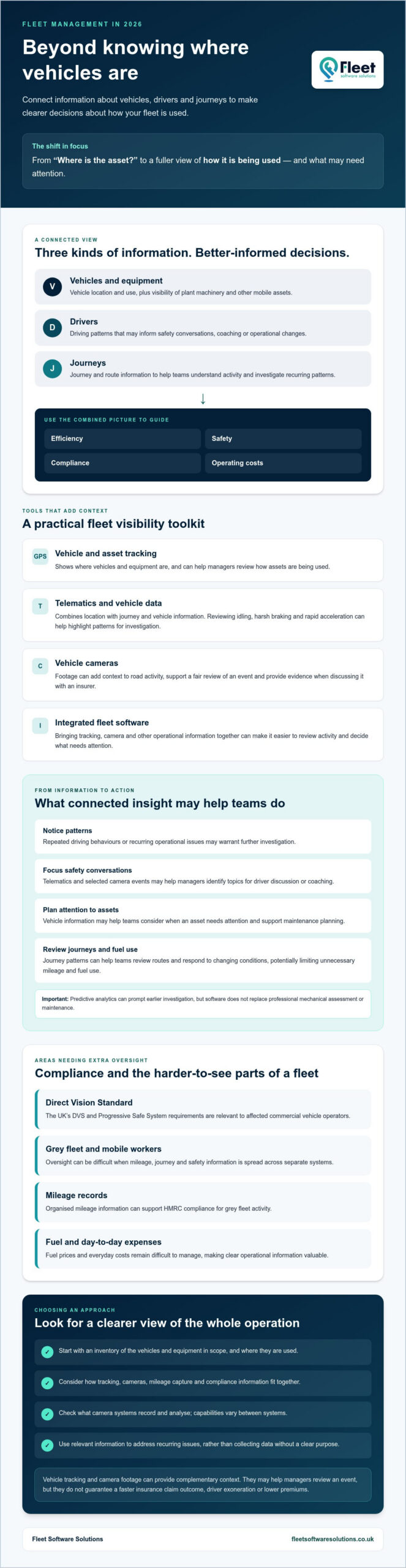
Knowing where every vehicle is isn’t enough to control a fleet. Modern fleet management brings together information about vehicles, drivers and journeys to help organisations make informed decisions about safety, compliance and operating costs.
Fuel prices and day-to-day expenses remain difficult to manage, whilst UK requirements such as the Direct Vision Standard add complexity for affected fleets. Grey fleet vehicles and mobile workers can also be hard to oversee when mileage, journey and safety information is spread across separate systems. Better visibility gives managers a clearer basis for action.
This guide explains what fleet management means in 2026 and how connected tools can support day-to-day decisions. It covers vehicle tracking, cameras, mileage capture, grey fleet management and compliance software, including practical points to consider when choosing a solution. The aim is to help you move beyond locating vehicles and understand how your fleet is being used.
Key Takeaways
- See how fleet management can connect operational data with decisions about efficiency, safety and compliance.
- Learn how telematics and predictive analytics may help identify driver safety risks and potential downtime.
- Understand the DVS and Progressive Safe System requirements relevant to affected commercial vehicle operators.
- Explore practical ways to oversee grey fleet vehicles and organise mileage records for HMRC compliance.
- Assess how integrated software can bring vehicle and plant machinery tracking into a clearer view of your operation.
Defining Modern Fleet Management in 2026
Modern fleet management is the coordination of a business’s vehicles, plant machinery, drivers and operational data. It can cover the working life of mobile assets, from tracking their use to monitoring driver behaviour, fuel use and compliance. In practical terms, it means using information about assets, people and journeys to guide decisions and maintain operational oversight.
The role of a fleet manager now extends beyond records and vehicle administration. Managers may need to interpret information from different parts of the operation and consider its implications for cost, safety, service and compliance. Reviewing patterns can help teams set priorities and address recurring issues, rather than responding only to individual incidents. For a foundational overview of the function’s scope, see Fleet management.
The Core Components of a Fleet Strategy
A useful strategy starts with an inventory of the vehicles and equipment in scope, along with a clear view of where they are used. Vehicle tracking can show the location and use of fleet vehicles, whilst asset and plant machinery tracking can help account for equipment beyond the road fleet. Reviewing this information helps managers spot gaps in oversight and consider whether assets are being used as intended.
Vehicle cameras add context by recording relevant road activity. Footage can help clarify incidents, inform driver conversations and provide evidence when discussing an event with an insurer. It doesn’t guarantee a particular insurance outcome. Fleet management software can bring information from tracking, cameras and other operational tools together, making it easier to review activity and decide what needs attention.
Moving Beyond Simple GPS Tracking
Basic GPS data answers one question: where is an asset? Telematics meaning goes further than simple location data — it can provide a broader view by combining location with journey and vehicle information. That can help managers understand how assets are being used. The aim is not to collect more data for its own sake, but to make relevant information available when a decision is needed.
For example, visibility of vehicle progress can help teams respond to customer enquiries, whilst recurring patterns may reveal an operational issue that needs investigation. Reviewing available vehicle information may also help a business decide when to arrange attention, rather than waiting for an unexpected disruption. Software supports that oversight, but it isn’t a substitute for mechanical maintenance.
The Rise of AI-Driven Telematics and Predictive Analytics
Telematics combines information about a vehicle’s location and use to give managers a more useful view of fleet activity. Artificial intelligence and predictive analytics can help interpret these records, highlight patterns and prompt earlier investigation. The aim is to support practical decisions about safety, fuel use and vehicle availability, not to gather data without a clear purpose.
For example, repeated harsh braking or rapid acceleration may point to a safety concern worth discussing with a driver. Patterns in vehicle data may also help managers identify when an asset needs attention. This information can support maintenance planning, although software doesn’t replace professional mechanical assessment. Journey information can help teams review routes and respond to changing conditions, which may help limit unnecessary mileage and fuel use.
Smart Telematics: Data that Drives Performance
In operational terms, telematics meaning for business fleets is the collection and use of vehicle data to understand how assets are being used. Monitoring idling, harsh braking and rapid acceleration can help managers identify driving patterns that may affect fuel economy and safety. An integrated dashboard can make it easier to compare like-for-like information across vehicles and drivers, then focus coaching or operational changes where they’re most relevant. The Fleet Management Best Practices Framework also outlines how vehicle data can inform a broader strategy.
Integrated Camera Systems and AI
Vehicle cameras can provide context that location data alone can’t show. Some systems use AI to flag selected events, helping managers review footage more efficiently. Capabilities vary, so check what a system records and analyses before choosing it. Video may help establish what happened, support a fair assessment of driver behaviour and provide evidence for an insurer. It can’t guarantee that a claim will be settled faster or that a driver will be exonerated.
Used together, business vehicle tracking and camera footage can connect where an event occurred with what the camera recorded, giving managers more information to review. Evidence of safer driving may help an insurer assess risk and could contribute to lower premiums, though no reduction is assured. When comparing options, review fleet camera systems against your operational requirements.
Navigating the UK’s Regulatory Landscape and DVS Requirements
Compliance is part of effective fleet management, not a separate administrative task. Requirements can depend on vehicle type, use and operating area, so identify which rules apply to each asset and keep relevant records accessible. Software can help organise vehicle details, compliance status and supporting documents. Check what your platform records and confirm current requirements with the relevant authority.
DVS and the Progressive Safe System
For 2026, the Direct Vision Standard (DVS) requirement applies to HGVs over 12 tonnes with a zero-, one- or two-star rating operating in the DVS zone. These vehicles must have a Progressive Safe System (PSS) fitted. The system includes a camera monitoring system, blind spot information system, moving off information system, side under-run protection and audible turning warnings. Don’t assume the same requirements apply to every LGV. Verify the rules for each vehicle and its intended journeys.
Operators also need to monitor permit status and ensure vehicles are properly equipped before entering the zone. A fleet platform can help organise vehicle records and flag items for review, but it doesn’t automatically provide a permit or guarantee compliance. Entering the zone without a valid safety permit can result in a penalty of up to £550, reduced to £275 if paid within 14 days. Non-compliance can also undermine customer confidence and cause avoidable operational disruption.
Tachographs, Audits and Worker Safety
Regulatory checks extend beyond DVS. From 1 July 2026, light commercial vehicles over 2.5 tonnes used for international hire and reward must be fitted with a Smart Tachograph 2. Operators affected should confirm which vehicles are in scope and understand the records and processes needed to manage driver hours. Software may help bring documentation together for an audit, but managers remain responsible for checking that records are accurate and requirements are met.
Mobile and lone workers also need practical safety arrangements. Employers have health and safety responsibilities towards staff, including people working alone, so they should assess risks and choose suitable controls. GPS-based lone worker protection can help a business see a worker’s location, supporting oversight when someone is away from a fixed workplace. It is one part of a wider safety process, not a substitute for agreed check-in procedures or an appropriate response plan. Managing relevant information alongside vehicle and compliance records can give managers a clearer view of operational risks, whilst sound procedures remain essential.
Managing Grey Fleet Risks and HMRC Compliance
A grey fleet consists of employees’ own vehicles used for work journeys. Because the business doesn’t own these vehicles, their condition, documentation and use can be harder to oversee than those of company vehicles. Businesses still need a clear process for checking that a vehicle is suitable for work and that its driver has appropriate business-use insurance. For a fuller walkthrough of employer duties and checks, see this practical UK guide to grey fleet management for employers.
The Hidden Dangers of the Grey Fleet
A consistent process helps bring different vehicles and individual circumstances under one standard. Depending on your checks, this may mean recording evidence of a valid MOT, confirming business-use insurance and checking that vehicle tax is current. Agree what employees must provide, how often records are reviewed and who follows up when information is missing or needs renewal.
Grey fleet software can help organise records and make gaps easier to spot, but it doesn’t remove the need to review evidence or confirm its accuracy. Make responsibilities clear: employees need to know what information to submit, whilst managers need a reliable way to track outstanding checks. This gives the business better oversight without assuming that every privately owned vehicle presents the same risk.
Automated Mileage Capture for HMRC
Manual mileage logs and spreadsheets can be incomplete, inconsistent or difficult to reconcile. This can create problems if the business needs to explain mileage claims during an HMRC inspection. GPS-based mileage capture can provide a more structured record of journeys and reduce reliance on handwritten notes or entries made long after a trip. Employees should still be able to check and classify journeys correctly, particularly if a vehicle is used for both business and private travel.
Accurate records also support the correct treatment of mileage reimbursements. HMRC’s Approved Mileage Allowance Payments (AMAP) rates for cars and vans in the 2026/27 tax year are 55p per business mile for the first 10,000 miles and 25p per mile thereafter. Keep journey records that show the business mileage being claimed, and check the applicable HMRC guidance when reviewing rates or circumstances.
As part of a wider fleet management approach, consistent processes for grey fleet records and mileage can give managers a clearer view of risk and reimbursement claims. Explore grey fleet management and mileage capture to see how dedicated software may support that oversight.
Strategic Implementation: Transitioning to Integrated Fleet Software
Replacing disconnected tools with an integrated platform can make information easier to access and compare, helping managers build a more consistent view of vehicles, plant machinery, drivers and compliance tasks. The right setup depends on the operation. A business with mobile teams and specialist equipment may need different functions from one managing only a small number of vehicles. Define the problems you need to solve before comparing platforms, rather than assuming one system will suit every fleet.
Consider whether the software handles both vehicles and plant machinery, and whether its dashboards make useful information easy to find. A shared view can reduce the effort of switching between systems, but long-term value depends on how well the platform fits the operation and whether staff use it. Assess return on investment against outcomes you can measure, such as time spent compiling reports, fuel use, safety indicators and the completeness of compliance records. Set a baseline first and review progress regularly. Don’t assume savings before you have evidence from your own operation.
Choosing the Right Telematics Partner
Evaluate hardware and software together. Ask how tracking devices and cameras perform in your operating conditions, how easily managers can find key information, and what training or support is available. If UK-based support or industry-specific expertise matters to your team, confirm these details with the provider. Check whether the system can be configured around your processes and reporting needs, rather than expecting your operation to fit a standard setup. For a broader view of what to look for, the practical guide to fleet software for UK fleet managers explains how different capabilities compare and where dedicated platforms may fit your operational requirements.
Driver buy-in matters too. Explain what information is collected, why it’s used and how it supports safety and fair performance discussions. Give drivers a chance to raise practical concerns, then provide clear guidance before introducing new tools. Transparent communication can help build trust and make the system more useful to the people whose work it records.
Next Steps for Your Fleet
Start with an operational audit. List the vehicles and equipment in scope, identify gaps in visibility or documentation, and note where teams rely on manual processes. Then choose a small set of relevant key performance indicators (KPIs), such as fuel use, safety events and completion of compliance checks. Define each measure clearly and review it regularly so you can distinguish genuine improvement from changes in how information is recorded.
Fleet Software Solutions provides vehicle tracking, cameras, grey fleet management, mileage capture, plant and machinery tracking, lone worker protection, DVS compliance solutions and fleet management software. These services can help businesses assess operational requirements and consider how to bring relevant oversight into one approach. Review fleet software and tracking solutions against your priorities.
Turn Fleet Insight into Your Next Step
Modern fleet management is about using connected information to make better operational decisions, not simply monitoring vehicle locations. Telematics and cameras can help teams understand vehicle use and safety, whilst clear processes for DVS compliance, grey fleet oversight and mileage records support more consistent control.
Focus first on the gaps that matter most to your organisation. Review your assets, current processes and priorities, then consider how suitable software could bring relevant information together and support measurable improvements over time. A solution should fit your operation, whether your priority is commercial vehicle compliance, employee-owned vehicles or clearer visibility of mobile assets.
Fleet Software Solutions offers DVS compliance solutions, grey fleet management, mileage capture, vehicle tracking, cameras and fleet management software. Explore Fleet Software Solutions’ fleet management services to discuss the tools that fit your operational priorities.
Frequently Asked Questions
What is the primary purpose of fleet management?
The primary purpose of fleet management is to coordinate vehicles, equipment, drivers and related information so a business can operate efficiently and maintain oversight. A well-planned approach can help managers understand how assets are used, identify safety or compliance gaps, and make informed decisions about costs and service delivery. Priorities depend on the organisation’s fleet, workforce and operational requirements.
How much can a business save by implementing fleet management software?
There’s no reliable saving figure that applies to every business. Results depend on factors such as current processes, fleet size, vehicle use and whether staff act on the information the software provides. Before implementation, record a baseline for relevant measures, such as fuel use, administrative time and safety events. Compare those measures over time, accounting for other changes, to assess whether the system is delivering value for your operation.
Is vehicle tracking legal for UK employees?
Vehicle tracking can be lawful, but employers should have a clear business purpose and handle location data transparently and proportionately. Tell employees what is collected, when tracking operates, why the information is used, who can access it and how long it is retained. Consider privacy implications, particularly where a vehicle may also be used privately, and document an appropriate policy. Seek professional guidance if you’re unsure about your data protection responsibilities.
What is a grey fleet and why should I manage it?
A grey fleet consists of employees’ own vehicles used for business journeys. Although the organisation doesn’t own these cars, it still needs a sensible process for checking that they are suitable for work and that employees have appropriate business-use insurance. Checks may include evidence of a valid MOT and vehicle tax, alongside agreed safety requirements. Managing records consistently helps reduce blind spots and supports responsible oversight of work-related travel.
How does fleet management software help with HMRC mileage claims?
Fleet management software with mileage capture can record journey details, such as dates, routes and distances, helping employees and managers maintain clearer business mileage records. Journeys should be checked and correctly classified, especially if a vehicle is also used privately. Digital records can make claims easier to review and retrieve if HMRC asks for supporting evidence, but software doesn’t guarantee compliance. Confirm applicable rates and record-keeping requirements against current HMRC guidance.
Do I need a fleet camera system for DVS compliance?
Not every business needs a camera system for DVS purposes. In 2026, the Progressive Safe System requirement applies to HGVs over 12 tonnes with a zero-, one- or two-star rating operating in the DVS zone, and it includes a camera monitoring system. A standard fleet camera system may not meet that requirement. Check each vehicle’s rating, intended routes and current specifications before selecting equipment.
Can I track plant and machinery with the same software as my vans?
What happens if a driver refuses to use a tracking system?
Start by listening to the driver’s concern and explaining the system’s purpose, what information it collects and how the business will use it. Check that your tracking policy is clear, proportionate and consistent with your data protection responsibilities, including arrangements for private use where relevant. If the issue remains unresolved, involve your HR or legal advisers before taking employment action. Don’t assume refusal alone determines the appropriate response.