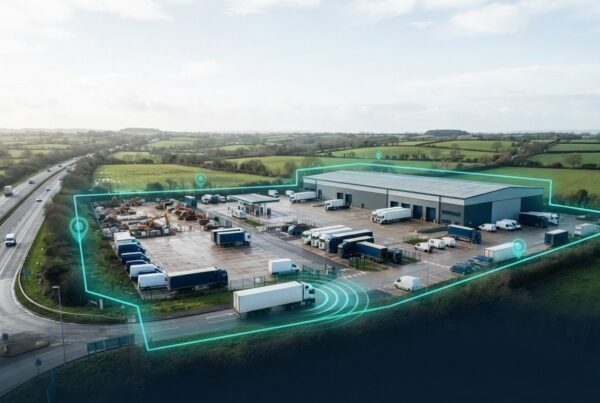

Reviewing yesterday’s vehicle logs will never prevent the fuel wastage, excessive idling, or delivery disputes occurring across your routes right now. Modern live fleet tracking systems eliminate this costly operational blind spot, transforming passive location records into immediate, actionable intelligence that keeps commercial vehicles moving efficiently. You likely already recognise the strain of rising operating costs and administrative delays, especially when transport teams must manually verify customer drop-off times against driver timesheets whilst striving to uphold stringent road safety standards.
In this guide, you’ll discover how dependable live telemetry reduces overheads, improves operational control, and protects drivers across the UK. We examine core telematics functionality, clarify data privacy compliance under UK GDPR, and outline the precise operational criteria that justify upgrading from legacy GPS to an integrated fleet management platform.
Key Takeaways
- Discover how modern live fleet tracking systems utilise high-frequency cellular telemetry and onboard diagnostics to replace static vehicle logs with dynamic operational oversight.
- Learn practical methods to curtail escalating fuel expenses and vehicle wear by pinpointing inefficient routing, harsh driving behaviour, and persistent engine idling.
- Review essential technical benchmarks for selecting reliable telematics hardware and software, focusing on data refresh rates, system stability, and seamless back-office integrations.
- Clarify your statutory obligations under UK GDPR and road safety legislation, ensuring your monitoring protocols protect driver privacy whilst satisfying corporate duty-of-care standards.
- Explore the strategic advantages of consolidating real-time location data, multi-channel vehicle cameras, and fleet management software within a single operational interface.
What Are Live Fleet Tracking Systems and How Do They Operate?
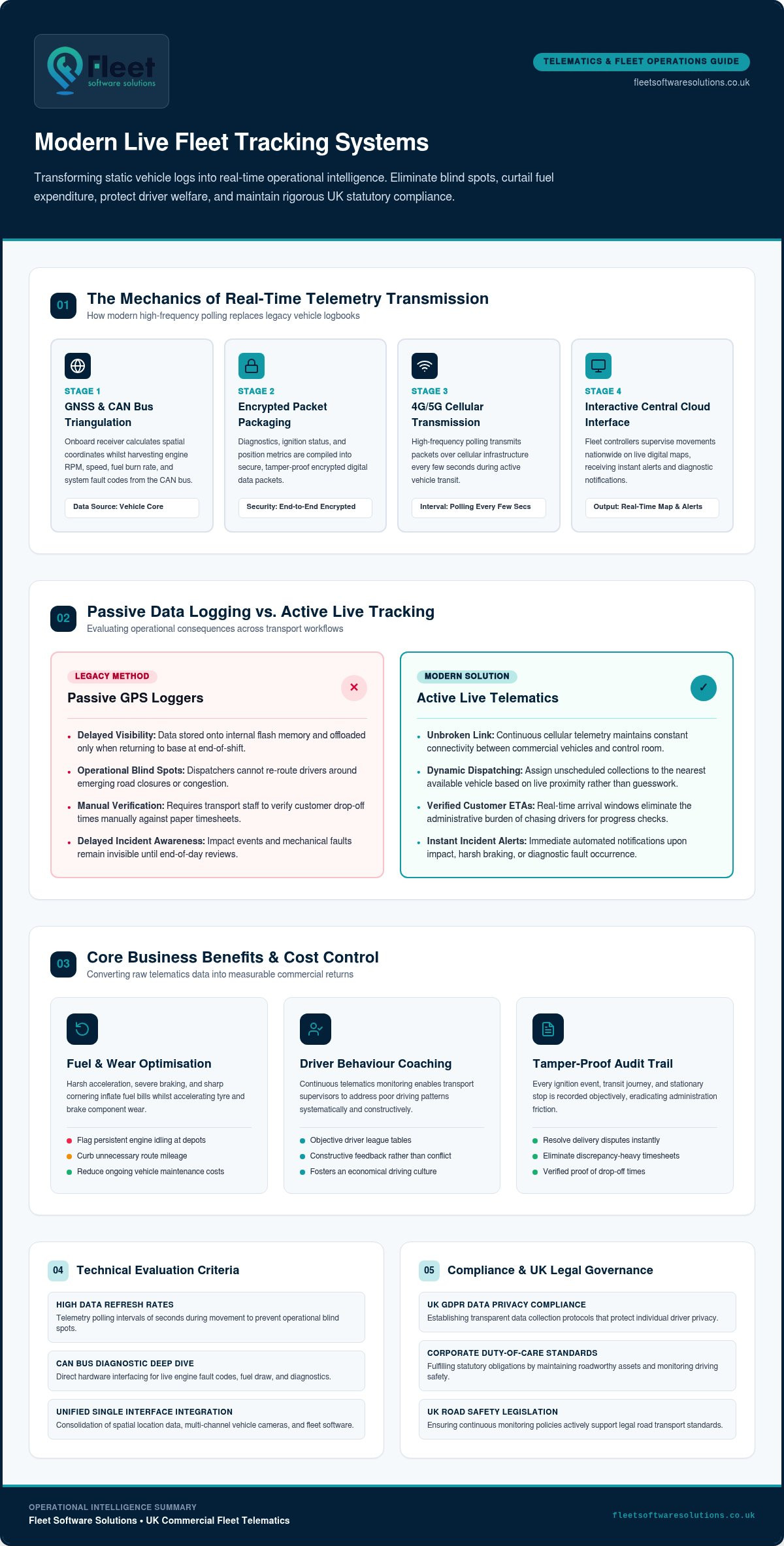
At their core, modern live fleet tracking systems combine Global Navigation Satellite System (GNSS) positioning with resilient cellular networks to provide continuous operational visibility. Rather than functioning simply as a basic vehicle tracking system that records historic transit routes, modern telematics architecture links physical vehicle sensors directly to responsive cloud platforms. Onboard hardware units capture diagnostic data, ignition status, vehicle speed, and spatial coordinates, instantly relaying this telemetry so fleet managers can supervise commercial vehicle movements nationwide through live, interactive digital mapping interfaces.
The Mechanics of Real-Time Telemetry Transmission
The telematics workflow begins when an onboard receiver triangulates signals from orbital satellites to calculate pinpoint geographical coordinates. Simultaneously, the device interfaces with the vehicle’s Controller Area Network (CAN bus), harvesting vital diagnostics such as engine RPM, fuel consumption rates, and system fault codes. The unit then encrypts these combined data points into secure packets before transmitting them over high-speed 4G or 5G cellular telecommunications infrastructure to centralised cloud servers. High-frequency polling intervals ensure this information updates every few seconds during active transit, eliminating the operational blind spots that routinely plague transport offices.
Passive Data Logging Versus Active Live Tracking
Historic GPS loggers store spatial coordinates onto internal flash memory, offloading the data only when the vehicle returns to base at the end of a shift. This passive architecture creates severe friction across daily operations; dispatch teams cannot re-route drivers around emerging road closures, verify urgent delivery enquiries, or respond swiftly to mechanical issues. In contrast, active live fleet tracking systems maintain an unbroken cellular link between every vehicle and your control centre.
This persistent connection generates real-time operational benefits:
- Instant incident alerts: Dispatchers receive automatic notifications the moment an impact, harsh braking event, or diagnostic fault occurs.
- Dynamic dispatching: Office staff can assign unscheduled collections to the nearest available vehicle based on live proximity rather than guesswork.
- Precise customer updates: Customer service teams can share verified arrival windows, reducing the administrative burden of chasing drivers for progress checks.
Active telemetry forms the technological backbone of modern business vehicle tracking, turning raw telematics into practical intelligence that keeps commercial fleets agile.
Core Business Benefits: How Real-Time Tracking Transforms Operations
Deploying live fleet tracking systems delivers measurable commercial returns by converting continuous vehicle telemetry into tighter cost controls. When transport managers possess genuine operational clarity, they can eradicate the routine inefficiencies that quietly erode profitability. Beyond curbing unnecessary route mileage, real-time tracking provides tamper-proof digital records of every ignition event, journey, and stop duration. This objective audit trail immediately resolves delivery disputes with customers whilst eliminating discrepancy-heavy paper timesheets.
Fuel Optimisation and Driver Behaviour Coaching
Fuel remains one of the largest ongoing expenses for any transport operation, yet erratic driving habits routinely inflate this cost. Harsh acceleration, severe braking, and sharp cornering consume excessive fuel whilst accelerating tyre and brake wear. As highlighted in the U.S. Department of Energy’s guide for efficient fleet management, continuous telematics monitoring allows fleet supervisors to identify and rectify poor driving patterns systematically.
By consolidating real-time telemetry into driver league tables, managers can foster an economical driving culture rooted in objective feedback rather than confrontation. Live alerts also notify managers when commercial vehicles spend excessive periods idling at depots or customer sites with engines running. Addressing these habits through targeted coaching protects operating margins and reduces fleet-wide tailpipe emissions.
Dynamic Scheduling and Accurate Customer ETAs
Operational agility relies on knowing precisely where every asset is positioned at any given moment. When urgent client requests or emergency call-outs arise, dispatchers can immediately identify and re-route the nearest qualified operative, cutting response times and eliminating wasted travel hours. Integrating live traffic feeds enables vehicles to bypass congestion bottlenecks before delays compound across daily delivery schedules.
Delivering reliable, real-time arrival windows transforms the customer experience, building commercial trust and protecting client retention rates. Transport teams looking to modernise their operations can leverage advanced vehicle tracking software to automate these workflows across their entire fleet. If you want to streamline administrative oversight while safeguarding your drivers, partnering with Fleet Software Solutions provides the tools needed to turn daily telemetry into lasting commercial resilience.
Key Evaluation Criteria: Choosing the Right Fleet Tracking Solution
Selecting between various live fleet tracking systems requires an objective technical framework rather than relying on generic software demonstrations. Fleet managers must assess whether the underlying hardware, data transmission protocols, and platform architecture can support demanding daily transport operations without creating administrative bottlenecks or telemetry blind spots.
Hardware Architecture: Hardwired Versus OBD Installation
Installation methodology directly influences data security and mechanical oversight. While plug-and-play OBD-II dongles offer rapid setup for light commercial vehicles, they remain vulnerable to accidental dislodgement or deliberate tampering. Dedicated, hardwired tracking units conceal the receiver securely behind the dashboard, protecting vehicle manufacturer warranties when completed by professional engineers; experienced vehicle security providers such as Safe & Sound Mobile specialise in discreet, professional hardware fitting that ensures reliable protection.
These hardwired devices offer distinct technical advantages:
- Internal backup batteries: Systems continue transmitting tamper alerts and coordinates even if the vehicle battery is disconnected.
- Ancillary sensor inputs: Telematics units can monitor specialised vehicle components, verifying the status of tail lifts, cargo doors, or PTO (Power Take-Off) equipment.
- Tamper-resistant connections: Secure integration prevents unauthorised disconnections during transit.
Data Granularity and Refresh Rates
Platform responsiveness hinges directly on transmission frequency and triggering logic. While a legacy tracker updating every 60 seconds might record a general route, dynamic route coordination and emergency response require rapid polling intervals between 5 and 30 seconds. Advanced units utilise heading-change logic, transmitting fresh pings whenever a vehicle turns a corner to preserve true road pathways rather than drawing crude straight lines across rural roads.
Reliable tracking systems must also feature onboard data caching. When vehicles navigate temporary cellular blackouts across rural UK areas, the unit stores coordinates, speed metrics, and diagnostic faults internally. The instant the vehicle re-enters network coverage, the hardware automatically dumps cached packets to cloud servers, preventing data loss. This stability ensures that broader fleet telematics solutions receive uninterrupted inputs for maintenance schedules and driver scoring.
Scalability Across Mixed Assets and Vehicles
Commercial operations rarely rely on a single vehicle type. An enterprise telematics platform must seamlessly accommodate light vans, HGVs, trailers, and heavy plant machinery within one interface. Evaluating platforms requires confirming role-based access permissions so local depots only view their assigned assets. Finally, open API connectivity allows live vehicle metrics to synchronise directly with internal maintenance, billing, and ERP suites, eliminating repetitive manual data entry.
Compliance, Safety, and Legal Considerations for UK Fleet Operators
Operating commercial fleets across Britain involves navigating rigorous legal frameworks governing worker welfare and personal data. Deploying live fleet tracking systems must be handled with care, balancing operational oversight with employee rights under the UK General Data Protection Regulation (UK GDPR) and the Data Protection Act 2018. When configured correctly, telematics safeguards your workforce while fulfilling statutory corporate duty-of-care obligations under UK health and safety legislation.
Navigating Workplace Privacy and Data Protection Rules
Employers cannot lawfully track employees without their explicit knowledge. Relying on “legitimate interests” as your lawful basis requires conducting and documenting a formal balancing test, demonstrating that commercial necessity genuinely outweighs individual privacy expectations. Clear, transparent communication is vital for workforce buy-in, ensuring drivers understand what telematics metrics are captured, how the data is retained, and why it is recorded.
To remain compliant when managing commercial vans or company cars permitted for private use, fleets should implement specific technical safeguards:
- Hardware privacy switches: Physical cab switches or mobile toggles that obscure precise location telemetry during non-working hours.
- Defined data retention policies: Purging historical location traces once operational and accounting requirements have lapsed.
- Published vehicle tracking policies: Distributing comprehensive written documentation outlining data boundaries prior to device deployment.
Lone Worker Safeguards and Geofence Security
Corporate duty of care extends far beyond administrative compliance; it requires actively protecting personnel operating in hazardous or remote environments. Modern telemetry units feature internal g-force sensors capable of triggering instantaneous crash and rollover alerts to head office dispatchers. When combined with dedicated panic buttons, systems offer mobile lone workers a direct emergency lifeline across remote UK road networks.
Geofencing tools enhance this protective framework by establishing automated virtual perimeters around operational yards, client depots, and high-risk construction projects. If an unauthorised vehicle leaves a site overnight, or an operative enters a restricted zone without clearance, dispatchers receive immediate alerts. These virtual boundaries prevent asset theft, curb off-hire equipment disputes, and confirm proof of attendance without manual paperwork. To review our compliant telematics architecture for your business, contact Fleet Software Solutions today to speak with an operational specialist.
Implementing a Unified Telematics Strategy with Fleet Software Solutions
Fragmented software systems create friction across transport departments. When vehicle tracking, safety cameras, and administrative records live on separate portals, staff waste hours cross-referencing conflicting spreadsheets. Deploying modern live fleet tracking systems within a consolidated management suite resolves this divide, connecting real-time telemetry, video evidence, and mobile asset oversight into a single operational interface across the UK.
The Synergy of Integrated Cameras and Asset Tracking
Combining live tracking with connected vehicle cameras bridges the gap between raw data and verifiable real-world context. When a harsh braking incident or collision alert triggers, fleet managers can immediately review synchronised forward-facing and multi-angle video footage alongside vehicle speed metrics. This dual stream of evidence accelerates incident investigations, protects drivers against fraudulent insurance claims, and speeds up claims resolution.
A unified telematics architecture extends visibility beyond standard road vehicles to the wider commercial asset base:
- Plant and machinery tracking: Monitor operational engine hours and job site locations for heavy plant alongside delivery vans.
- Direct Vision Standard (DVS) compliance solutions: Fit required sensor and camera systems to ensure heavy goods vehicles meet statutory safety requirements for urban routes.
- Automated mileage capture: Log business versus private journeys accurately, ensuring full compliance with HMRC reporting guidelines while removing paperwork burdens.
- Grey fleet management: Maintain thorough oversight of personal vehicles used on company time to verify duty of care.
Consultative Onboarding and Long-Term Value Creation
Transitioning from disparate legacy trackers to a modern platform demands careful planning rather than a generic, off-the-shelf rollout. Fleet Software Solutions takes a consultative approach, evaluating your operational fleet composition, working environments, and driver schedules to specify the right hardware configuration. Whether outfitting heavy transport, mixed light commercials, or off-grid machinery, hardware selection aligns directly with your practical risks and commercial workflows.
Dedicated UK-based technical support ensures your team receives structured onboarding, custom dashboard configuration, and ongoing software optimisation. This hands-on guidance minimises operational disruption, reassuring staff and driving rapid user adoption. As your organisation expands, scalable fleet management software accommodates additional commercial vehicles, specialised machinery, and mobile lone workers without requiring costly platform migrations. Moving to modern live fleet tracking systems safeguards your workforce and secures steady operational control for the future.
Take Operational Control of Your Fleet Today
Operating a productive transport department requires real-time clarity rather than retrospective guesswork. Upgrading to dependable live fleet tracking systems allows commercial operators across the UK to eliminate excessive fuel consumption, dispatch vehicles dynamically, and verify daily driving hours without manual disputes. By pairing high-frequency cellular telemetry with transparent workplace privacy controls, businesses protect mobile lone workers whilst fully satisfying statutory duty-of-care requirements.
Consolidating your operational assets into a single platform delivers lasting commercial stability. Whether coordinating commercial vans, heavy goods transport, or off-highway plant machinery, an integrated telematics strategy links camera footage, mileage capture, and vehicle diagnostics without administrative clutter. Partnering with experienced specialists ensures your rollout remains smooth, compliant, and tailored to your specific operational workflows. Request a personalised live tracking demonstration with Fleet Software Solutions to strengthen your fleet oversight and safeguard your drivers on every journey.
Frequently Asked Questions
What is the difference between standard GPS tracking and live fleet tracking systems?
Standard GPS units often rely on passive batch logging, storing coordinates on internal memory to review after a shift concludes. In contrast, modern live fleet tracking systems utilise continuous cellular telemetry to stream location, speed, and engine diagnostics to dispatchers in real time. This persistent connection enables immediate route diversion, rapid dispute handling, and automated arrival alerts whilst journeys are still underway.
How frequently do live fleet tracking systems update a vehicle location?
Most commercial systems refresh coordinates every 15 to 60 seconds during standard driving conditions. However, enterprise-grade telematics hardware employs smart triggering logic. Units transmit instantaneous pings when detecting a sharp heading change around a bend, an abrupt braking event, or an ignition status change. This responsive polling ensures precise map traces without leaving blind spots between scheduled intervals.
Can live tracking systems differentiate between business journeys and personal mileage?
Yes, systems achieve this via physical in-cab privacy buttons or dedicated mobile driver applications. When a driver selects private mode outside working hours, the software suppresses precise GPS coordinates, logging only total distance travelled for maintenance records. This mechanism ensures complete HMRC mileage capture compliance while fully protecting worker privacy rights under UK GDPR regulations.
Will installing live telematics drain a commercial vehicle battery when parked?
No, professional telematics hardware includes intelligent power management that prevents battery drain. When the vehicle ignition switches off, the unit enters an ultra-low-power sleep mode, waking briefly only to ping a heartbeat signal or trigger a movement alert if the vehicle is towed. Internal backup batteries also keep the hardware functioning independently without drawing current from the starter battery.
How does live vehicle tracking assist UK businesses with duty-of-care obligations?
Telematics helps employers satisfy statutory obligations under the Health and Safety at Work etc. Act 1974 by monitoring risk factors on the road. The system flags excessive speeding, fatigue-inducing driving hours, and erratic behaviour, allowing managers to intervene with targeted training. Built-in collision detection and lone worker distress triggers also ensure immediate assistance reaches drivers during remote roadside emergencies across the UK.
Can live tracking hardware be transferred when renewing or upgrading fleet vehicles?
Yes, professional telematics hardware is fully modular and designed for straightforward transfer between commercial vehicles. Qualified auto-electricians can safely decommission hardwired units, external sensors, and cameras from older vehicles and reinstall them into replacement vans, HGVs, or plant machinery. This reusability preserves your hardware investment across multi-year vehicle lease cycles without interrupting historical software analytics.
What happens to vehicle tracking data when travelling through cellular signal dead zones?
Telemetry units feature onboard non-volatile flash memory specifically engineered to handle cellular dropouts. When a vehicle enters a remote dead zone, the unit continues logging GPS coordinates, speeds, and sensor events locally. The moment the device reconnects to a cellular network, it securely uploads all cached packets to the cloud portal, ensuring complete journey continuity without data loss.
How do real-time tracking systems directly help in lowering commercial insurance premiums?
Insurers often recognise the proven risk-reduction profile that active telematics introduces to commercial operations. Tracking systems deter unauthorised vehicle usage and accelerate recovery following theft, while driver behaviour scoring curtails high-risk habits that lead to collisions. When paired with integrated vehicle cameras, operators provide clear objective evidence to dispute non-fault claims rapidly, preserving vital fleet no-claims bonuses.