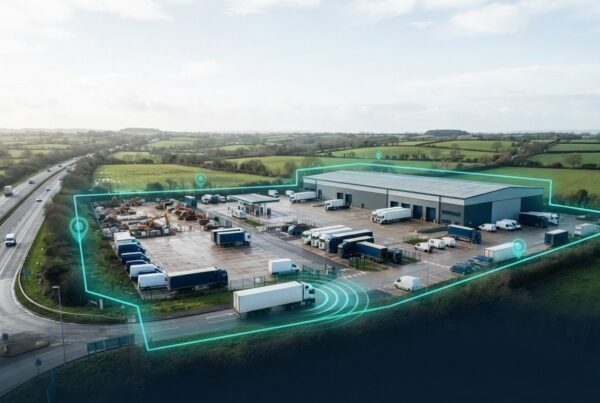

According to research published by Gallagher in 2026, road-facing video evidence exonerates commercial drivers in approximately 63% of incident investigations, yet transport managers across the UK still lose valuable days manually retrieving SD cards to challenge disputed claims. If your team is constantly juggling disconnected GPS tracking software alongside standalone cab recorders, you know first-hand how quickly 50/50 insurance settlements and escalating fleet premiums can erode operational margins. Transitioning to integrated vehicle camera systems for business turns isolated video footage into actionable risk intelligence, linking road events directly to vehicle telematics.
You already recognise that protecting drivers whilst satisfying stringent UK compliance benchmarks, such as the Direct Vision Standard (DVS), demands comprehensive oversight rather than retrospective guesswork. In this 2026 guide, discover how uniting high-definition multi-angle cameras with telematics data protects your workforce, expedites incident resolution, and streamlines fleet management operations within a single, cohesive platform.
Key Takeaways
- Deploying integrated vehicle camera systems for business eliminates manual memory card retrieval by linking cloud-connected video footage directly to telematics telemetry.
- Instant access to contextual collision data accelerates dispute resolution and neutralises crash-for-cash fraud, directly protecting fleet insurance loss ratios.
- Matching the correct hardware setup, from forward-facing cameras to multi-angle perimeter arrays, ensures tailored blind-spot coverage and supports UK Direct Vision Standard compliance.
- Unified fleet management software automatically synchronises telematics exceptions, such as harsh braking or severe impact, with exact timestamped video for objective driver coaching.
- A structured governance framework ensures full compliance with UK data protection legislation, including required CCTV notifications and Data Protection Impact Assessments.
What Are Integrated Vehicle Camera Systems for Business?
At their core, integrated vehicle camera systems for business represent a fundamental shift from passive video recording to connected risk management. Rather than operating in isolation, these connected devices link optical hardware directly to vehicle telematics platforms. Commercial fleets, ranging from light commercial delivery vans and heavy haulage lorries to passenger coaches, rely on these unified networks to instantly transmit incident footage over 4G and 5G cellular connections. By combining high-definition vision with onboard vehicle diagnostics, contemporary video telematics systems transform raw visual files into verifiable operational intelligence.
Standalone Commercial Dash Cams vs. Integrated Telematics Systems
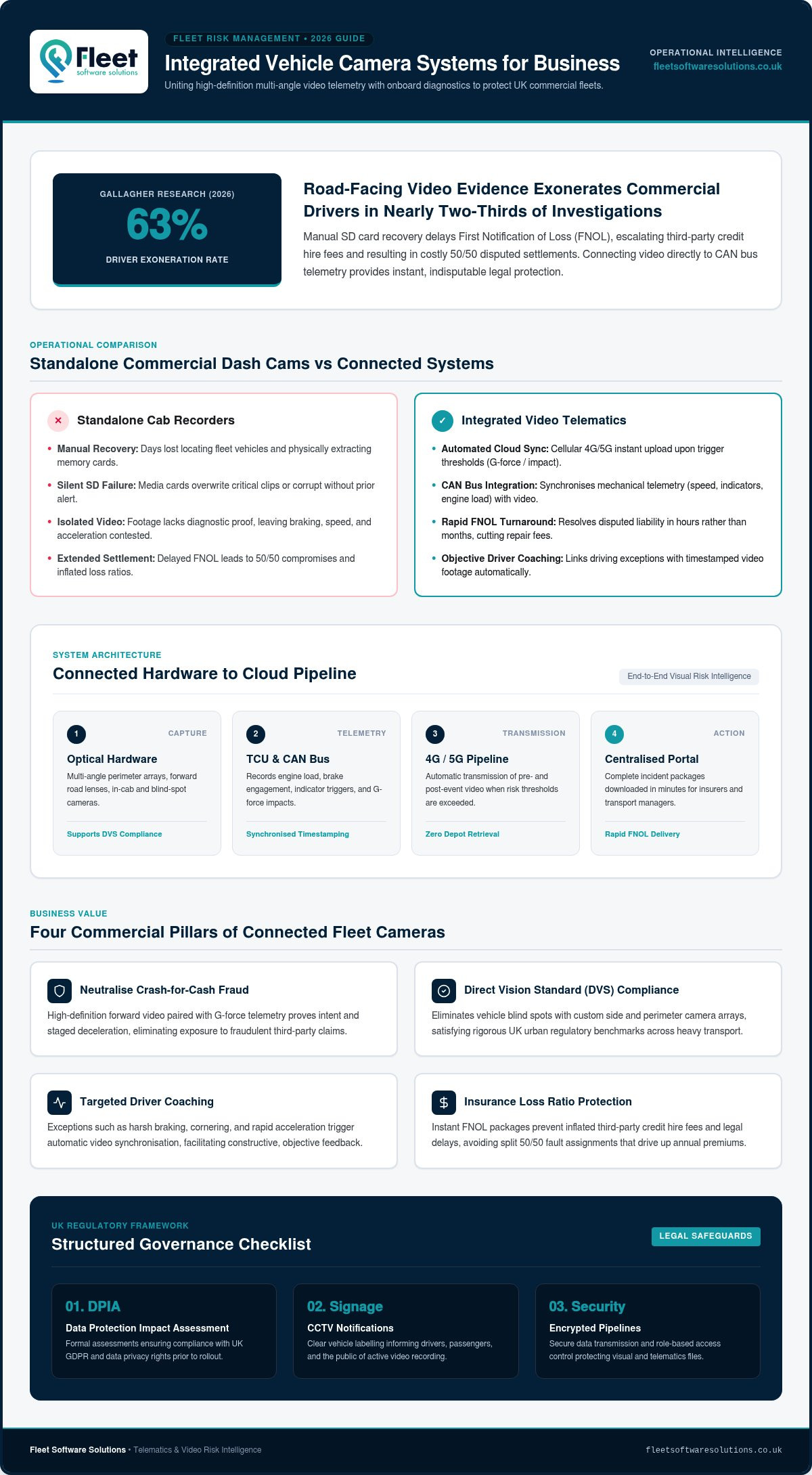
The operational divide between consumer-grade units and enterprise systems centres on data accessibility. Standalone commercial dash cams record continuously onto local SD cards, requiring transport teams to physically locate vehicles and extract media cards whenever an incident occurs. This manual method creates substantial vulnerabilities for commercial operators:
- Memory cards can corrupt silently or overwrite critical footage before an investigation even begins.
- Manual recovery delays First Notification of Loss (FNOL), which often drives up third-party claim costs.
- Video without diagnostic data fails to prove driver actions, leaving acceleration, braking, and speed open to dispute.
Connected vehicle systems resolve this friction by uploading event-triggered clips automatically. When an anomaly occurs, transport managers receive instant visual context linked directly with speed, g-force, and spatial mapping, which eliminates administrative delays entirely.
Core Architecture of an Integrated Fleet Camera System
A unified deployment connects specialised optical hardware to a central telematics control unit (TCU), often interfacing directly with the vehicle’s CAN bus network. This hardware arrangement supports multiple perspectives, including forward-facing road cameras, in-cab units, side-mounted blind-spot sensors, and rear lenses. Because the camera hardware communicates directly with vehicle systems, it captures mechanical signals like indicator engagement, engine load, and hard braking alongside video frames.
Secure cloud data pipelines complete this architecture. The moment an operational threshold is crossed, the system packages pre- and post-event video with corresponding vehicle data and transmits it to a centralised management portal. Transport operators don’t need to wait for vehicles to return to the depot; they can review, analyse, and download indexed incident packages in minutes, ensuring complete visibility across nationwide operations.
Key Commercial Benefits: Protecting Fleets, Drivers, and Profitability
Operating a modern commercial fleet requires managing fine financial margins, where a single contested road traffic collision can disrupt annual cash flow. Implementing integrated vehicle camera systems for business shifts an organisation from defensive claims handling to active risk management. By fusing optical evidence directly with real-time telematics, companies gain measurable operational advantages that safeguard bottom-line performance. These networked platforms protect your balance sheet through rapid incident assessment, automated claims processing, and targeted driver protection.
Mitigating Disputed Claims and Reducing Fleet Insurance Premiums
Disputed motor claims frequently stall in prolonged legal discussions, resulting in frustrating 50/50 fault apportionments that unnecessarily penalise loss ratios. Connected video changes this outcome completely. When an incident occurs, automated First Notification of Loss (FNOL) packages provide immediate video clips synchronised with G-force telemetry, vehicle heading, and speed logs. Pairing high-resolution vision with comprehensive business vehicle tracking ensures that claims handlers establish liability within hours rather than months.
This rapid turnaround enables insurers to direct third-party vehicle repairs immediately, avoiding excessive credit hire fees and exaggerated injury compensation. According to Gallagher’s 2026 insurance market findings, commercial underwriters report claim reductions between 10% and 45% for fleets combining verified driver coaching with connected video hardware. Demonstrating lowered claims severity and lower loss ratios gives transport directors significant leverage to negotiate favourable annual underwriting terms.
Driver Exoneration and Workforce Welfare Protection
Road-facing multi-lens cameras act as impartial witnesses for your driving team. Malicious roadway allegations, ranging from aggressive lane-weaving claims to pre-meditated crash-for-cash manoeuvres, create severe personal distress for drivers and consume considerable administrative time. Providing definitive visual records exonerates innocent drivers rapidly, ensuring their professional standing remains intact.
Modern transport operations also utilise driver assistance technologies to identify fatigue and distraction early, helping protect drivers before incidents happen. Clear internal policies that focus on workforce protection rather than invasive surveillance help build lasting operational trust. Professional drivers gain genuine peace of mind knowing that objective technology supports their daily decisions on the road. If you want to strengthen your risk posture and safeguard your team, exploring integrated fleet platforms with Fleet Software Solutions offers a dependable way forward.
Evaluating Commercial Vehicle Camera Hardware Configurations
Selecting optical hardware demands a clear understanding of vehicle duty cycles, blind-spot vulnerabilities, and operational environments. Commercial operations rarely suit a uniform hardware model; a long-wheelbase delivery van requires a very different configuration than a 44-tonne articulated lorry working on active construction sites. Specifying robust integrated vehicle camera systems for business requires assessing physical resilience, including IP69K weatherproof housings, lockable tamper-proof SD and SIM enclosures, and high-dynamic-range night vision sensors that preserve evidential clarity across poorly lit rural routes.
Camera Arrangements: Forward-Facing to 360-Degree Coverage
Matching camera arrangements to vehicle categories ensures tailored risk management without unnecessary hardware expenditure:
- Forward-Facing Cameras: Best suited for field engineer vans and company cars, these units capture external road traffic, lane discipline, and unexpected hazards ahead of the bonnet.
- Dual-Facing Systems: Pairing road visibility with an internal lens provides vital context regarding driver attentiveness. An ongoing industry study investigating the Safety Impacts of In-Cab Monitoring highlights how internal optical recording helps operators assess behavioural triggers, such as mobile phone distractions or micro-sleep indicators, before collisions happen.
- Multi-Channel and 360-Degree Arrays: For rigid haulage vehicles and plant machinery, four to eight synchronised lenses provide complete perimeter visibility. By integrating side-mounted cameras, rear-view reversing lenses, and cab monitors, drivers can safely navigate tight delivery docks and congested urban junctions.
Regulatory Compliance: DVS and Commercial Road Standards
Hardware specification directly dictates regulatory access for heavy goods vehicles operating across the UK. Transport for London’s Direct Vision Standard (DVS) and the Progressive Safe System (PSS) require all commercial vehicles exceeding 12 tonnes to eliminate near-side blind spots. Operators entering the capital must demonstrate compliant safety equipment to obtain safety permits, or face substantial operational fines.
Meeting these standards involves installing certified near-side blind-spot camera systems, Blind Spot Information Systems (BSIS) that warn of vulnerable road users, and front-mounted Moving Off Information Systems (MOIS). Equipping vehicles with fully certified hardware guarantees unhindered access to urban trade corridors whilst ensuring your operations meet rigorous national safety benchmarks.
Software Integration: Uniting Telematics, AI, and Video Data
Raw video without contextual intelligence creates administrative overload. A modest commercial fleet generates hundreds of hours of driving footage every day, which transport managers cannot realistically audit manually. Advanced integrated vehicle camera systems for business solve this challenge by applying edge computing and cloud analytics to isolate critical road incidents. Instead of streaming endless terabytes over cellular connections, onboard processors evaluate optical inputs in real time. When machine vision detects hazardous events, such as harsh swerving, close following, or driver fatigue, the system packages that brief clip and transmits it directly to the management dashboard.
Event-Driven Video Retrieval and Telematics Synchronisation
Automated telemetry correlation replaces hours of tedious timeline scrubbing. Telematics sensors monitor 3-axis accelerometers, CAN bus signals, and GPS tracking points continuously. When an exception occurs, such as sudden heavy braking or a sudden g-force shock, the software automatically captures a short video clip surrounding that exact timestamp.
Within a unified web portal, fleet managers review the optical evidence alongside synchronised vehicle telemetry, including speed profiles, g-force graphs, and satellite location data. Having these datasets aligned in one place provides indisputable clarity during incident investigations, drastically reducing administrative work whilst conserving cellular data allowances through selective edge filtering.
Driver Behaviour Coaching and Positive Safety Culture
Translating video intelligence into long-term risk reduction requires an objective, supportive coaching framework. Research published by Navionyx in 2026 revealed that 74% of fleets using video telematics experienced noticeable improvements in driver safety, directly driven by real-time alerts and tailored feedback. Using actual event clips transforms driver debriefs from subjective confrontations into constructive learning sessions:
- Managers can review near-miss footage alongside drivers to analyse blind spots and reaction intervals impartially.
- Positive driving decisions, such as successful defensive manoeuvres that prevented a third-party collision, can be identified and commended.
- Consistent monitoring of behaviour trends encourages smoother driving styles, delivering substantial reductions in fuel consumption and vehicle component wear.
To centralise your vehicle diagnostics and establish an objective driver safety programme, explore fleet management software solutions designed to unite connected hardware and actionable road intelligence.
Selecting, Deploying, and Governing Business Camera Systems
Successfully adopting connected fleet technology requires balancing technical integration with workforce engagement. Deploying integrated vehicle camera systems for business involves far more than simply fixing lenses onto windscreens. Fleet operators achieve lasting return on investment by following a clear four-stage framework:
- Operational Assessment: Audit vehicle types, blind-spot requirements, and high-risk driving environments across your nationwide fleet.
- Policy and Compliance Drafting: Establish robust privacy controls and complete necessary regulatory documentation before equipment touches a vehicle.
- Phased Pilot Deployment: Test hardware on a representative sample of vehicles to evaluate network reliability and gather driver feedback.
- Centralised Operational Governance: Integrate live video pipelines into day-to-day fleet management software workflows and ongoing safety reviews.
Legal Compliance, GDPR, and In-Cab Privacy Policies
Commercial vehicle video recording falls directly under UK GDPR and Data Protection Act mandates. Because vehicle cameras capture identifiable personal data from both employees and third-party road users, businesses must complete a Data Protection Impact Assessment (DPIA) before activation. This document details why visual processing is legitimate, necessary, and proportionate to operational safety.
Vehicles equipped with external cameras require clear CCTV warning decals displayed prominently on the bodywork. To reassure drivers and encourage internal support, leading organisations introduce configurable privacy profiles. These include configuring driver-facing lenses to activate only when moving or completely disabling internal monitoring during personal mileage periods. Role-based user permissions also ensure that only authorised transport managers can review incident footage.
Professional Installation and Rollout Management
Commercial hardware requires permanent, professional installation directly into the vehicle’s ignition and CAN bus circuitry. Relying on auxiliary 12V sockets or basic windscreen suction mounts creates severe operational vulnerabilities; cables become dislodged during transit, drivers can easily unplug the equipment, and sudden power spikes risk damaging recording memory.
A professional installation hides wiring safely behind interior panelling, securing tamper-proof hardware that operates consistently whenever the engine turns over. Partnering with an experienced commercial provider that delivers hardware, telematics tracking, and unified fleet management software ensures a streamlined rollout. Rather than negotiating with multiple vendors for cameras, sim cards, and tracking modules, your business gains a single consultative partner to support compliant fleet performance across the UK.
Future-Proofing Your Fleet Operations for 2026 and Beyond
Treating vehicle safety as a reactive exercise is no longer sustainable when commercial transport margins depend on operational efficiency and swift risk mitigation. Deploying modern integrated vehicle camera systems for business transforms isolated video footage into actionable intelligence. By uniting onboard vehicle telematics with multi-angle visual records, commercial operators eliminate protracted claims disputes, protect drivers against spurious roadway allegations, and maintain continuous alignment with regulatory benchmarks like the Direct Vision Standard.
Achieving genuine operational peace of mind requires a dependable technology partner capable of bridging the gap between vehicle hardware and daily transport management. Fleet Software Solutions provides comprehensive telematics and video synchronisation on a single unified platform, supported by proven DVS compliance technology and dedicated nationwide commercial fleet support. Explore our integrated vehicle camera and tracking systems to protect your workforce, reduce claims liabilities, and establish a resilient foundation for your fleet operations.
Frequently Asked Questions
How do integrated vehicle camera systems differ from consumer dash cams?
Integrated systems connect directly to telematics platforms and cellular networks, whereas consumer dash cams store footage locally on manual SD cards. Consumer units require physical retrieval after an accident, risking overwritten evidence. Enterprise integrated vehicle camera systems for business automatically upload incident-triggered clips to a centralised cloud portal alongside vehicle CAN bus data, g-force telemetry, and GPS coordinates, streamlining First Notification of Loss without physical intervention.
Can commercial vehicle cameras record audio inside the cab?
Yes, commercial vehicle cameras can technically record audio, but UK employment and data privacy laws heavily restrict routine in-cab audio monitoring. Recording private driver conversations is rarely justifiable under UK GDPR and often creates employee distrust. Most commercial operators configure their hardware with internal microphones permanently muted, focusing solely on external roadway sound or restricting cab recordings to active panic-button triggers or severe crash impact events.
How much cellular data do connected vehicle camera systems consume?
Data consumption depends on whether the system uses event-driven triggering or continuous live streaming. Modern enterprise systems rely on edge AI to filter video locally, transmitting short 10-to-20-second clips only when triggered by harsh driving or impacts. This intelligent edge processing keeps typical monthly data usage low, usually between 500MB and 2GB per vehicle, preventing excessive cellular network charges while ensuring critical incident evidence uploads immediately.
Are integrated vehicle camera systems compliant with UK GDPR regulations?
Yes, provided businesses follow statutory data protection principles. Organisations must carry out a Data Protection Impact Assessment (DPIA), display clear external CCTV signage on vehicles, and define legitimate operational grounds for processing personal visual data. Installing integrated vehicle camera systems for business requires establishing secure cloud access controls, defined data retention periods, and transparent vehicle policies that clearly explain to drivers how recorded footage is used, audited, and protected.
Can commercial vehicle cameras help reduce business fleet insurance premiums?
Yes, insurers frequently offer lower premiums or improved renewal terms for fleets deploying connected camera technology. Real-time video synchronised with telematics data neutralises crash-for-cash scams and expedites First Notification of Loss, preventing costly 50/50 settlements and excessive third-party credit hire claims. Lowering claims loss ratios through objective video evidence gives commercial operators leverage to negotiate significantly more favourable underwriting agreements across their fleet policies.
What camera hardware is required to meet the London Direct Vision Standard (DVS)?
To satisfy the DVS Progressive Safe System requirements for heavy goods vehicles over 12 tonnes, operators must eliminate near-side blind spots. This requires an active camera monitoring system covering the entire near side of the vehicle, coupled with an in-cab display monitor for the driver. Vehicles also need sensor technology such as Blind Spot Information Systems (BSIS) and Moving Off Information Systems (MOIS) to detect and protect vulnerable road users.
What happens to video footage if a vehicle loses cellular connectivity?
Footage remains completely safe if a vehicle enters a mobile blackspot. Commercial camera units record continuously to internal solid-state memory or tamper-proof storage drives. When an incident or harsh driving event triggers an upload in an area without network reception, the device queues the packaged video file locally. The moment cellular connectivity is re-established, the system securely transmits the queued event footage to your cloud portal automatically. For solution providers and integrators seeking reliable multi-network coverage to minimise these blind spots, visit Choice IoT to explore dedicated IoT SIM solutions.