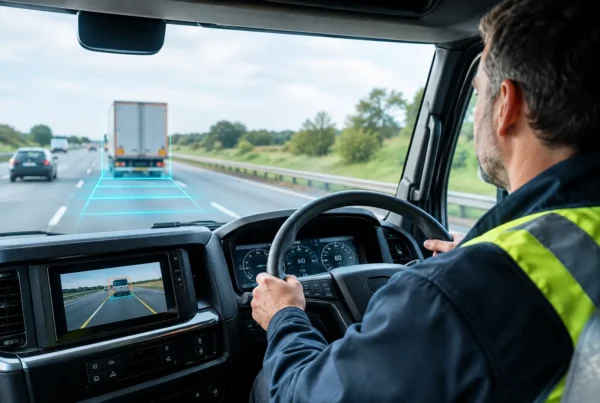

A disputed collision can consume days of management time, leave a driver feeling unfairly blamed and put an insurance excess at risk. In that context, the question is not simply whether cameras are available. It is when are driver cameras justified as a proportionate operational control – and how can a fleet introduce them without damaging trust?
For UK fleet operators, the strongest case is usually built around a specific risk: recurring claims, vulnerable road users, high-value loads, hazardous routes, poor incident evidence or a duty to protect lone workers. Cameras should solve a defined business problem, not become surveillance for its own sake.
When are driver cameras justified in a fleet?
Driver cameras are justified when the expected safety, evidential or operational benefit is greater than the intrusion involved, and when there is no less intrusive measure that would achieve the same result. That means the answer varies by fleet, vehicle type and role.
A road-facing camera is often straightforward to justify for vans, lorries and service vehicles operating on public roads. It records what happened outside the vehicle and can provide independent evidence following a collision, allegation or near miss. Footage can help establish whether a driver was at fault, support a claim defence and bring a quicker resolution for everyone involved.
An inward-facing camera needs a higher threshold because it records the driver in their workplace. It may be justified where a fleet has a clear pattern of serious collisions, fatigue-related risk, mobile phone use, aggressive driving allegations or work that exposes drivers to heightened danger. It can also be appropriate in passenger transport, security-sensitive work and lone-worker roles where understanding the events inside the cab may be essential after an incident.
The distinction matters. A fleet that needs proof of what happened at a junction may only need a forward-facing device. Fitting an inward-facing camera by default, without a documented reason, can be difficult to defend commercially and from a privacy perspective.
Start with the risk, not the camera specification
The best camera policy begins with evidence from the operation. Review collision history, insurance claims, vehicle damage, driver reports, customer complaints and telematics events such as harsh braking, speeding or unusual hours. Look for patterns rather than reacting to a single difficult incident.
For example, a utilities business may find that false third-party claims are concentrated in congested urban areas. A forward-facing camera with event-triggered recording could provide the evidence it needs. A distribution fleet experiencing repeated reversing damage may benefit more from external side and rear cameras than a cab-facing system. If the issue is driver fatigue on long-distance work, inward-facing event footage, combined with working-time controls and driver welfare measures, may be proportionate.
This approach prevents technology being used as a substitute for sound management. Cameras can show that a driver is distracted, but they will not fix unrealistic schedules, weak induction processes or poorly planned routes. The operational response still matters.
A clear purpose makes decisions easier
Before selecting hardware, write down the purpose in plain language. It may be to investigate collisions fairly, protect drivers from false allegations, improve coaching after verified safety events, reduce vehicle damage, or meet a particular security requirement.
Avoid broad statements such as “monitoring driver performance”. They invite uncertainty about how footage will be used. A defined purpose sets boundaries for managers, reassures drivers and helps determine the right recording setup, retention period and access permissions.
Proportionality is the practical test
A proportionate system collects the minimum footage necessary to achieve its stated purpose. In practice, this often means event-based recording rather than continuous review, limited access to live streams, and cameras positioned to capture relevant activity without unnecessarily recording private areas.
Continuous inward-facing recording may be justified in some high-risk settings, but it should not be treated as the default. Consider whether footage can be saved only when a collision, harsh braking or panic alert occurs. This reduces the amount of personal data held while retaining the evidence required to investigate a serious event.
The same principle applies to audio. Recording conversations in a cab creates an additional privacy concern and is rarely necessary for normal fleet safety management. If audio is not needed to meet the stated aim, switch it off.
For many fleets, the right answer is a layered system: telematics identifies an event, the camera provides a short clip before and after it, and the fleet manager reviews only exceptions that meet agreed thresholds. That is more manageable than asking a manager to sift through hours of video, and more defensible than routine observation.
Privacy, consultation and UK data protection duties
Camera footage of identifiable drivers is personal data. Employers must therefore operate within UK data protection requirements, including having a lawful basis for processing, being transparent about what is collected and using footage only for legitimate, communicated purposes.
A data protection impact assessment is particularly sensible before deploying inward-facing cameras, live streaming or AI-enabled driver monitoring. It forces the business to assess the risk to drivers, explain why the proposed approach is necessary, and document safeguards. It should also examine who can view footage, where it is stored, how it is secured and when it is deleted.
Drivers should hear about a proposed rollout before equipment appears in vehicles. Explain the safety and claims issues being addressed, show examples of the footage collected, and set out what managers can and cannot do with it. Consultation with employees, recognised representatives or trade unions, where relevant, is not merely a procedural step. It often exposes practical concerns early, such as camera positioning, false alerts or misunderstanding about live monitoring.
A written policy should cover the purpose of the cameras, the types of footage recorded, retention periods, access controls, incident review and disciplinary boundaries. It should be consistent with contracts, staff privacy notices and wider policies on vehicle use and driver behaviour. Specialist legal or data protection advice may be appropriate for higher-risk deployments.
Use footage to protect and coach drivers
Driver acceptance improves sharply when people see cameras used fairly. The most persuasive example is a driver cleared quickly after a non-fault collision because the footage showed exactly what happened. That protects the individual as well as the business.
Footage can also support more useful driver debriefs. Instead of relying on a vague report of harsh braking, a manager can review the road context: a pedestrian stepped out, a vehicle cut in, or a driver was following too closely. The conversation can then focus on learning and prevention rather than assumption.
That does not mean every alert needs a formal intervention. Set sensible thresholds and distinguish between one-off events and repeat behaviour. A camera programme that treats every sharp manoeuvre as misconduct will create unnecessary admin and undermine confidence. Repeated, verified risk patterns deserve coaching, while serious incidents may require a more formal process.
Managers need training too. They should know when footage may be accessed, how to document a review, and how to avoid making subjective judgements from a short clip. Video is powerful evidence, but it does not always show road conditions, driver health, workload pressure or the full sequence of events.
Make the commercial case before rollout
Camera systems should be assessed as an operational investment, not simply an additional vehicle cost. Quantify the current cost of claims, uninsured losses, vehicle-off-road time, management investigation, legal disputes and rising premiums. Then estimate where better evidence and improved driving standards could reduce that exposure.
The return may come from fewer at-fault incidents, but that is not the only value. Faster claims resolution can reduce disruption. Better evidence can defend drivers against fraudulent allegations. Reversing cameras can lower damage rates. A visible safety programme can support customer and contract requirements.
Start with a pilot if the evidence is incomplete. Select a representative group of vehicles, agree the measures that matter and review results after a defined period. Compare incident outcomes, claims progress, driver feedback and management time against the baseline. A pilot also allows the fleet to test device reliability, mobile coverage, installation quality and the usability of the reporting platform before a wider commitment.
Fleet Software Solutions can help operators match camera types, telematics data and reporting rules to the risks they are trying to reduce, rather than forcing every vehicle into the same specification.
A fair camera policy is a stronger safety policy
Cameras are justified when they address a real risk, are proportionate to that risk and are introduced with clear safeguards. They are harder to justify when the purpose is vague, the system records more than necessary, or managers use footage inconsistently.
The most effective fleets treat camera footage as a source of evidence and improvement, not a shortcut to blame. If drivers can see that the system will protect them after an incident, support fair coaching and reduce avoidable claims, it becomes a practical part of safer, more profitable operations.