
A driving licence or insurance certificate collected once can become outdated. Grey fleet driver document verification works best as an ongoing process, not a one-off request. Employers need to know which documents to collect, what each one shows and how to keep records current when employees drive their own vehicles for work.
A consistent process can help identify gaps before they create avoidable risks. It should also be clear to drivers and straightforward for the people who request evidence, review it and manage follow-up.
This checklist covers core driver and vehicle documents, including driving licences, business-use insurance and MOT evidence. It sets out practical steps for initial and ongoing reviews, then compares manual checks, spreadsheets and software-supported oversight. Fleet management software can help organise grey fleet administration, but it should not be assumed to automate every check.
Key Takeaways
- Use a proportionate checklist to identify what driving licence, business-use insurance, MOT and vehicle tax records can help establish.
- Treat grey fleet driver document verification as a repeatable evidence process, not proof of ongoing compliance or vehicle safety.
- Assign responsibility for requesting evidence, reviewing exceptions, recording checks and arranging follow-up.
- Compare paper, email, spreadsheets and software for consistency, visibility, effort and reporting.
- Consider whether centralised fleet oversight and mileage capture can help organise grey fleet administration alongside wider fleet processes.
Why grey fleet driver document verification matters to employers
Employees may use their own vehicles for anything from an occasional client visit to regular work journeys. As a result, relevant records can end up spread across drivers, managers and inboxes. Grey fleet driver document verification is the process of reviewing relevant driver and vehicle evidence for an employee’s work-related use of their own vehicle. A defined process records what was checked, when it was checked and what needs follow-up.
Verification supports oversight, but it does not replace judgement. An MOT record, for example, shows that a vehicle met the required test standard on the date of the test. It does not confirm the vehicle’s condition today or how it will be driven. Set clear expectations for drivers to report changes and raise concerns about vehicle condition.
What does grey fleet driver document verification mean?
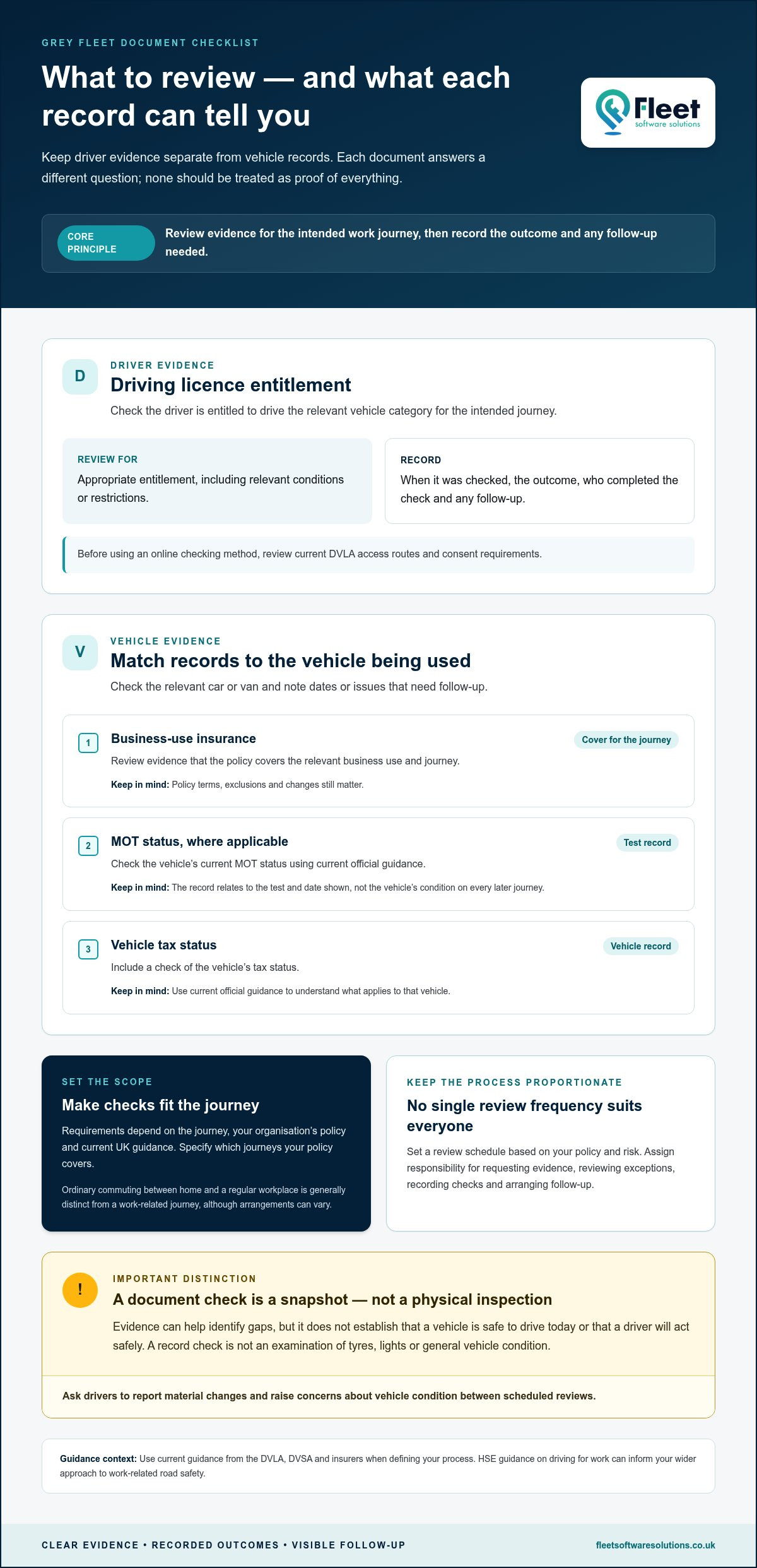
The process covers driver evidence, such as driving entitlement, and vehicle records, such as insurance for the intended business use, MOT status where applicable and vehicle tax status. Each document answers a different question, so do not treat them as interchangeable. A record check is also different from a physical inspection: it reviews evidence rather than examining the vehicle’s tyres, lights or general condition.
The checks you need depend on the journey, your organisation’s policy and current UK guidance. Ordinary commuting between home and a regular workplace is generally distinct from a work-related journey, although arrangements can vary. Specify which journeys your policy covers and consult current official guidance when setting requirements for particular journey types.
Why do employers need a consistent process?
Consistency makes checks easier to explain and administer. Drivers know what evidence to provide, reviewers know how to record the outcome, and managers can see which cases need attention. Without agreed steps, one employee might receive a reminder while another’s missing or expired record goes unnoticed.
Assign an owner for requesting evidence, reviewing exceptions and recording completion. Set out how to handle missing, unclear or out-of-date records, including who decides whether a driver can undertake a particular work journey while an issue is addressed. This creates a record of actions without overstating what the documents prove.
Paperwork alone cannot establish that a vehicle is safe to drive or that a driver will act safely. Document checks help employers identify gaps and respond, while driver responsibilities, reporting procedures and appropriate attention to vehicle condition remain important. Treat the evidence as a snapshot, and tell drivers to report material changes between scheduled reviews.
Document verification is one part of wider grey fleet oversight, which also involves work journey decisions, responsibilities and record management. A practical grey fleet management guide can help put checks in that wider operational context. The aim is not to collect paperwork for its own sake, but to maintain a proportionate process with clear responsibilities and visible follow-up.
Grey fleet document checklist: what employers should review
Separate driver evidence from records relating to the vehicle. This makes each check easier to interpret and reduces the risk of treating one document as proof of something it cannot establish. Set the scope according to your organisation’s risk assessment and policy, alongside current guidance from the DVLA, DVSA and insurers. The HSE guidance on driving for work can inform your wider approach to work-related road safety.
Driver evidence: licence and journey eligibility
Check that the employee has the appropriate entitlement for the vehicle they will use, including any relevant conditions or restrictions. Record the date and outcome of the check, along with any follow-up, so there is a clear account of what was reviewed. Set a proportionate review schedule based on your policy and risk rather than assuming one frequency suits every organisation.
- Driving licence entitlement: Check that the driver is entitled to drive the relevant vehicle category for the intended journey.
- Check record: Record when the evidence was reviewed, the outcome and who completed the check. Before adopting an online checking method, review current DVLA access routes and consent requirements.
Vehicle evidence: insurance, MOT and tax
Match vehicle records to the car or van being used rather than relying on a general declaration from the driver. Record what you reviewed and any dates or issues that need follow-up. Requirements can vary by vehicle and use, so use current DVSA, DVLA and insurer guidance when defining your process.
- Business-use insurance: Review evidence that the policy covers the relevant business use and journey. The document helps establish the stated cover, but policy terms, exclusions and changes still matter.
- MOT status, where applicable: Check the vehicle’s current MOT status using current official guidance. The record relates to the test and date shown, not the vehicle’s condition on every later journey.
- Vehicle tax status: Include a check of the vehicle’s tax status and use current official guidance to understand what applies to that vehicle.
Your organisation may add evidence that fits its policy or risk assessment, such as vehicle details or the driver’s confirmation that the vehicle is suitable for the planned journey. For verifying build specifications and factory records directly from a VIN, platforms like VinSignal can provide instant access to factory vehicle data. Treat these as additional controls, not universal document requirements. Checks should also sit alongside a process for reporting defects and any appropriate condition checks. Records can support oversight, but they cannot show that a vehicle is roadworthy at the point of use.
For a dispersed workforce, use the same core fields for each driver and vehicle, then record exceptions separately for review. Grey fleet management software from Fleet Software Solutions supports centralised fleet oversight alongside mileage capture, helping organise administration.
Manual checks, spreadsheets or software: compare verification approaches
The right approach depends on how many employees drive for work, how often the driver group changes, the risks involved and who owns the checks. A small scheme with occasional journeys may be manageable with a controlled spreadsheet. A dispersed workforce with frequent changes may benefit from more centralised oversight. Compare the options against consistent criteria before deciding.
| Approach | Consistency and visibility | Effort and reporting |
|---|---|---|
| Paper or email | Evidence can be reviewed directly, but records may sit in separate files or inboxes. | Simple to start; locating history or summarising outstanding checks can take time. |
| Spreadsheet | Shared fields can standardise entries, with visibility depending on how the file is managed. | Can support basic status tracking, but reminders, updates and reporting need ongoing ownership. |
| Fleet software | Can offer a more centralised view, depending on the system and its configured capabilities. | Can support broader administration and reporting; document workflows depend on the platform. |
When manual or spreadsheet checks may be proportionate
For a low-volume scheme, assign a role to request and review evidence, then use a controlled record with consistent fields for the driver, vehicle, check date, outcome and follow-up. Avoid relying on personal inboxes: staff absence or role changes can make evidence difficult to find. Limit access appropriately, agree how updates are recorded and review open actions on a defined schedule.
A well-organised spreadsheet can still become unreliable if people keep separate copies or rely on memory for reminders. A recorded status is useful only when someone understands what it means and acts when a check needs attention.
When centralised software can support oversight
Assess whether a system can bring relevant driver and vehicle records, check status and follow-up actions into one view. Consider whether its reporting works for the people responsible for oversight. Treat these as selection criteria, not assumed capabilities: review the actual workflow before relying on a platform for document verification. For example, staff can use the GOV.UK MOT history check as an official source within a process, but using software does not itself verify that record.
Fleet Software Solutions provides grey fleet management software and mileage capture to support centralised fleet administration. This is distinct from vehicle tracking: the business vehicle tracking guide covers a related operational area, but location visibility is not document verification. Organisations can explore grey fleet management software as part of a wider oversight approach.
The best verification process is one your organisation can maintain consistently and evidence when needed. Match the approach to your workforce and responsibilities, then keep ownership, access and review arrangements clear as the scheme changes.
A practical workflow for verifying and updating grey fleet records
A reliable process tracks each check from driver onboarding through later renewals or changes. Assign responsibilities by role: drivers need to know what to provide, while the people overseeing the scheme need to know who reviews evidence, resolves exceptions and records outcomes. Put these steps in your policy before employees use their vehicles for work.
From driver onboarding to a recorded check outcome
Explain which journeys the policy covers, what evidence is required and how drivers should report changes or concerns. Make clear that the required checks must be completed before a driver undertakes a covered work journey. Then use a consistent sequence:
- Set the requirements. Document the journey types covered, the records needed and who is responsible for each part of the process.
- Request and review evidence. Ask the driver to provide the required information through an agreed, secure route. The reviewer checks it against the organisation’s policy and records questions or gaps.
- Record the outcome. Note the driver and vehicle reference, document type, check date, outcome, reviewer and next action. Keep only the information needed to show that the check took place, rather than making unnecessary copies or notes.
- Resolve exceptions. If evidence is missing, inconsistent or unclear, record the issue and refer it to the designated manager. Follow organisational policy on whether the driver may undertake the relevant journey, and document the decision and any follow-up.
This structure makes grey fleet driver document verification easier to apply consistently, even when different managers handle requests and reviews. It also creates a clear handover when an issue needs escalation.
Managing renewals, exceptions and personal data
Use known expiry dates to plan reminders in advance, allowing time for drivers to provide updated evidence and reviewers to address problems. Set review triggers that fit your policy, such as a vehicle change, a change in journey use, a reported incident or information suggesting a record may no longer be current. One fixed review interval will not suit every driver or risk profile.
Handle records carefully. Collect only what the process needs, restrict access to people with a clear role, and define retention and secure disposal arrangements in line with your organisation’s requirements. Review current Information Commissioner’s Office (ICO) and UK GDPR guidance before deciding how personal data is collected, stored and retained. Avoid keeping evidence indefinitely simply because it might be useful later.
A practical checklist can be a controlled spreadsheet or another approved record with fields for document type, status, review date, responsible owner and next action. Include a driver and vehicle reference, plus space to note an exception and its resolution. Review open actions regularly so reminders and escalations do not disappear in an inbox.
Grey fleet management software from Fleet Software Solutions brings grey fleet administration and mileage capture into wider fleet oversight.
Putting grey fleet verification into practice with fleet management software
Software can help organise grey fleet administration, but it does not remove the need for a clear policy or accountable people. First map how your organisation requests evidence, reviews it, records decisions and follows up exceptions. Then assess whether centralised oversight would make those steps easier to manage across your workforce.
What to assess in a software-supported process
Start with the information and oversight your process needs. Consider how a system can help organise relevant records, manage access, support reminders and reporting, and show who owns each action. Establish how updates, exceptions and unresolved checks will be handled in practice.
Usability matters for drivers as well as administrators. A process that is difficult to follow can lead to incomplete records or extra work. Consider how drivers submit evidence, how changes are communicated and how staff find the status of an outstanding action. Review data governance and integration needs alongside these day-to-day considerations.
- Centralised oversight: Can responsible staff view relevant information and understand the status of the process?
- Clear ownership: Can the right people see responsibilities and follow-up actions?
- Useful reporting: Can the organisation review progress in a format that supports its oversight needs?
- Fit with existing processes: Will the approach work with current responsibilities, driver communications and data-handling arrangements?
These are assessment questions, not assumed software features. Centralised fleet administration does not mean grey fleet driver document verification is automated. Check what the platform supports and retain an appropriate human review process for evidence, exceptions and decisions.
How Fleet Software Solutions supports grey fleet oversight
Fleet Software Solutions provides grey fleet management software and mileage capture as part of wider UK fleet administration. Centralised fleet oversight helps teams organise related activity, while mileage capture supports the management of work-related vehicle use. The software supports administration and visibility; it does not replace organisational policy or establish that a document is valid.
Review your current process, identify where records or follow-up become fragmented, then decide whether centralised oversight would address those needs. Consider how grey fleet administration fits with your wider fleet activity, and explore Fleet Software Solutions as part of that review.
Make your next review a practical one
Start with your current process. Identify where responsibility is unclear, follow-up is delayed or evidence is hard to locate, then choose the improvement that would make the greatest difference. A manageable approach to grey fleet driver document verification should fit the way people work, with clear ownership and records that can be maintained over time.
If fragmented administration is making this difficult, consider whether centralised fleet oversight could help. Fleet Software Solutions’ grey fleet management software and mileage capture sit within wider fleet management software, helping organisations organise mobile operations while keeping their own policies and review responsibilities in place.
Explore Fleet Software Solutions to see how grey fleet management software could support your organisation’s approach.
Frequently Asked Questions
Is grey fleet document verification a legal requirement?
Employers have health and safety responsibilities for work-related road risk, but there is not one universal statutory document checklist for every grey fleet arrangement. Grey fleet driver document verification is a way to gather evidence in support of an organisation’s process, not a checklist that automatically defines legal compliance. Set requirements in light of journey type, vehicle use and a documented risk assessment, and check specific duties against current UK legislation and official guidance.
Can an employee drive for work while a document check is outstanding?
Do not treat missing evidence as proof that the driver or vehicle meets your organisation’s requirements. Follow your policy, assess the circumstances and resolve the outstanding check before authorising the relevant work-related journey. For example, if a driver changes vehicles shortly before a client visit, review the new vehicle’s required records before approving that trip. Avoid applying a blanket legal ruling, and distinguish business journeys from ordinary commuting when setting your decision process.
Does a grey fleet driver need business-use car insurance?
Whether a policy covers a particular journey depends on its terms and the nature of the use. Do not assume ordinary social or commuting cover includes business travel. Ask drivers for evidence that relates to the journeys your organisation permits, and record any limits or questions for review. Insurance categories and wording can vary, so do not treat one label as universally sufficient or interpret an individual policy beyond your organisation’s process.
Can employers check a driving licence online?
Some UK licence information can be checked through online routes, but access and available details depend on the driver, consent and the service used. Before building a process around an online check, consult current DVLA guidance and decide how consent and personal information will be handled. Record the check outcome, but remember that a licence result does not establish whether the vehicle has suitable insurance or current required documents.
Should employers keep copies of grey fleet documents?
Not necessarily. Decide what evidence is needed to show that your process was completed rather than keeping every document by default. A record of the document reviewed, date, outcome and reviewer may be enough for your organisation’s purpose, but requirements can vary. Limit access, set a clear retention period and dispose of records securely when they are no longer needed. Check current ICO and UK GDPR guidance alongside your own retention rules.
Is checking MOT status enough to confirm a grey fleet vehicle is safe?
No. An MOT result relates to the vehicle’s test status at a particular time and does not guarantee its condition on a later journey. A vehicle could develop a defect after its test, so provide a clear route for drivers to report faults and concerns before or during work use. Keep document checks separate from any proportionate condition-reporting or assessment process, and do not present an MOT record as a substitute for either.