
A GPS tracker review should not begin with a map screen or a monthly price. For a fleet manager, the real question is whether the system will reduce avoidable mileage, improve customer updates, support safer driving and provide evidence when something goes wrong. A low-cost tracker that creates more admin, produces unreliable locations or cannot deliver the reports you need will soon become an expensive compromise.
The best choice depends on the vehicles you run, the way your teams work and the operational problem you need to solve. A courier fleet, a facilities team covering several counties and a construction business managing plant will all need location data, but they will use it differently. That is why a useful assessment looks beyond basic tracking and considers the complete service around it.
GPS Tracker Review: What Fleet Operators Should Assess
Start with the operational outcome
Before comparing devices, define what needs to improve. Some businesses need accurate arrival and departure times to answer customer queries without ringing the driver. Others need to cut unauthorised vehicle use, reduce idling, improve job allocation or protect lone workers. If you are reviewing trackers only because competitors have one, the project can quickly become a source of data without a clear purpose.
Set a small number of measurable objectives. This could mean reducing excess idling, improving on-time attendance, lowering speeding events, recovering stolen assets faster or reducing mileage claims in a grey fleet. Clear objectives also make it easier to involve finance, health and safety, HR and operations in a decision that affects each of them.
A good provider should ask these questions early. They should be able to show how the technology, alerts and reports relate to your working practices rather than simply recommending the same unit for every vehicle.
Location accuracy is only the starting point
Live location remains fundamental. Dispatchers need to see where vehicles are, identify the closest suitable resource and give customers a realistic estimated arrival time. However, accuracy on a map is not enough on its own. Consider how often the platform updates, whether historical journeys are easy to replay and how clearly it handles weak GPS signal areas, such as city centres, covered loading bays or rural locations.
For many fleets, geofencing is where location information becomes operationally useful. A virtual boundary around a customer site, depot or restricted area can create automatic proof of arrival, departure and dwell time. This reduces manual timekeeping and gives service teams reliable information when a customer disputes a visit.
Asset and plant tracking often needs a different approach. Battery-powered devices may be more suitable where there is no permanent vehicle power supply, but battery life, reporting frequency and installation position all need careful consideration. A tracker hidden too deeply within metal plant can affect signal performance; a device reporting too frequently may shorten battery life. The right balance depends on the risk and value of the asset.
Look at the quality of driver data
Vehicle tracking can improve driver behaviour, but only if events are fair, understandable and properly managed. Harsh braking, harsh acceleration, speeding and idling alerts can highlight patterns that affect fuel spend, wear and tear, collision risk and the public perception of your business.
The important detail is context. A single harsh braking event may be the result of another road user pulling out. Repeated events on the same journey type, vehicle or driver are more meaningful. Your system should help managers identify trends, review them with the driver and record sensible follow-up action.
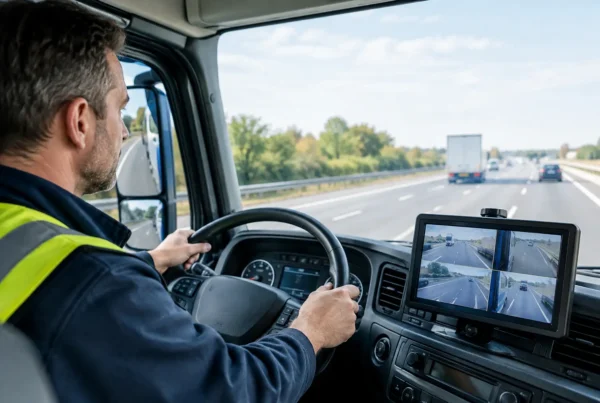
This is also where vehicle cameras can add value. Footage can provide context during incident review, support driver exoneration and strengthen an insurer’s understanding of what occurred. Cameras are not appropriate for every fleet requirement, but for higher-risk operations, vehicles carrying valuable goods or businesses facing frequent third-party claims, the combination of video and telematics can be compelling.
Reporting must save time, not create it
Many systems offer hundreds of reports. Most fleet teams do not need hundreds of reports. They need a concise dashboard that shows exceptions requiring action: vehicles with excessive idling, overdue checks, repeated speeding, unusual out-of-hours use or significant gaps between planned and actual activity.
Test how easily reports can be scheduled and shared. A transport manager may need a daily exceptions report, while the finance team may need monthly mileage and utilisation figures. Directors may only need a short view of cost, risk and service performance. Configurable dashboards matter because each role needs a different level of detail.
Also check whether the data can support the wider fleet process. Mileage capture can make business and private mileage clearer for drivers and payroll teams. Driver identification can be vital where vehicles are shared. Maintenance alerts may support planned servicing, although they should complement rather than replace your formal maintenance controls. The aim is to reduce duplicate data entry and give people information they can act on promptly.
GPS Tracker Review: Questions to Ask a Supplier
A product demonstration can make every platform look straightforward. Ask the supplier to show your likely day-to-day scenarios instead: finding the nearest engineer, investigating a customer complaint, reviewing a collision, setting a site alert or producing a weekly driver risk report. This exposes how intuitive the platform is when someone needs an answer quickly.
Ask about device compatibility and installation. Hard-wired trackers can provide dependable power and richer vehicle data, while plug-in devices may suit shorter-term requirements or lower-complexity fleets. Neither option is automatically better. The choice should reflect the vehicle type, expected contract period, data requirements and the risk of devices being removed or tampered with.
Installation quality deserves proper attention. Poor installation can cause avoidable downtime, unreliable data and frustration for drivers. For multi-site fleets, a nationwide engineering network and planned fitting schedule can prevent operational disruption. Discuss what happens if a vehicle is off the road, a device fails or a new vehicle joins the fleet at short notice.
Support should be assessed with the same scrutiny as the hardware. Find out who configures alerts, builds reports, trains managers and helps turn data into improvement. Fleet technology is most valuable when someone takes responsibility for making it useful after installation, not just for fitting devices.
Data ownership, retention and access are equally relevant. You should understand how long journey and event data is retained, who can access it, how user permissions work and how information is handled when an employee leaves. GPS data can be valuable evidence, but it must be managed responsibly and in line with your policies.
Cost Should Be Considered Against the Business Case
The cheapest monthly fee rarely represents the lowest overall cost. A more capable solution may justify itself through lower fuel consumption, fewer unproductive miles, improved utilisation, reduced collision exposure or stronger evidence for insurance claims. Equally, paying for advanced features that nobody uses is wasteful.
Build the business case around your current baseline. Look at fuel spend, annual mileage, idling time, incidents, missed appointments, insurance excesses and the administration involved in answering location queries. Even modest improvements across several vehicles can create a meaningful return. Include implementation time and training in the calculation, because adoption is part of the investment.
Be wary of promises based solely on headline savings percentages. Your results will depend on driver engagement, manager follow-through, journey patterns and how consistently the system is used. A provider should help you establish realistic measures and review progress after deployment.
Implementation Makes the Difference
The rollout should be treated as an operational change, not an IT purchase. Explain to drivers why the system is being introduced and what it will, and will not, be used for. Framing telematics only as surveillance invites resistance. Explaining how accurate records can protect drivers, reduce unnecessary calls and support fair incident reviews creates a more constructive starting point.
Begin with agreed rules for speeding, idling, private use, out-of-hours alerts and driver coaching. Managers need consistent processes so that data is handled fairly across the business. A pilot group can be useful for testing alert thresholds and report formats before a full rollout.
Fleet Software Solutions approaches this stage as a consultative exercise, matching hardware, camera and reporting options to the practical outcomes a fleet needs to achieve. That flexibility matters where mixed vehicle types, mobile teams and valuable assets require different devices but a single operational view.
The tracker worth choosing is the one that gives your team clear, credible information at the point decisions are made. If it helps a controller communicate with confidence, a manager coach fairly and a business prove what happened, it is doing far more than showing dots on a map.