

What if knowing where every LGV is still didn’t help you make the next operational decision? That’s the practical challenge behind lgv fleet tracking: location visibility can show where vehicles are, but its value depends on how teams use it to plan work, respond to changes and review activity. More data alone won’t resolve uncertainty if staff don’t know what to do with it.
This guide explains how to assess LGV fleet tracking against your routes, workflows and oversight needs, then connect location information to decisions your team can act on. It takes a case-study approach without presenting unverified customer results, so you can distinguish useful evidence from assumptions and set realistic measures before implementation.
You’ll find practical tracking scenarios, questions to ask about system fit and driver communication, and records that can help you evaluate outcomes responsibly. The aim is a credible plan for your fleet, based on the way your operation works rather than promises that may not apply.
Key Takeaways
- Use a clearly labelled operational scenario unless verified customer evidence is available, and separate assumptions from documented results.
- Assess how lgv fleet tracking could inform dispatch and oversight within your existing workflows. Location data is not an outcome in itself.
- Compare essential fleet requirements with confirmed system capabilities, and verify functions or integrations before relying on them.
- Plan who will coordinate installation, manage system access and review data so responsibilities are clear from the outset.
- Set baseline measures before rollout and compare equivalent records over time to assess whether operational changes are supported by evidence.
LGV fleet tracking: the operational challenge behind the case study
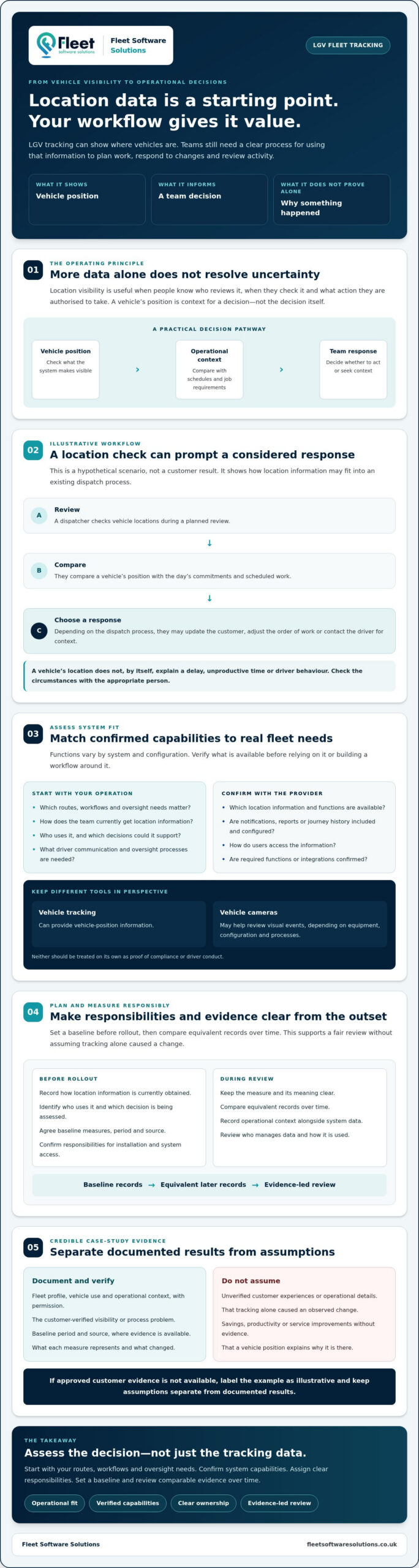
Illustrative scenario, not a customer case study: an LGV fleet works across multiple locations during the day, but staff have limited visibility of vehicle positions once vehicles leave the depot. When a job changes or a customer asks for an update, a manager may need to contact colleagues before deciding how to respond. The practical question is whether better location visibility could help the team respond within its existing workflow.
This scenario is a starting point, not evidence of a customer’s experience or a promise of results. Before publishing a real case study, confirm the fleet profile, operational challenge and permission to share those details. If approved evidence isn’t available, label examples as illustrative and avoid claims about savings, productivity or service improvements.
What does LGV fleet tracking show a fleet manager?
LGV fleet tracking uses vehicle tracking hardware and software to provide visibility of vehicle locations. A vehicle tracking system combines tracking technology with software. The precise information and functions vary by system, so confirm them before describing what a solution can do. Vehicle-position information helps a manager see where a vehicle is, but it doesn’t explain why it is there, whether work is progressing as planned or how a driver is behaving.
How to establish a credible case-study baseline
A useful baseline records conditions before a tracking approach is introduced. For a customer case study, confirm the fleet size, vehicle use and operational context with the customer’s permission. Then describe the visibility or process problem they have verified. Don’t fill gaps with assumed routes, delays or dispatch practices.
Where evidence is available, state the baseline period and its source, such as approved operational records or system data. Explain what each measure represents, and keep the starting question specific. For example, ask whether location information could help the team make a particular operational decision. This gives later reviews a fair comparison point without implying that tracking alone caused any observed change.
For your own assessment of lgv fleet tracking, note how your team currently gets location information, who uses it and which decisions it could support. That turns a broad concern about oversight into a practical question for solution selection and measurement. Next, identify the requirements that matter to your operation and ask providers to confirm which capabilities are available.
How LGV tracking data supports day-to-day fleet decisions
Hypothetical workflow, not a customer example: a dispatcher checks vehicle locations during a planned review and sees that an LGV is still some distance from its next scheduled job. They compare the position with the day’s commitments, then decide whether to update the customer, adjust the order of work or contact the driver for context. The right response depends on the organisation’s dispatch process. Location data can inform a decision, but it doesn’t make that decision automatically.
Tracking data can inform fleet oversight by showing vehicle positions that managers can consider alongside schedules, job requirements and information from drivers. To make lgv fleet tracking useful in day-to-day operations, decide who reviews location information, when they check it and what action they’re authorised to take. A clear process helps staff use visibility consistently instead of relying on ad hoc checks.
First confirm what the system provides. Routine location visibility is different from notifications, reports, journey history or other functions, which may vary by system and configuration. Ask the provider to confirm available capabilities and how users access information before building workflows around alerts or reports. Don’t infer a delay, unproductive time or driver behaviour from a vehicle’s position alone. Check the context with the appropriate person.
Use tracking alongside cameras or compliance tools
Vehicle tracking and vehicle cameras support different, though sometimes related, oversight needs. Tracking can provide vehicle-position information, while camera footage may help review visual events, subject to the equipment, configuration and processes in place. Neither should be treated as proof of compliance or driver conduct on its own. If cameras are relevant to your requirements, see this guide to fleet camera systems for further considerations.
Tracking should complement, not replace, an operator’s wider responsibilities. The GOV.UK Goods Vehicle Operator Licensing Guide provides official guidance for goods vehicle operators. Assess your compliance processes separately rather than assuming location records meet the guide’s requirements.
Before rollout, review driver communication and internal data-handling practices. Explain why location information is collected, who can access it, how it will be used and how drivers can raise concerns. Agree suitable access and retention arrangements with relevant internal teams, and check that monitoring practices align with your organisation’s policies and applicable requirements.
If you’re assessing whether vehicle tracking fits your operation, review vehicle tracking options alongside the decisions your team needs to make and the capabilities a provider can confirm.
How to assess an LGV tracking solution against your fleet needs
Start with the decisions your team needs to make, not a long list of features. For lgv fleet tracking, a requirement is essential if the operation depends on it. Functions that aren’t needed for routine work can remain optional. This keeps comparisons focused on fit, confirmed capabilities and the effort required to adopt a new process.
Which LGV fleet tracking requirements should be prioritised?
Map your fleet size, vehicle use, working patterns and the people who need operational visibility. For each requirement, ask the provider to confirm what the proposed hardware, software and reporting can do. Check compatibility and any integrations rather than assuming they’re included. Finally, consider how staff would use the information alongside existing dispatch and fleet-management processes.
| Assessment area | What to establish | Implementation consideration |
|---|---|---|
| Operational visibility | Which roles need vehicle-location information, and for what decisions? | Confirm access arrangements and how the information fits current workflows. |
| Hardware and software | Which vehicle types and required system functions are supported? | Verify compatibility, installation coordination and any dependencies. |
| Reporting and data | What information can be reviewed, and in what format? | Check who can access it, how it can be used and whether it meets reporting needs. |
| People and support | What guidance and support arrangements are available? | Agree expectations, responsibilities and how drivers will be informed. |
Mark each item as essential or optional, then put the same questions to every provider. The business vehicle tracking guide offers wider context for understanding the technology. For broader industry perspective, the Logistics UK 2026 industry report is reported to find that 57.4% of logistics businesses plan to invest in fleet management data systems. That trend doesn’t establish which solution is right for your fleet.
How to judge whether case-study results apply to your fleet
Check whether the example’s fleet profile, vehicle use and starting process resemble your own. Look for a stated baseline, measurement period, data source and explanation of operational changes. An observed change isn’t automatically caused by tracking. Other process changes or circumstances may have contributed, so treat results as questions to investigate rather than a forecast.
Before deciding, compare the proposed workflow with your current one. Document what would change, who would review information and how you’d assess the outcome. You can also review vehicle tracking options against the requirements you’ve prioritised.
Planning an LGV fleet tracking rollout and measuring its impact
A structured rollout helps ensure lgv fleet tracking addresses a defined operational need instead of adding information without a clear purpose. Agree responsibilities and success measures before deployment. Then review how the system fits day-to-day work before drawing conclusions about its impact.
A practical sequence for introducing LGV tracking
- 1. Define the requirements. Record the vehicles in scope, how they’re used, who needs access to location information and which operational decisions the system should support. Separate essential requirements from optional ones.
- 2. Confirm the arrangements. Ask the provider to verify hardware and software capabilities, vehicle compatibility, installation coordination, system setup, user guidance and support arrangements. Assign an internal lead to coordinate with the provider, and confirm access roles with the people who will use the system.
- 3. Prepare drivers and users. Explain the purpose of tracking, what information will be collected, who will use it and how it will inform operational processes. Give managers and relevant staff clear guidance on access and data handling before the system is used.
- 4. Review early use. Check whether intended users can access the information and whether agreed processes work in practice. An operational manager can review usage and identify issues, with a named contact responsible for raising them with the provider.
- 5. Assess against the baseline. Compare agreed measures with the starting position over a comparable period. Document changes to routes, staffing, schedules or working practices that could affect interpretation.
Which measures can demonstrate operational progress?
Choose measures that relate directly to your objective and can be recorded consistently. If the aim is to improve dispatch decisions, define what a useful decision looks like and how the team will record relevant events before rollout. Pair tracking information with suitable operational records where needed, and compare equivalent periods using consistent definitions.
A simple measurement plan can specify the question, measure, data source, review owner and comparison period. The right measure depends on the fleet and its processes. Location data alone can’t establish productivity, savings or safer driving. Record what changed and when, so later reviews can distinguish observed results from assumptions or other influences.
Keep reviews regular enough for the responsible team to spot process issues, with a frequency suited to your operation. If you’re planning a rollout, discuss vehicle tracking requirements with Fleet Software Solutions and confirm which capabilities and implementation arrangements are available for your fleet.
What the LGV tracking case study shows and how to take the next step
No approved customer evidence has been provided for this guide, so it can’t responsibly report a verified fleet challenge, chosen tracking approach or measured outcome as a real case study. The illustrative workflow earlier in the article is not customer evidence. Instead of presenting assumed results as fact, use the questions below to assess whether an example is relevant to your operation and what evidence you’d need before drawing conclusions.
What lessons can another LGV operator take from the evidence?
Separate transferable process lessons from customer-specific results. A clear operational objective, defined responsibilities and a documented baseline can make an evaluation more credible, but they don’t prove another fleet will achieve the same outcome. Before applying published findings to your business, ask:
- What was the fleet’s size, vehicle use and working pattern?
- What visibility or process problem was documented at the outset?
- Which tracking capabilities and operational changes were introduced?
- What measures, data sources and comparison period support the reported outcome?
- Were other changes made that could have influenced the result?
These details matter because results may depend on how a fleet is organised, how managers use location information and whether staff follow the intended process. If an example doesn’t explain its baseline, measurement period or relevant operational changes, treat its claims cautiously. The useful lesson may be the evaluation method, not a numerical result to expect from your own LGV fleet tracking plans.
Discuss your LGV fleet tracking requirements
Before making an enquiry, prepare a brief picture of your fleet and current approach. Include the vehicles in scope, how they’re used, who needs location visibility, how dispatch or fleet decisions are currently made and what you want to assess. Note any system functions or reporting you consider essential. List details that need confirmation too, including hardware compatibility, access arrangements and implementation responsibilities.
Fleet Software Solutions provides vehicle tracking and fleet management software for UK businesses. A useful discussion should establish which confirmed capabilities fit your requirements and what information you’ll need to review outcomes responsibly, without assuming a particular result in advance.
For a practical conversation about your operation, discuss your fleet tracking requirements with Fleet Software Solutions. Bring your priorities and questions to help establish whether the approach fits your workflows.
Turn fleet visibility into a practical next step
Effective lgv fleet tracking is not simply about seeing vehicle locations. Its value depends on whether that information supports decisions your team needs to make, fits existing workflows and can be assessed against a clear baseline. Before adopting a system, define your requirements, confirm available capabilities and agree how you’ll review outcomes. This keeps conclusions grounded in evidence rather than assumptions.
Fleet Software Solutions provides business vehicle tracking hardware and fleet management software, with vehicle camera and DVS compliance offerings for relevant requirements. The company serves customers nationally across the UK. A discussion about your fleet can help clarify which requirements to prioritise and what details to verify before planning implementation.
Ready to explore a practical fit for your operation? Discuss your LGV fleet tracking requirements with Fleet Software Solutions. Bring your fleet details, current processes and operational priorities to start with a clear view of what you need to assess.
Frequently Asked Questions
What is LGV fleet tracking?
LGV fleet tracking uses vehicle tracking hardware and software to provide authorised users with information about fleet vehicles. Depending on the solution and its configuration, this may include location visibility and tools for operational review. Confirm which functions are available, especially alerts, reports or integrations, then assess whether the information supports real decisions across your fleet and workflows. Don’t assume every system offers the same capabilities.
How can LGV fleet tracking help a business?
LGV fleet tracking may improve vehicle visibility and help managers make operational decisions when information is used consistently. For example, location information could inform a dispatch review, depending on the team’s process and the system’s confirmed functions. Value depends on these factors and on how outcomes are measured. Set a relevant baseline and compare equivalent periods. Don’t assume tracking alone will reduce costs or improve performance.
Can LGV fleet tracking help with route planning?
Tracking information may support operational oversight, but route-planning functions vary between solutions. Confirm whether the system provides the capabilities your business needs, and check how they would fit existing dispatch processes before relying on them. If a case study reports a route-related improvement, establish whether it followed from tracking, wider planning changes, staffing decisions or other operational factors. This helps you judge whether the finding applies to your fleet.
What should a business look for in an LGV tracking system?
Start with your fleet’s vehicle use, operating patterns, user roles and priorities. Identify the decisions the system should support, then ask the provider to confirm available hardware, tracking functions, reports, data access and any integrations you require. Clarify installation arrangements, support expectations and how drivers will be informed. Compare each option with your current process and mark requirements as essential or optional, rather than selecting a system on its feature list alone.
How do you measure whether LGV fleet tracking is working?
Choose measures linked to your business objective before rollout, then record a clear baseline and compare it with data from an equivalent period afterwards. Document the data source, measurement period and operational changes, such as altered schedules or processes, that could affect interpretation. Use measures your team can record consistently, and report only outcomes supported by evidence. Separate observed changes from assumptions about what caused them.
Does LGV fleet tracking include cameras or DVS compliance?
Not necessarily. Vehicle tracking, vehicle cameras and DVS compliance solutions address related but distinct requirements, and availability varies by provider and solution. Fleet Software Solutions offers vehicle cameras and DVS compliance solutions alongside vehicle tracking. Confirm which capabilities suit your vehicles and operational needs. Tracking information alone shouldn’t be treated as proof that a fleet meets compliance requirements.
How should drivers be informed about vehicle tracking?
Explain why tracking is being introduced, what information will be collected, who can access it and how the business intends to use it. Give drivers an opportunity to ask questions before implementation, and establish clear internal arrangements for access and data handling. The right approach depends on your organisation and applicable requirements. Seek qualified guidance where necessary instead of relying on a generic case study or software description.
How can I tell whether an LGV tracking case study applies to my fleet?
Compare the case-study fleet and operating context with your own, including the original challenge, approach and measurement period. Check what data supports the reported outcome and whether other operational changes may have contributed. If the source doesn’t explain its baseline or limitations, treat the result cautiously. Use the example as a reference point, not a forecast, and define your own starting measures before choosing a solution.