

A vehicle can have dvs cctv fitted and still lack equipment needed for a valid HGV Safety Permit. For operators working in Greater London, compliance depends on the vehicle’s DVS star rating and, where required, the full Progressive Safe System, not simply on whether a camera is installed.
It’s understandable to be unsure what a camera system needs to do or whether existing equipment is suitable. “DVS CCTV” is a commonly used search term, not an official designation, and a standard CCTV installation isn’t necessarily the same as a camera system specified for vehicle safety.
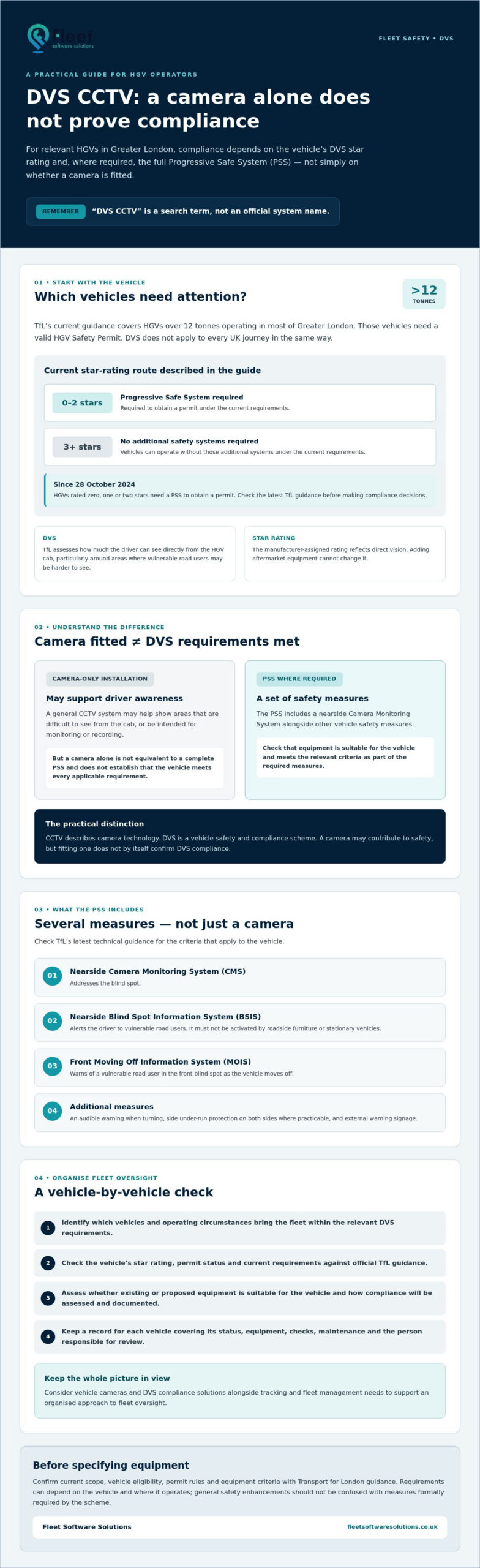
This guide explains how DVS relates to vehicle cameras, what to check before installing or replacing equipment, and how to organise fleet monitoring. The camera is only one part of the picture: under current requirements, HGVs rated zero, one or two stars need the Progressive Safe System, whilst vehicles rated three stars or above can operate without those additional systems. Check the latest Transport for London guidance before making compliance decisions.
Key Takeaways
- Identify which vehicles and operating circumstances bring your fleet within the relevant DVS requirements, then check the latest details against official guidance.
- Use dvs cctv as a starting point for assessing camera provision, not as proof that a vehicle meets every applicable requirement.
- Before choosing equipment, check its suitability for the vehicle and how compliance will be assessed and documented.
- Keep a record for each vehicle covering its status, equipment, checks, maintenance and the person responsible for review.
- Consider vehicle cameras and DVS compliance solutions alongside tracking and fleet management needs to support an organised approach to fleet oversight.
What does DVS CCTV mean for a commercial fleet?
“DVS CCTV” is commonly used to describe camera equipment considered in relation to the Direct Vision Standard, but it isn’t the official name for a standalone system. DVS is a vehicle safety and compliance scheme; CCTV describes camera technology. A camera may support driver awareness, but fitting one doesn’t establish that a vehicle meets the scheme’s requirements.
What is the Direct Vision Standard?
Transport for London (TfL) uses DVS to assess how much a driver can see directly from an HGV cab, particularly around areas where vulnerable road users may be harder to see. The manufacturer-assigned star rating reflects direct vision and can’t be changed by adding aftermarket equipment. For a neutral introduction to its background and rating approach, see the Direct Vision Standard (DVS).
The scheme doesn’t apply to every UK journey in the same way. TfL’s current guidance covers HGVs over 12 tonnes operating in most of Greater London, where those vehicles need a valid HGV Safety Permit. Since 28 October 2024, vehicles rated zero, one or two stars need a Progressive Safe System (PSS) to obtain a permit; vehicles rated three stars or above can operate without those additional safety systems under the current requirements. Check TfL guidance for the latest scope, vehicle eligibility and permit rules before planning journeys or specifying equipment.
Why does CCTV appear in DVS searches?
Camera systems can show drivers areas that are difficult to see from the cab and contribute to wider fleet safety oversight. However, a camera-only installation isn’t equivalent to a complete PSS. Depending on the vehicle and applicable requirements, the PSS includes a nearside Camera Monitoring System alongside other measures, such as blind-spot detection, a front Moving Off Information System, audible turning warnings, side under-run protection where practicable, and external warning signage.
This distinction matters when comparing suppliers or reviewing equipment already fitted. A general CCTV system may be intended for monitoring or recording, but operators should check that proposed equipment meets the relevant vehicle-level requirements and works as part of the required safety measures. For a broader introduction to camera options, a fleet camera systems guide can help explain the technology; this section focuses on how cameras fit into DVS compliance.
In practical terms, DVS compliance depends on the vehicle’s rating, operating circumstances, permit status and any required safety systems. “DVS CCTV” is a useful search term, but it shouldn’t be treated as proof that fitting a camera alone makes a fleet compliant.
Which DVS requirements and vehicle safety systems should operators check?
Start with the vehicle’s circumstances, not a supplier’s product label. Applicable DVS requirements depend on factors such as the vehicle and where it operates. Before specifying equipment or relying on an existing system, confirm current eligibility, permit rules and equipment criteria against Transport for London (TfL) guidance. General safety enhancements may be useful, but don’t confuse them with measures formally required by the scheme.
How the Progressive Safe System fits into DVS
The Progressive Safe System (PSS) is TfL’s term for a set of safety measures required for certain HGVs under the scheme. It isn’t the name of a camera product or a general label for any equipment package. Under current requirements, HGVs rated zero, one or two stars need a PSS for a permit to operate in Greater London. Check TfL’s latest technical guidance for the criteria applying to the vehicle.
The PSS includes several distinct measures, not just a camera:
- A nearside Camera Monitoring System (CMS) to address the blind spot.
- A nearside Blind Spot Information System (BSIS) that alerts the driver to vulnerable road users and isn’t activated by roadside furniture or stationary vehicles.
- A front Moving Off Information System (MOIS) to warn of a vulnerable road user in the front blind spot as the vehicle moves off.
- An audible warning when the vehicle is turning, side under-run protection on both sides where practicable, and external warning signage.
For an industry perspective on DVS changes and their implications for hauliers, consult the RHA DVS guidance for operators, alongside TfL’s official requirements.
What role can cameras and sensors play?
A camera can show the driver an area that may be difficult to see directly, while a detection system identifies a potential hazard and alerts the driver. These functions aren’t interchangeable: recorded footage, a live camera view and a sensor-based warning serve different purposes. A system’s label, or a supplier’s description of it as “DVS CCTV”, doesn’t confirm that it meets the required specification.
Before relying on equipment for compliance, verify the vehicle’s star rating and operating eligibility, its permit status, the function and position of each required system, relevant performance criteria, and evidence that the complete vehicle setup meets current TfL guidance. Fleet operators considering vehicle cameras or DVS compliance solutions can review commercial fleet camera and compliance support as part of their equipment assessment.
DVS CCTV versus a camera-only installation: what is the difference?
A camera fitted to a vehicle may improve visibility, but its presence alone doesn’t establish DVS compliance. The distinction is between installing one piece of equipment and assessing the complete vehicle against the requirements for its rating and operating circumstances. Assess the required systems together rather than treating “DVS CCTV” as a pass-or-fail product label.
What CCTV can and cannot demonstrate
Depending on its function, a camera may provide a live view of an area that’s difficult to see directly or footage for later review. Neither function, by itself, confirms that all applicable safety measures are present, correctly installed and working as intended. For example, recorded footage doesn’t show whether a separate detection system or audible warning operates as required.
For fleet oversight, keep a clear record for each vehicle of the equipment fitted, installation details, checks, reported faults and maintenance actions. These records help managers spot gaps and follow up issues. Treat them as operational evidence, not a substitute for checking current official requirements.
How to compare DVS CCTV options
Ask suppliers for a written explanation that relates their proposal to the specific vehicle and applicable requirements. Check the intended coverage, how information is presented to the driver, whether the system provides live visibility, recording or detection, and how faults and maintenance are handled. Don’t assume two systems perform the same role just because both are described as vehicle cameras.
| Area | Camera-only installation | Vehicle-level compliance approach |
|---|---|---|
| Purpose | Provides a camera function, such as a live view or recording, depending on the equipment. | Assesses the vehicle against the requirements that apply to its rating and operation. |
| Evidence to check | Confirm the camera’s coverage and documented capabilities. | Review vehicle rating, permit position, required equipment, installation details and relevant checks. |
| Operational responsibility | Assign someone to check operation and report faults. | Allocate an owner to maintain the vehicle record and coordinate reviews across the required systems. |
| Limitation | Camera presence doesn’t prove that other requirements are met. | Needs ongoing oversight; a one-off assessment doesn’t remove the need to monitor equipment condition. |
For wider fleet oversight, operators can also consult a business vehicle tracking guide and consider how tracking information may sit alongside camera and compliance records. Document what each system does, then check the full vehicle setup against current official guidance rather than relying on a supplier label.
How to assess and manage DVS CCTV across your fleet
A repeatable review process turns DVS checks from a one-off equipment decision into manageable fleet oversight. Assign someone to coordinate the work, keep a record for each vehicle and confirm current requirements with Transport for London (TfL) before making compliance decisions.
A practical fleet review checklist
Review vehicles in stages. Record decisions and outstanding actions so you can prioritise according to planned use and unresolved issues.
- 1. Identify vehicles to review. List HGVs that may fall within the scheme, then check scope, eligibility and permit requirements against current TfL guidance.
- 2. Record each vehicle’s position. Note its rating and permit status, where relevant, as well as its intended operating area and use. Verify details instead of relying on assumptions or old records.
- 3. Audit existing equipment. Record safety systems, their condition, available installation or commissioning documents, and any known faults. Compare the vehicle’s setup with its current requirements.
- 4. Prioritise and assign actions. Identify gaps and allocate a responsible person and next step. Consider planned journeys and operational exposure when deciding what needs attention first.
- 5. Verify, document and review. Check the proposed setup against official guidance, retain relevant evidence and revisit the record when equipment, vehicle use or requirements change.
Installation, driver training and ongoing checks
Before installation, ask the supplier to confirm in writing that the proposed equipment is compatible with the specific vehicle and explain how it supports the applicable requirements. Agree who is responsible for installation and what evidence will be provided after commissioning. A product description or invoice isn’t confirmation that the full vehicle setup meets the rules.
Brief drivers on how to use the systems, what they can and can’t show, and how to report faults. Clear reporting routes help managers identify issues and follow up unresolved problems. Consistent procedures also make it easier to record checks.
Set a review schedule that suits your fleet’s operations. Include checks of equipment condition and records, follow-up of reported faults, and a process for reviewing changes to TfL guidance or a vehicle’s use. Recheck the position when vehicles are transferred between depots or assigned different work, since their operating circumstances may change.
A simple record for each vehicle should capture its status, equipment, checks, maintenance actions and responsible owner. If you’re assessing dvs cctv or broader fleet requirements, explore DVS compliance solutions for your fleet as part of your review.
How Fleet Software Solutions can support DVS CCTV oversight
Managing DVS requirements across a fleet involves more than selecting camera equipment. Operators need to identify which vehicles may be in scope, determine what systems each one requires, and make responsibility for checks and follow-up clear. Fleet Software Solutions supplies vehicle cameras and DVS compliance solutions for commercial fleets, alongside vehicle tracking and fleet management software. These options can be considered as part of a wider approach to vehicle safety and fleet operations.
These services can be considered together, but their suitability depends on the vehicles and the operator’s requirements. Camera provision, tracking or software doesn’t automatically confirm compliance. Assess each vehicle against current official guidance and establish what remains your organisation’s responsibility.
When integrated fleet support may be useful
A consistent approach can help when a fleet has multiple vehicles, different operating patterns or compliance tasks shared across several people. Including vehicle camera and DVS considerations in wider fleet planning may help teams organise vehicle information and agree who will follow up outstanding actions. The extent to which systems work together depends on the specific solution, so confirm this with the provider rather than assuming integration or particular reporting functions.
Operators can also consider camera provision alongside tracking and fleet management needs. Cameras relate to vehicle visibility and safety oversight, whilst tracking and fleet management software support wider fleet operations. Clarify the purpose of each to avoid expecting one system to meet every need.
What to prepare before speaking with a provider
A focused discussion is easier when you have a clear picture of the fleet. Gather:
- Vehicle types, relevant ratings and the journeys or operating patterns to assess.
- Existing camera and safety equipment, including available installation or check records.
- Known faults, outstanding compliance questions and the person responsible for each vehicle.
- Your requirements for vehicle cameras, DVS compliance support, tracking or fleet management software.
Ask how a proposed solution relates to the requirements for each vehicle, what evidence or documentation is available, and which checks and ongoing responsibilities remain with your organisation. Confirm technical details with the provider and verify current scheme requirements through official guidance. This keeps supplier discussions grounded in your fleet’s circumstances without treating a product description as proof of compliance.
If you’re ready to discuss your fleet’s needs, discuss your fleet’s DVS CCTV requirements with Fleet Software Solutions. A vehicle-specific conversation can help you assess the options, but compliance decisions should still be checked against current official requirements.
Build a clearer compliance process for your fleet
The practical takeaway is straightforward: treat dvs cctv as part of a wider, vehicle-level compliance review, not as a camera purchase that settles the question. Use current official guidance to confirm which requirements apply to each vehicle, then keep clear records of equipment, checks, outstanding actions and responsibility.
A consistent review process can make fleet oversight more manageable, particularly when vehicles have different operating patterns or several people share compliance tasks. Cameras may contribute to safety oversight, whilst vehicle tracking and fleet management software can support wider operational needs. Assess each system’s role separately and confirm its capabilities before choosing a solution.
Fleet Software Solutions provides vehicle cameras and DVS compliance solutions, alongside vehicle tracking and fleet management software for commercial fleets. To discuss your next steps, discuss your fleet’s DVS CCTV requirements and the vehicle-specific questions you need to resolve. A clear assessment and practical record-keeping process can help you manage fleet compliance with confidence.
Frequently Asked Questions
What does DVS CCTV mean?
“DVS CCTV” is a commonly used search phrase for vehicle camera systems considered in relation to the Direct Vision Standard. DVS is Transport for London’s HGV safety and compliance scheme, whilst CCTV refers to camera technology. The phrase isn’t an official name for a standalone system, so check what equipment is being offered and whether it addresses the requirements for the specific vehicle.
Does CCTV alone make an HGV DVS compliant?
No. Fitting a camera alone doesn’t establish that an HGV meets the requirements that apply to it. Compliance depends on factors including the vehicle’s star rating, operating circumstances, permit position and, where required, the complete Progressive Safe System. Check current Transport for London guidance and keep vehicle-specific records of equipment, installation and checks. Don’t rely on a product label or camera footage as proof that every requirement has been met.
Which vehicles need to meet DVS requirements?
The current scheme applies to HGVs over 12 tonnes gross vehicle weight operating in most of Greater London. Those vehicles need a valid HGV Safety Permit to operate within the scheme area. DVS doesn’t apply identically to every UK journey or vehicle category. Before planning operations, confirm the vehicle’s eligibility, route and permit requirements against the latest Transport for London guidance.
What is the Progressive Safe System for DVS?
The Progressive Safe System (PSS) is a set of safety measures required for certain HGVs under the DVS scheme, not a camera product. Under current requirements, HGVs rated zero, one or two stars need a PSS for a permit. Measures include a nearside camera monitoring system, blind-spot and moving-off detection, an audible turning warning, side under-run protection where practicable, and external warning signage. Verify current technical specifications with Transport for London.
Do DVS cameras need to record footage?
Don’t assume recording is required simply because a camera forms part of a DVS-related system. A camera monitoring system may provide the driver with a view of a blind spot, whilst recording footage is a separate function. Check the latest Transport for London technical specification for the applicable vehicle and system before choosing equipment. Ask the supplier to explain what the camera does and provide written details relevant to the vehicle’s requirements.
How can a fleet operator check DVS CCTV compliance?
Start by identifying vehicles that may be in scope, then confirm each vehicle’s star rating, operating circumstances and permit status. Record fitted equipment, installation details, checks, known faults, maintenance actions and the person responsible. Compare the complete vehicle setup with current Transport for London requirements and follow up any gaps before relying on it. A camera’s presence alone doesn’t prove compliance, so retain relevant evidence and review records when vehicle use or equipment changes.
Can fleet management software help with DVS oversight?
Fleet management software may help operators organise wider fleet information and responsibilities, but its specific capabilities depend on the solution. Don’t assume it connects directly to cameras, monitors safety systems or confirms DVS compliance unless the provider verifies those functions. Fleet Software Solutions offers fleet management software, vehicle cameras and DVS compliance solutions for commercial fleets, alongside vehicle tracking. Confirm how each option fits your needs and verify compliance against official guidance.