

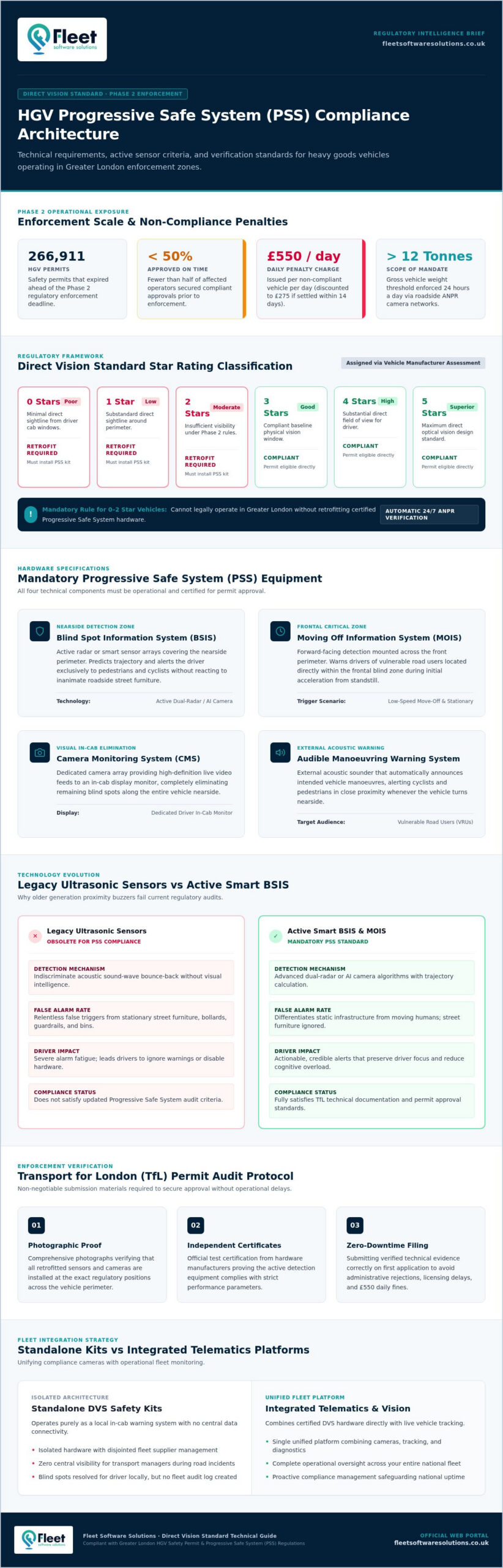
When 266,911 HGV safety permits expired ahead of Phase 2 enforcement, fewer than half secured their approvals on time, exposing operators to daily fines of up to £550. For transport managers overseeing busy commercial fleets, sourcing dependable direct vision standard compliance solutions has become a pressing priority. You’re likely all too familiar with the frustration of low-grade proximity sensors that trigger relentless false alarms at street furniture, leaving drivers exhausted whilst your team wrestles with convoluted Progressive Safe System documentation rules.
Securing your safety permits shouldn’t mean compromising driver focus or juggling disjointed hardware from multiple disconnected suppliers. In this guide, you’ll discover how to select, specify, and install certified safety systems that secure effortless permit approvals whilst dramatically reducing false alerts. We examine the mandatory technical specifications for active sensor systems, explain the required photographic evidence, and demonstrate how integrating compliance cameras with live vehicle tracking delivers complete operational oversight across your entire fleet.
Key Takeaways
- Clarify the regulatory criteria governing zero-to-two-star HGVs and how updated Progressive Safe System requirements dictate safety equipment selection.
- Identify certified direct vision standard compliance solutions that satisfy strict documentation rules whilst eliminating false alerts that cause driver fatigue.
- Examine the critical operational mechanics of active Blind Spot Information Systems (BSIS) and front-mounted Moving Off Information Systems (MOIS).
- Uncover why unifying safety cameras with live vehicle tracking delivers greater long-term visibility than isolated, standalone warning systems.
- Follow a structured five-stage procurement framework to evaluate accredited engineers, streamline fleet installation, and safeguard national operational uptime.
Evaluating Direct Vision Standard Compliance Solutions: Regulations and Equipment Criteria
Operating heavy commercial transport across urban environments demands rigorous attention to road safety legislation. The Direct Vision Standard was introduced to dramatically reduce fatal collisions involving vulnerable road users by targeting the physical sightlines of heavy goods vehicles. Fleet operators who fail to equip their fleets with certified direct vision standard compliance solutions face severe financial penalties, including daily Penalty Charge Notices of up to £550 per vehicle, reduced to £275 if settled within 14 days. Understanding these evolving regulatory requirements ensures uninterrupted fleet operations and shields your business from costly enforcement disruption.
The Direct Vision Standard Regulatory Framework for Heavy Goods Vehicles
The standard applies to all commercial vehicles exceeding 12 tonnes gross vehicle weight entering designated enforcement zones. Monitored 24 hours a day via Automatic Number Plate Recognition cameras, compliance hinges on a star rating assigned by the vehicle manufacturer. This rating measures the volume of space a driver can see directly through cab windows, graded on a scale from zero stars (poor visibility) to five stars (excellent visibility). Vehicles rated zero, one, or two stars cannot legally operate without retrofitting a Progressive Safe System to qualify for a mandatory HGV Safety Permit.
Mandatory Equipment Criteria Under Progressive Safe System Rules
Meeting the current Progressive Safe System criteria represents a major technological leap from legacy regulations. Earlier rules permitted passive ultrasonic proximity sensors that sounded alerts indiscriminately, bombarding drivers with false alarms whenever they passed traffic islands or roadside bollards. Under current standards, compliance demands active, intelligent safety equipment that differentiates stationary infrastructure from moving people.
To successfully specify direct vision standard compliance solutions that satisfy strict permit audits, operators must incorporate several certified components:
- Nearside Camera Monitoring Systems (CMS): Dedicated camera arrays that completely eliminate the remaining nearside blind spot, providing clear visual feeds to in-cab displays.
- Blind Spot Information Systems (BSIS): Active radar or smart sensors covering the vehicle’s nearside that alert the driver to pedestrians and cyclists without reacting to inanimate street furniture.
- Moving Off Information Systems (MOIS): Forward-facing detection fitted across the front perimeter to warn drivers of vulnerable road users within the critical frontal blind zone during initial acceleration.
- Audible Manoeuvring Warnings: External acoustic alerts informing cyclists and pedestrians when the vehicle executes a turn.
Transport for London requires comprehensive photographic evidence demonstrating that all retrofitted equipment meets exact positioning rules before issuing permits. Independent test certificates from reputable hardware manufacturers are non-negotiable; submitting compliant technical proof on the first application prevents administrative rejections and costly vehicle downtime.
Progressive Safe System Specifications: Essential DVS Safety Equipment Breakdown
Selecting robust direct vision standard compliance solutions requires an understanding of how individual safety components operate in dense urban conditions. Simple warning beepers no longer meet regulatory thresholds. Modern hardware must intelligently interpret roadside risks, giving drivers reliable insight without contributing to cognitive overload.
Active Blind Spot Information Systems (BSIS) vs Ultrasonic Proximity Sensors
Legacy ultrasonic sensors calculate distance purely through sound-wave bounce-back, which means they routinely register guardrails, refuse bins, and parked vehicles as road hazards. This flood of false warnings induces alarm fatigue, prompting drivers to ignore warnings or deactivate systems altogether. Active BSIS technology uses advanced dual-radar or artificial intelligence cameras positioned along the nearside perimeter. These systems calculate trajectory, differentiating between static road furniture and moving pedestrians or cyclists across the entire length of the rigid vehicle or articulated trailer combination.
Moving Off Information Systems (MOIS) and Front Blind Spot Mitigation
Frontal collisions often happen when an HGV pulls away from traffic lights where pedestrians have stepped into the low cab blind spot. MOIS hardware continuously sweeps a critical zone spanning up to two metres directly ahead of the front bumper. If a vulnerable road user enters this zone whilst the vehicle is stationary, the system illuminates a non-intrusive dashboard icon. If the driver begins to accelerate or release the handbrake while the person remains in danger, the system instantly escalates to an urgent audible tone, giving the driver immediate cause to brake.
Audible Alarms, Camera Monitoring Systems, and Side Underrun Protection
A comprehensive Progressive Safe System also incorporates clear exterior signals and enhanced indirect vision:
- Acoustic Turning Alarms: External sounders that emit spoken-word or tonal directional warnings (such as “Vehicle turning left”) at volumes typically between 65 and 88 decibels, alerting surrounding traffic without disturbing residential areas at night.
- Digital Camera Monitoring Systems (CMS): In-cab screens mounted cleanly to the A-pillar to replace or augment traditional Class V and VI mirrors, presenting an uncompromised view in poor weather or low light.
- Side Underrun Protection: Fitted physical sideguards that stop pedestrians and cyclists from being drawn beneath the chassis wheels during turning manoeuvres.
Transport managers reviewing industry guidance like the Road Haulage Association’s Progressive Safe System FAQs will recognise the importance of precise sensor calibration. Working alongside a specialist provider of direct vision standard compliance solutions ensures every component is calibrated accurately for your chassis specifications, protecting both your drivers and road users.
Comparing Standalone DVS Kits vs Integrated Telematics Platforms
Fleet operators face a clear choice: treat compliance as an isolated retrofitting task with budget bolt-on kits, or deploy connected safety architecture. While standalone hardware satisfies the basic statutory thresholds set out under Transport for London’s Direct Vision Standard, it operates in total isolation. By contrast, advanced direct vision standard compliance solutions feed sensor and camera intelligence directly into central fleet management networks, transforming a mandatory safety exercise into a strategic operational advantage.
| Operational Metric | Standalone DVS Kits | Integrated Telematics Platforms |
|---|---|---|
| Data Visibility | In-cab alerts only; zero back-office reporting. | Live alerts, centralised telemetry, and cloud video retrieval. |
| Driver Environment | Multiple aftermarket screens creating cab clutter. | Single unified display consolidating sensor views. |
| System Maintenance | Manual physical checks; undetected sensor failure risk. | Automated remote diagnostics identifying sensor faults instantly. |
| Fleet Scalability | Fragmented warranties across disparate vendors. | Unified national support across cameras and tracking hardware. |
Operational Limitations of Disconnected Standalone Hardware
Isolated hardware creates ongoing friction across commercial workshops. Because standalone proximity sensors and blind-spot monitors lack cellular connectivity, transport managers cannot verify system health remotely. When road grime, heavy salt spray, or physical damage obstructs a nearside radar, the fault goes undetected until a driver reports it or an incident occurs. Managing separate vendor agreements and disparate equipment warranties places an unnecessary administrative burden on procurement teams, while isolated buzzers fail to capture warning data that could otherwise inform targeted driver coaching.
Strategic Benefits of Combining DVS Safety Equipment with Fleet Telematics
Unifying vehicle cameras and active side-detection sensors with business vehicle tracking bridges the gap between passive safety and commercial oversight. Intelligent diagnostic software continuously monitors equipment health, immediately alerting maintenance controllers if a camera connection drops or a radar sensor goes offline.
When nearside sensors detect vulnerable road users during tight turning manoeuvres, paired video telematics automatically bookmarks the time-stamped incident footage. This rich context protects hauliers against third-party liability disputes and fraudulent insurance claims. Rather than burdening drivers with a patchwork of competing dashboard monitors, integrated direct vision standard compliance solutions deliver streamlined, defensible risk management across the entire commercial fleet.
Procurement and Implementation Guide: Selecting DVS Compliance Solutions
Executing a smooth rollout requires a structured procurement strategy that avoids taking vehicles off the road during peak trading cycles. When specifying direct vision standard compliance solutions, transport managers should coordinate installations alongside routine six-weekly preventative maintenance inspections. This methodical approach safeguards operational uptime whilst ensuring every asset receives certified safety equipment without disrupting daily delivery schedules.
Fleet Auditing and Vehicle Star Rating Verification
Begin by compiling Vehicle Identification Numbers across your commercial fleet to verify direct vision ratings directly with each chassis manufacturer. Group your assets into those with three-to-five-star ratings, which qualify for straightforward permit applications, and those with zero-to-two-star ratings requiring hardware upgrades. Remember to evaluate specialist bodywork, tractor unit dimensions, and drawbar combinations, as custom chassis build-outs often require tailored sensor brackets to maintain correct operational angles.
Supplier Due Diligence and Sensor Performance Benchmarking
Long-term fleet reliability hinges on component build quality. Always request verifiable test certificates from technology providers demonstrating that active radar and camera systems meet UNECE Regulation 151 and 159 performance benchmarks. Hardware must carry high ingress protection ratings to withstand high-pressure washing, road grime, and winter salt spray. Crucially, confirm that your chosen provider operates an accredited nationwide engineering network able to support your vehicles across the United Kingdom without lengthy dispatch delays.
Installation Best Practice and Safety Permit Application Procedures
Diligent installation ensures your permit application succeeds on the first submission. Certified technicians must position sensors at precise heights and angles to prevent chassis interference, false ground reflections, or unmonitored blind zones. Once equipment is fitted, operators must compile an exact photographic audit trail:
- Clear photos of the front-mounted detection sensors and nearside camera equipment.
- Images showing fitted side under-run protection, audible alarm sounders, and external warning signage.
- Broad contextual images displaying the vehicle registration plate alongside the newly installed equipment.
Submitting complete photographic evidence alongside manufacturer compliance declarations prevents administrative rejections. To simplify technical audits and protect your vehicles from regulatory disruption, partner with Fleet Software Solutions for certified DVS compliance to organise your fleet rollout seamlessly.
Deploying Certified DVS Compliance Solutions with Fleet Software Solutions
Meeting technical mandates shouldn’t distract your team from daily transport logistics. Fleet Software Solutions acts as a dependable, consultative technology partner for commercial fleets across the United Kingdom. By pairing certified direct vision standard compliance solutions with advanced fleet management software, we assist transport managers in eliminating dangerous blind spots, securing swift permit approvals, and protecting operating margins without adding administrative complexity.
Robust Hardware Engineered for Demanding Commercial Operations
Long-distance haulage exposes electronic safety systems to severe operational stress. Our certified hardware includes type-approved active radar, intelligent AI vision sensors, and high-definition in-cab monitors engineered to withstand high-mileage commercial duty cycles. Built with heavy-duty wiring looms and ruggedised enclosures sealed against weather and road spray, this equipment provides dependable performance day after day. Investing in robust hardware ensures your vehicles stay compliant as UK transport safety rules evolve.
Seamless Integration into Centralised Fleet Management Systems
Compliance works best when it isn’t treated as an isolated function. Rather than forcing drivers to monitor disconnected cabin alarms, our direct vision standard compliance solutions feed active sensor data directly into your central vehicle tracking portal. Fleet managers gain real-time visibility over nearside blind-spot alerts alongside continuous vehicle tracking, plant and machinery tracking, and high-definition vehicle camera feeds.
Automated reporting confirms whether every asset entering regulated areas carries a verified permit. By centralising video telematics alongside proximity alerts, transport controllers gain clear, objective records to guide driver development, resolve liability disputes, and lower collision risks across national routes.
Comprehensive Installation Support Across the United Kingdom
Rolling out hardware updates across multi-depot operations demands disciplined coordination. Our certified engineering network provides national installation capability across the United Kingdom, aligning retrofits with your routine vehicle inspections to avoid costly downtime. We compile complete photographic packs and manufacturer declarations to accelerate approval workflows. Explore DVS compliance solutions with Fleet Software Solutions to audit your fleet and secure lasting regulatory compliance today.
Strengthen Fleet Safety and Secure Lasting Permit Compliance
Upgrading your commercial vehicles to meet stringent safety criteria shouldn’t feel like an uphill struggle against technical ambiguity. By specifying fully certified systems that comply with strict Progressive Safe System standards, transport operators eliminate frustrating sensor false alarms and safeguard their businesses against disruptive enforcement penalties. Moving beyond isolated warning kits to a unified platform that connects high-definition vehicle cameras, live vehicle tracking, and compliance management delivers lasting oversight that protects your drivers and bottom line.
Coordinating retrofits across busy multi-depot operations is seamless when backed by an accredited nationwide mobile installation network, keeping fleet downtime to an absolute minimum during scheduled maintenance. With comprehensive photographic evidence packs and type-approved hardware in place, securing your HGV safety permits becomes an efficient, repeatable process. Take control of your transport operations today: equip your fleet with certified direct vision standard compliance solutions from Fleet Software Solutions and keep every vehicle operating safely, efficiently, and compliantly across the United Kingdom.
Frequently Asked Questions
Which commercial vehicles are required to fit DVS safety equipment?
All heavy goods vehicles over 12 tonnes gross vehicle weight entering designated enforcement zones must hold an HGV Safety Permit. Vehicles rated zero, one, or two stars under manufacturer direct vision assessments cannot obtain this permit without retrofitting certified equipment. While vehicles achieving three stars or higher satisfy vision thresholds without retrofitting, operators must still apply for electronic permits to operate legally across controlled areas.
How does the Progressive Safe System differ from original DVS requirements?
The Progressive Safe System replaced previous baseline standards with stricter technological requirements. While earlier rules accepted passive ultrasonic sensors and basic blind-spot mirrors, current mandates demand active detection technology. Vehicles rated below three stars must now feature intelligent Blind Spot Information Systems, front-mounted Moving Off Information Systems, and Camera Monitoring Systems that actively identify vulnerable road users rather than sounding indiscriminate alarms at inanimate road furniture.
Can traditional ultrasonic side sensors still be used for compliance?
No, traditional ultrasonic side sensors don’t meet the technical criteria established under current rules. Ultrasonic devices lack the processing intelligence to distinguish people from stationary infrastructure like lamp posts or road cones, causing frequent false alarms. Transport operators must install certified direct vision standard compliance solutions featuring active dual-radar or artificial intelligence cameras that accurately detect moving pedestrians and cyclists across the entire nearside.
What documentation is required to submit a successful HGV safety permit application?
Operators must provide comprehensive photographic evidence and verified technical documentation when applying for a safety permit. Submissions require clear images showing fitted nearside cameras, sensor placement, in-cab monitors, external warning alarms, and side under-run protection, alongside the vehicle registration plate. You must also supply a formal manufacturer statement of compliance confirming that retrofitted hardware meets official UNECE Regulation 151 and 159 test protocols.
What are the penalties for operating non-compliant HGVs in regulated zones?
Vehicles entering enforcement zones without a valid HGV Safety Permit receive a Penalty Charge Notice of up to £550 per day. If settled within 14 days, this fine reduces to £275 per infringement. Because enforcement relies on automated number plate recognition systems operating 24 hours a day, non-compliant vehicles risk accumulating multiple penalties across consecutive working shifts, quickly generating severe overheads for fleet operators.
How long does it take to install a complete DVS compliance kit on a vehicle?
Professional installation of certified direct vision standard compliance solutions typically requires between three and five hours per vehicle, depending on chassis dimensions and custom bodywork. Experienced mobile engineers usually schedule retrofits during planned preventative maintenance inspections or off-shift periods. This approach ensures all sensors are properly calibrated and tested without removing active vehicles from frontline commercial routes or disrupting daily client deliveries.
Is an HGV safety permit required if a vehicle already holds a three-star rating?
Yes, every HGV over 12 tonnes must possess an electronic safety permit before entering regulated zones, regardless of star rating. While a three-star vehicle doesn’t require aftermarket progressive hardware retrofits to qualify, the permit doesn’t issue automatically. Fleet operators must complete the digital application process with the licensing authority to ensure their registration details are recognised across automated number plate recognition networks.