
What makes a mileage claim easier to substantiate: a software label, or a complete record of the journey behind it? For businesses collecting logs across employees and grey-fleet vehicles, manual processes can make that record time-consuming to gather, review and reconcile. Choosing HMRC compliant mileage tracking software is only part of the answer.
HMRC doesn’t certify specific mileage software. The quality of your records and the process for capturing and reviewing them matter more than a product label. This guide explains which details to record for each business journey, how those records support mileage claims and what to assess when comparing software.
Consistent mileage capture can also form part of wider fleet administration, helping employers manage business journeys across a mobile workforce. When comparing solutions, consider record quality, ease of use and how the process fits your organisation. Fleet Software Solutions provides mileage capture and grey-fleet management through centralised fleet software designed to streamline administrative tasks.
Key Takeaways
- Reliable mileage claims depend on consistent journey records and review processes, not simply the software’s label.
- Capture the details needed to understand each trip, and distinguish claim evidence from extra fields used for internal administration.
- Compare HMRC compliant mileage tracking software by record completeness, review steps, usability and fit with your business processes.
- A clear rollout, with responsibilities for submitting journeys and resolving gaps, can help make mileage capture more consistent across your workforce.
- Mileage capture and grey-fleet oversight can sit within broader fleet administration using centralised fleet software.
Why UK businesses need reliable mileage tracking software
Mileage tracking software helps capture and organise records of work-related journeys. For employers, it can provide a consistent way to collect mileage information, organise submissions for review and support the administration of business travel. The aim is not just to record distance, but to make each claim understandable in context.
That context matters when journeys are submitted by different people, teams or departments. If employees use different formats, managers may need to clarify trip purposes, check distances and reconcile claims before processing them. A shared digital process gives employees and reviewers a common approach, including when staff use their own vehicles for work.
Software supports record-keeping, but it cannot turn an inaccurate or incomplete claim into a compliant one. Employers still need procedures for submitting journey details and reviewing them. Mileage capture is also different from vehicle tracking: a vehicle tracking system monitors a vehicle’s location, while mileage administration documents work journeys and their purpose. For related guidance on employees’ own vehicles, see this grey fleet management guide.
Which businesses benefit from structured mileage capture?
Structured capture is particularly useful for employers whose staff make business journeys in personal vehicles, and for organisations handling claims across several employees or departments. A shared process sets clear expectations about what employees submit and how managers assess it, instead of leaving each team to develop its own approach.
Spreadsheets can be easy to start with, but different templates, naming conventions and review habits can make records difficult to compare. One department might request a clear business purpose, while another records only a destination. A consistent process reduces these differences and gives reviewers a predictable basis for identifying missing information. It also fits within wider grey-fleet management, where business oversight extends beyond company-owned vehicles.
Mileage reimbursement and tax relief are not interchangeable
HMRC distinguishes between payments employers make and tax relief employees may be able to claim. Mileage Allowance Payments (MAPs) are payments an employer makes to an employee for qualifying business travel in their own vehicle. Mileage Allowance Relief (MAR) is tax relief an employee may be able to claim in certain circumstances when the employer’s payment is below the applicable approved amount, or no payment is made. The rules and eligibility depend on individual circumstances.
These terms describe different things: one concerns employer reimbursement, the other an employee’s possible tax relief. A journey record alone does not establish eligibility or determine the correct tax treatment. Employers and employees should consult current HMRC guidance on vehicles used for work for the rules that apply to their circumstances. Keeping reimbursement records separate from any individual relief claim can also help prevent confusion during review.
What HMRC mileage records need to support
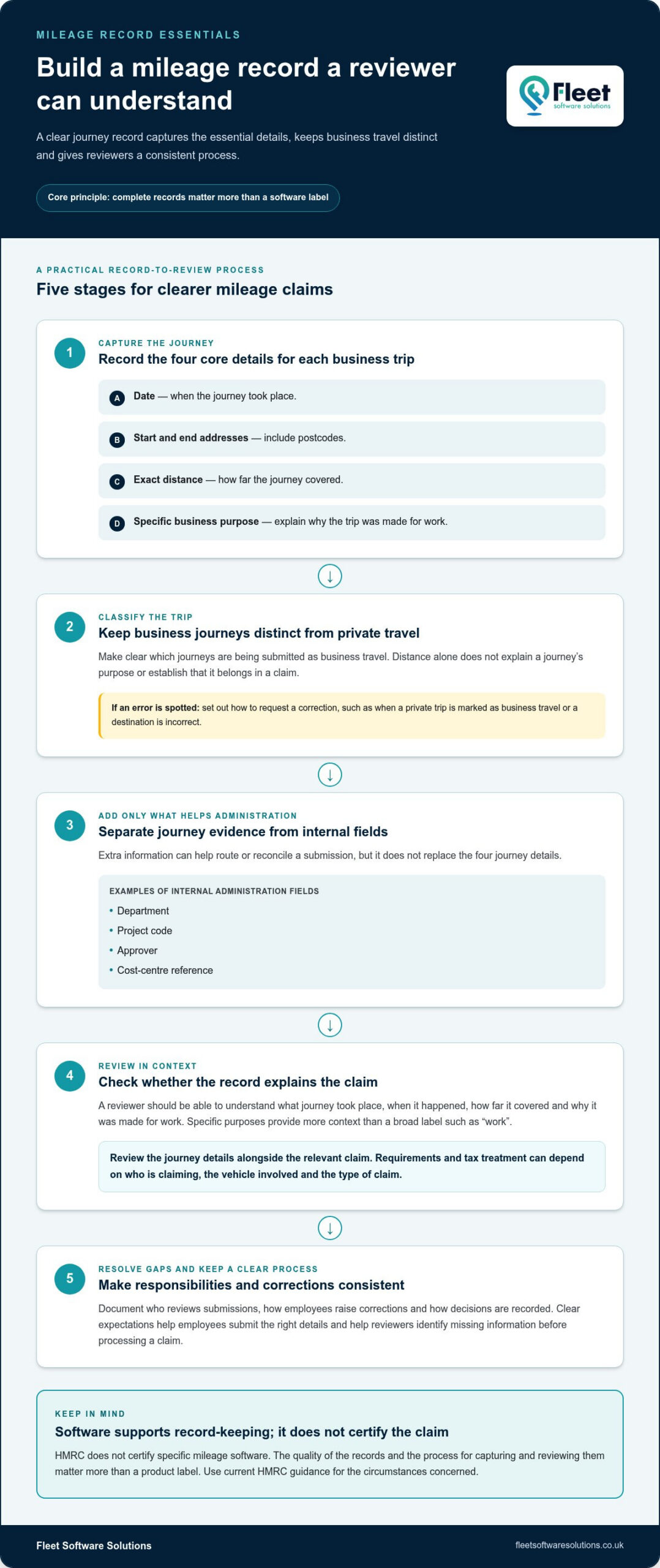
A mileage record should allow a reviewer to understand what journey took place, when it happened, how far it covered and why it was made for work. HMRC’s current guidance identifies these details for each business trip:
- The date of the journey.
- The start and end addresses, including postcodes.
- The exact distance travelled.
- A clear, specific business purpose.
These details provide evidence to assess alongside the relevant claim. A software label alone does not establish that a journey or claim meets the applicable rules. Requirements and tax treatment can depend on who is claiming, the vehicle involved and the type of claim, so use current HMRC guidance for the circumstances concerned.
Build a practical mileage record checklist
Use the HMRC record details as the core of your organisation’s checklist, then decide which additional fields will help with internal review. “Client meeting” gives more context than “work”; naming the meeting or business task can make the purpose clearer still. A specific description helps a reviewer understand why the journey was made, without relying on assumptions or follow-up questions.
Keep journey evidence distinct from information used to administer a claim. A department name, project code, approver or cost-centre reference may help route or reconcile a submission, but these internal fields do not replace the journey details above. Clear labels help employees understand what to provide and help reviewers spot missing information before processing a claim.
Keep business journeys distinct from private travel
Your claim process should make clear which journeys are being submitted as business travel and which are private. This distinction supports accurate review, particularly when an employee uses the same personal vehicle for work and personal journeys. Distance alone does not explain a journey’s business purpose or establish that it belongs in a claim.
Set out how employees should classify journeys and what to do if they spot an error, such as a private trip marked as business travel or an incorrect destination. Employees should know how to request a correction before the record is relied on. Document who reviews submissions, how corrections are raised and how decisions are recorded. This creates a consistent process without relying on any particular software function.
When assessing HMRC compliant mileage tracking software, focus on whether the process helps your organisation capture the necessary evidence consistently. Software can support the collection and organisation of records, but employees and employers remain responsible for the accuracy of submitted and reviewed information. HMRC does not certify specific mileage software, so assess the records and working practices rather than relying on a compliance claim in a product description.
For organisations bringing mileage capture into wider fleet administration, business mileage capture and fleet software can support a more consistent approach to managing journey records.
How to compare HMRC-compliant mileage tracking software
A useful comparison looks beyond advertised automation to the full process: what journey information employees provide, how managers review it and how exceptions are resolved. HMRC doesn’t certify specific mileage software, so a product label alone cannot establish that your organisation’s records or claims are compliant. Assess how well each solution could support your procedures and the records required for the claims you handle.
Use the same criteria for each option to compare practical fit across your organisation:
- Record completeness: Can employees provide the journey information your process requires, including the date, start and end points, distance and business purpose?
- Review steps: Is it clear who checks a submission, raises a query and approves it? Consider how your team would identify and resolve missing or inconsistent details.
- Employee usability: Can staff understand how to classify a journey and what to do if they spot an error? A process that is difficult to follow can lead to inconsistent submissions.
- Business administration: Can the process fit your review responsibilities and internal references, such as departments or project codes, without confusing those fields with journey evidence?
These criteria help distinguish advertised functions from the controls your organisation still needs. Automated capture may reduce some manual input, but it does not confirm that a journey was for business or that its record is accurate. Consider how the approach fits into wider fleet management, especially if mileage administration sits alongside other fleet responsibilities.
Assess records, review and administrative workflows
Map the journey of a claim before comparing systems. The employee submits it, a designated reviewer checks it, missing or unclear information is queried, and an authorised person makes the approval decision. Roles may differ by organisation, but everyone involved should understand their responsibilities.
Then consider how your process handles exceptions. If an employee enters an unclear business purpose or incorrect distance, decide who will contact them, how they should correct the record and how the reviewer will know the issue has been addressed. This process-based assessment sets realistic expectations and avoids assuming that a software feature will identify or resolve every issue.
Balance employee usability with privacy
Explain what journey information employees are expected to provide, why it is needed and how to distinguish work journeys from private travel. Clear expectations help staff submit relevant information and support a transparent review process.
Include privacy in your comparison from the outset. Assess who needs access to mileage information, how long records are kept under your retention approach and how employees are told about the handling of their data. Review your organisation’s responsibilities under UK GDPR and consult current Information Commissioner’s Office guidance when setting these arrangements. This provides a practical basis for comparing options without treating a software claim as proof of data protection compliance.
How to introduce mileage tracking software across your business
Successful implementation involves more than giving employees access to a new tool. Before launch, establish the policy, responsibilities and communication that will make mileage capture straightforward for staff and manageable for reviewers. A staged rollout gives your business an opportunity to spot confusion early and improve the process before it becomes routine.
Set policy and responsibilities before onboarding
Write down which journeys qualify under your organisation’s mileage policy, who reviews submissions and how employees can raise questions or request corrections. Check the policy against current HMRC guidance and your privacy obligations. Clear ownership helps prevent claims from sitting between teams, while transparent communication helps employees understand what journey information is collected and why.
- Review the existing policy. Confirm how the organisation defines eligible business journeys and how employees using personal vehicles should submit them. Align the written policy with current HMRC guidance and applicable privacy requirements before setting up the new process.
- Assign responsibilities. Identify the roles responsible for submitting journey records, reviewing them, asking for clarification and making approval decisions. Explain how queries and corrections should be raised so employees know where to turn and managers understand their responsibilities.
- Prepare employee guidance. Show staff how the process works, what information they need to provide and how to distinguish business travel from private journeys. Explain how personal-vehicle journey information will be handled, who can access it and where employees can ask questions.
- Introduce the process in stages. Start with a defined group or team, then review how submissions move from employee to reviewer. Note recurring questions, incomplete entries and unclear handovers. Use these observations to improve instructions before expanding the rollout.
- Review performance periodically. Check whether the process produces complete records and consistent decisions, and whether administrative effort is changing. Revisit procedures when business needs or official guidance changes, rather than assuming the initial setup will remain suitable indefinitely.
Measure whether the process is working
Choose measures your organisation can realistically track, such as missing journey details, records queried, time taken to process submissions and common reasons for corrections. These indicators can show where instructions or responsibilities need attention. Pair them with employee feedback about clarity, workload and ease of reporting, so improvements reflect both administrative needs and the staff experience.
Periodic checks should look beyond the volume of submissions. Compare how different teams apply the same policy, identify where exceptions take longer to resolve and confirm that employees still understand the process. Record procedural changes and communicate them clearly, particularly if they affect people using their own vehicles for work.
Reviewing these measures can help your business refine mileage administration over time. To support a more centralised approach to mileage capture and fleet processes, explore business fleet software solutions.
Manage business mileage with Fleet Software Solutions
Mileage administration connects closely with wider fleet oversight, particularly when employees use their own vehicles for work. Employers need a consistent way to organise business journey information alongside the responsibilities involved in managing a mobile workforce. Fleet Software Solutions provides mileage capture and grey-fleet management through centralised fleet software designed to streamline administrative tasks.
For organisations assessing HMRC compliant mileage tracking software, the practical question is how mileage capture fits the business’s records, review steps and responsibilities. No software label or platform can establish that an individual claim is accurate or meets HMRC rules. Your internal policy and review process remain important, and claims should be assessed against current guidance applicable to the claimant and journey.
Bring mileage capture into wider fleet administration
Business mileage does not always sit neatly within one team. Employees may travel for different departments, while managers need to understand who submits journey information and who oversees its review. A consistent process helps the organisation coordinate mileage administration instead of allowing separate teams to develop different practices.
Grey-fleet oversight adds another consideration: staff may use personal vehicles for work, so employers need processes that account for those journeys as part of wider fleet responsibilities. Fleet Software Solutions brings mileage capture and grey-fleet management within its fleet software offering. This provides a business-focused foundation for organising mileage administration, while recognising that software does not replace policy, review or employees’ responsibility to submit accurate information.
The value of a centralised approach depends on how it fits your organisation. Consider how your teams handle submissions, internal queries and oversight, then establish how mileage administration should work alongside other fleet activities. A clearly defined process can support consistent handling of records across a mobile workforce and give employees and reviewers shared expectations.
Choose a practical next step for your organisation
Bring together the questions raised throughout this guide. Which journey details must employees provide? Who reviews submissions and resolves exceptions? How will you distinguish business from private travel, communicate data handling and check the process against current HMRC and privacy guidance? Clear answers give your organisation a sound basis for assessing its requirements.
It can also help to identify where administration currently becomes difficult. Review whether departments request the same information, whether employees know how to correct an entry and how much time managers spend clarifying submissions. These observations can guide a practical discussion about mileage capture and grey-fleet oversight.
Fleet Software Solutions offers fleet management software that includes mileage capture and grey-fleet management, with centralised software designed to streamline administrative tasks. If you’re planning to improve how your organisation manages business mileage, discuss your fleet and mileage requirements with Fleet Software Solutions.
Make your next mileage decision with confidence
Before choosing a platform, bring together the people responsible for travel policy, claim review and fleet administration. Agree what a dependable process should look like for your organisation, where accountability sits and how you’ll revisit those decisions as needs change. This gives you a clearer basis for assessing HMRC compliant mileage tracking software than a feature list alone.
Fleet Software Solutions brings mileage capture and grey-fleet management into a centralised fleet software offering designed to streamline business administration. Consider how these services could fit your organisation’s approach to mobile-workforce oversight and mileage processes.
Explore Fleet Software Solutions’ mileage capture and fleet management options to take a considered next step towards more organised mileage administration.
Frequently Asked Questions
Is mileage tracking software enough to make a mileage claim HMRC compliant?
No. Mileage tracking software can help organise journey information, but it cannot make a claim compliant by itself. The claimant must provide accurate details, the journey must qualify under the relevant rules, and the treatment depends on their circumstances. A tool marketed as HMRC compliant mileage tracking software is not HMRC approval or a guarantee. Compare records with current HMRC guidance and follow your organisation’s mileage policy before submitting or approving a claim.
Can I claim business mileage for journeys between home and work?
Ordinary travel between home and a permanent workplace is generally treated as commuting, not business travel, but the position can depend on the facts, including the workplace and reason for the journey. A work-related trip from home to another location may need separate consideration. An employee’s tax-relief claim and an employer’s reimbursement are distinct processes. Check current HMRC guidance against your employment circumstances and the specific journey before including it.
How much can employees claim for business mileage?
There isn’t one amount that applies to every employee or claim. The outcome depends on whether the question concerns employer reimbursement or an employee’s possible tax relief, the vehicle and the applicable HMRC rules, which can change. Before calculating a payment or claim, check current official HMRC guidance and your employer’s mileage policy. Keep journey information available so the calculation can be reviewed on the right basis.
Do employees need to keep mileage records when using a company car?
Not necessarily for every purpose. A company-car journey may be recorded for an employer’s operational or expense procedures, while a particular tax process may have different evidence requirements. The answer depends on why the journey is being logged and the employee’s circumstances. Employers can set internal recording expectations even where a specific claim does not require the same log. Check current HMRC guidance and workplace policy for the situation.
Can employees claim mileage allowance for using their own car for work?
Possibly. An employee using their own car for work may receive a Mileage Allowance Payment from their employer, or may be able to consider Mileage Allowance Relief in relevant circumstances. These are different routes, and neither should be assumed to apply automatically. Record journeys accurately and distinguish employer reimbursement from a personal tax-relief claim. Check current HMRC guidance and your employer’s policy before submitting either.
What happens if a mileage log contains missing or incorrect journeys?
Missing or inaccurate entries can make a claim harder to assess and may prompt a reviewer to request clarification or correction. They do not determine a particular HMRC outcome by themselves. If you find an issue, amend the record transparently, retain available supporting information, such as work appointment details or route notes, and follow your employer’s correction process. If the claim has already been submitted, consult current HMRC guidance about appropriate next steps.
How should businesses address employee privacy when recording work journeys?
Explain the purpose and boundaries of mileage recording before employees start, including what information is collected, who can access it and how long it is kept. For example, clarify how the process treats personal journeys when staff use their own vehicles for work. Document a transparent, proportionate approach, then review it against current UK GDPR and Information Commissioner’s Office guidance. Appropriate arrangements depend on your organisation’s specific use of the data.