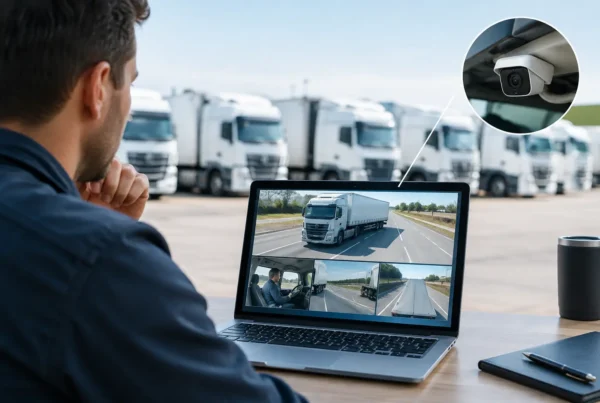

A fleet manager should not have to sift through hundreds of journeys to find one late arrival, one speeding concern or one vehicle that has spent half a day idling. The best telematics reports for managers turn live vehicle data into clear operational decisions: who needs support, where money is being lost and what action will improve tomorrow’s performance.
The most useful reporting is not necessarily the reporting with the most columns. It is the reporting that answers a specific business question quickly, reaches the right person automatically and provides enough context to act fairly. For a service fleet, that may mean proving attendance at a customer site. For a transport operation, it may mean identifying repeat drivers’ hours risks. For a business running vans, cars and grey fleet, it may mean reducing mileage claims and exposure on the road.
What makes a telematics report useful?
A report earns its place when it is linked to an outcome. Fuel reports should support lower consumption, not merely show litres used. Driver behaviour reports should lead to constructive coaching, not a monthly league table that drivers distrust. Compliance reports must highlight exceptions early enough for a manager to prevent a problem.
The right mix also depends on the operation. A national engineering business will want evidence of job attendance, utilisation and private-use controls. A fleet with high-value plant may focus on location, unauthorised movement and operating hours. A business with a small number of company vehicles may get more value from simple weekly exception reports than from a complex dashboard nobody has time to review.
Configurable reports and dashboards matter because management roles differ. An operations director needs trends and financial impact. A transport manager needs exceptions requiring intervention. A supervisor may only need a morning list of vehicles that have not moved, drivers with overdue checks or appointments likely to be missed.
The best telematics reports for managers
1. Driver behaviour and risk report
This is often the highest-value report because it brings together the behaviours that affect collisions, fuel use, wear and insurance costs. Depending on the device and configuration, it can flag speeding, harsh acceleration, harsh braking, sharp cornering, seat belt events and phone distraction where camera technology is in use.
The best version does not rely on a single score. It shows the frequency, severity, location and time of each event, allowing managers to distinguish an isolated incident from a pattern. A driver repeatedly braking harshly on the same approach to a customer site may be dealing with unrealistic scheduling or a poor route choice, rather than simply driving carelessly.
Use this report for regular, evidence-based driver conversations. Recognise improvement as well as addressing risk. When linked with video footage for serious events, it can also support a fair incident review and help defend drivers against unfounded claims.
2. Idling and fuel waste report
Idling is a familiar cost that can hide in plain sight. A vehicle left running outside a depot, during a break or at a job site uses fuel without moving the business forward. Across a large fleet, those minutes add up quickly.
A useful idling report identifies total idle time, fuel consumed while stationary and the vehicles or locations responsible. It should separate legitimate operational idling from avoidable behaviour where possible. Refrigerated vehicles, specialist machinery and vehicles operating auxiliary equipment may have a valid reason to run while stationary.
This distinction is essential. Setting an arbitrary idling target can create friction and lead to poor decisions. Instead, review recurring exceptions by vehicle type, location and driver, then agree practical actions such as revised depot procedures, clearer shut-down guidance or checks for equipment faults.
3. Vehicle utilisation report
Buying, leasing and maintaining vehicles that are underused ties up capital. Equally, a heavily used vehicle may be approaching an avoidable maintenance issue while similar vehicles sit idle elsewhere. A utilisation report gives managers a factual view of distance travelled, driving hours, engine hours, days used and periods of inactivity.
For a mobile workforce, this report can reveal whether vehicle allocation still reflects workload. It can support decisions to pool vehicles, redeploy assets between sites or adjust replacement plans. It also helps make the business case for additional capacity when the data shows that existing vehicles are consistently operating at their limit.
Avoid judging utilisation on mileage alone. A low-mileage vehicle may be essential for emergency response, specialist equipment or a remote area. The point is to challenge assumptions with data, not to remove capacity blindly.
4. Journey, route and customer attendance report
When a customer says an engineer did not arrive, or a delivery is disputed, managers need evidence without asking staff to reconstruct a day from memory. Journey reports show routes, start and finish times, stops, distance and time at location. Geofenced site reports can confirm arrival and departure at a customer address, depot or restricted area.
This reporting improves customer communication as much as internal accountability. A service desk can provide an accurate estimated arrival time, explain a delay with confidence and respond to queries using facts. It can also expose repeated route inefficiencies, excessive detours and jobs that are regularly scheduled with insufficient travel time.
Care is needed around privacy and policy. Drivers should understand what is monitored, when it is monitored and how the information will be used. Clear boundaries around private mileage are particularly important for take-home vehicles.
5. Speeding and speed limit exception report
Speeding reports are simple in principle but need careful configuration. A report that only records a vehicle exceeding a fixed threshold can miss risk on lower-speed roads. One that produces too many minor alerts can bury the events that deserve attention.
The most practical reports compare vehicle speed with mapped road speed limits, apply sensible tolerance rules and prioritise repeated or significant breaches. They should also show where and when the event happened. A speeding issue late in a shift may indicate fatigue, a tight schedule or a driver trying to make up lost time.
This report supports road-risk policy, driver training and insurance discussions. It is most effective when managers investigate the operational cause as well as the behaviour. A target that rewards unrealistic numbers of calls will undermine even the strongest safety message.
6. Maintenance, mileage and vehicle health report
Telematics can help teams move from reactive maintenance to planned intervention. Mileage and engine-hour reports support service scheduling, while compatible vehicle data can identify warning lights, diagnostic fault codes, battery voltage and other health indicators.
Managers can use these reports to identify vehicles nearing service intervals, unusually high mileage, excessive engine running or recurring faults. Acting early can reduce breakdown disruption, protect customer commitments and avoid the higher cost of a fault becoming more serious.
The report should feed a workable process. Someone needs ownership of the exception, a defined response and a record of action taken. Alerts without a maintenance workflow soon become background noise.
7. Drivers’ hours and working time report
For operators subject to drivers’ hours rules, this reporting is a compliance necessity rather than a management extra. It can highlight potential infringements, driving time, breaks, rest periods and working time exceptions, helping transport teams intervene before risk becomes entrenched.
It is equally useful for non-HGV mobile workforces where fatigue and long days are concerns. Journey duration, first movement, final movement and time spent at sites can reveal working patterns that deserve review. This is not a substitute for properly managed tachograph and legal compliance processes, but it provides valuable operational visibility.
8. Asset and plant movement report
Vehicles are not the only items that create cost and operational risk. Trailers, generators, small plant and specialist equipment can be expensive, difficult to locate and vulnerable to theft. An asset movement report records location, movement history, operating hours and unauthorised activity outside agreed times or geofenced areas.
For facilities and construction-related operations, this can reduce time spent searching for equipment and improve planning between sites. Alerts for unexpected movement can also give managers an early warning of theft or misuse. Battery-powered tracking options are particularly useful where a powered vehicle installation is not appropriate.
Turn reports into a management routine
Reports create value when they prompt a consistent response. Start with a small set of priorities – typically driver risk, idling, utilisation and maintenance – rather than distributing every available report to every manager. Set realistic thresholds, assign ownership and review whether the information is leading to a measurable change.
A weekly exception report is often more effective than a lengthy monthly pack. It gives managers time to speak with drivers, investigate routes, contact a workshop or adjust a schedule while the event is still relevant. Monthly reporting then becomes an opportunity to assess trends, savings and whether the interventions are working.
Fleet Software Solutions can tailor reporting, alerts and dashboards around the decisions your team needs to make, using compatible tracking and camera technology rather than forcing a one-size-fits-all system. The best report is the one that makes the next operational decision clearer – and gives managers the evidence to make it with confidence.