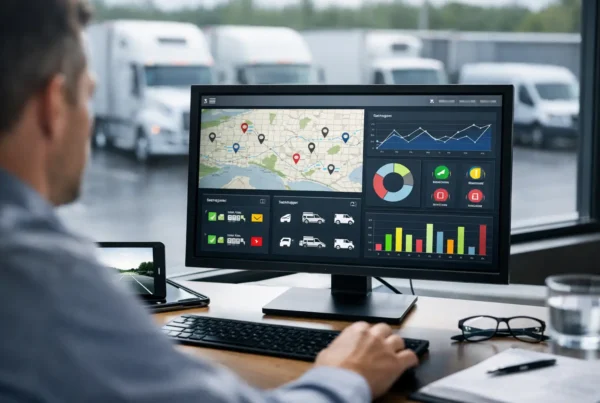

Mileage claims often look simple until someone has to check them. A driver forgets a few journeys, another rounds up distances, and finance ends up chasing missing details at month end. A business mileage capture app solves that problem properly when it records journeys accurately, reduces manual entry and gives managers a clearer view of how vehicles are being used.
For UK businesses running company cars, vans or a grey fleet, mileage data is not just an expenses issue. It affects payroll, reimbursement, compliance, utilisation and the confidence you have in the information used to make operational decisions. If the data is weak, the process becomes slow, and the cost of that weakness spreads further than most firms expect.
Why a business mileage capture app matters
At surface level, mileage capture is about paying people correctly. In practice, it is also about control. When journeys are logged automatically, you can see who travelled, when they travelled and how much business travel actually took place. That gives finance teams cleaner records, operations teams better visibility and managers less time spent questioning claims.
The real value appears when mileage capture is connected to day-to-day fleet management. Businesses often discover they are reimbursing inconsistent claims, missing private mileage separation or carrying unnecessary administrative effort across several departments. A well-chosen app tightens that process without asking drivers to spend more time filling in forms.
That matters even more for organisations with mixed fleets. If you run company vehicles alongside employee-owned cars used for work, the margin for error is wider. Grey fleet activity can be hard to monitor if mileage is self-reported and records sit in spreadsheets. An app creates a more reliable record and helps standardise the process across the whole operation.
What good mileage capture should actually do
The best systems do more than log start and stop points. They should identify journeys automatically, classify them correctly and make it easy for drivers and managers to review information without friction. If the software saves data but creates extra admin, it has only moved the problem.
A strong business mileage capture app will usually combine automatic trip logging with clear categorisation of business and private journeys, simple claim review and reporting that can stand up to scrutiny. Accuracy matters, but so does usability. Drivers will not engage with a system that feels awkward, and managers will not trust one that is difficult to audit.
There is also a difference between a basic mileage app and a business-grade solution. Consumer-style apps may suit sole traders or very small teams, but larger operations need stronger reporting, policy alignment and the ability to fit into existing workflows. If your business has approval chains, reimbursement rules or multiple sites, those features quickly move from nice to have to essential.
The case for automation over manual claims
Manual mileage processes tend to hide their true cost. The obvious cost is overpayment from errors, rounding or missed deductions for private use. The less obvious cost is the hours spent by drivers, line managers and finance teams trying to reconstruct journeys after the event.
Automation changes that. When mileage is captured in real time, claims are based on recorded movement rather than memory. That improves confidence in reimbursement and removes many of the conversations that slow the process down. It also gives businesses a firmer basis for internal policy enforcement.
There is a trade-off, though. Automated systems need sensible implementation and clear communication. Drivers need to understand what is being recorded, how private mileage can be handled and why the process benefits them as well as the business. If that part is ignored, adoption can become harder than it needs to be.
How to assess a business mileage capture app
The right choice depends on the shape of your operation. A sales team in private cars has different needs from a field engineering fleet, and both differ again from a local authority or a care provider. The aim is not to buy the most feature-heavy platform. It is to choose a system that improves control without complicating daily work.
Start with journey capture. Ask how trips are recorded, how reliable the data is in poor signal areas and how easily users can correct or classify journeys. If drivers need several manual steps after every trip, the process may still leak time and accuracy.
Then look at reporting. Finance and fleet teams need more than total miles. They need data by driver, vehicle, department or time period, along with clean separation between business and private use where relevant. Good reporting should support expenses, operational review and compliance checks without requiring spreadsheets to do the real work.
Integration also matters. Some businesses only need clean exports for payroll or expenses, while others want mileage data to sit alongside wider telematics, driver behaviour or vehicle usage reporting. A standalone app can work, but connected data often provides more value because it shows mileage in the context of the broader fleet picture.
Finally, consider support. Software is only part of the result. If your processes need refining, policies need aligning or the rollout needs tailoring to different user groups, practical guidance makes a measurable difference. That is often where a consultative provider adds more value than a low-cost app with limited implementation support.
Common pitfalls when choosing mileage software
One of the biggest mistakes is treating every journey as an expenses event rather than an operational data point. If the only question asked is whether claims can be submitted faster, businesses may overlook wider gains in utilisation analysis, duty of care visibility and policy control.
Another common issue is choosing on headline price alone. Lower-cost tools can seem attractive, but if they rely on high levels of user input or produce weak reporting, the internal administration cost remains. What looks cheaper at procurement stage may prove expensive once finance and operations teams start using it at scale.
There is also the risk of buying a system that suits one part of the business but not the whole estate. Multi-site operators, mixed fleets and mobile workforces usually need flexibility. A one-size-fits-all approach rarely reflects the different demands placed on company vehicles, pool cars and grey fleet drivers.
Where mileage capture fits in wider fleet control
Mileage capture is often most effective when it is part of a broader operational strategy. Recorded journeys can support reimbursement, but they can also help identify underused vehicles, review territory planning and spot unnecessary travel. That turns mileage data from an admin output into a management tool.
For businesses already using tracking, cameras or driver behaviour monitoring, mileage capture can add another useful layer. It helps tie journey records to the practical realities of vehicle use. If a business is trying to reduce fuel costs, tighten scheduling or improve customer communication, accurate mileage data gives those conversations more substance.
This is particularly relevant where vehicles are central to service delivery. If teams are visiting customers, transporting equipment or covering reactive call-outs, travel is part of the operating model. Understanding that travel properly supports better planning and more defensible commercial decisions.
Getting implementation right
A mileage system should reduce friction, not create another policy headache. That means rollout needs to be clear from the start. Drivers should know what the app does, what they need to do themselves and how claims will be reviewed. Managers should know what exceptions to look for and how to deal with them consistently.
It is also worth agreeing what success looks like before launch. For some businesses, the priority is fewer disputed claims. For others, it is stronger grey fleet control or less time spent on month-end administration. Defining that early helps you judge whether the software is doing its job.
Providers that understand operational realities tend to make this stage easier. Fleet Software Solutions, for example, approaches technology as a business improvement tool rather than a standalone product, which is often the difference between installation and real adoption.
The right app should save more than miles
A business mileage capture app should give you cleaner claims, better visibility and less wasted admin. Just as importantly, it should fit the way your drivers and managers already work. If it does not, even accurate technology can struggle to deliver full value.
For most fleet operators, the best decision is not the app with the longest feature list. It is the one that gives dependable data, supports your policies and helps your teams spend less time proving journeys and more time running the operation properly. That is where mileage capture starts paying for itself.