
A customer rings asking where their engineer is. Your transport manager is checking fuel spend. Health and safety wants clearer evidence after a road incident. That is usually the point when the question shifts from what is fleet tracking system technology to whether the current operation can afford to run without it.
A fleet tracking system is a combination of in-vehicle hardware, connectivity and software that shows where vehicles are, how they are being used and what is happening on the road in real time. In practical terms, it gives fleet operators live location data, journey history, driver behaviour insight and management reports that help them make better operational decisions.
For some businesses, that starts with simply seeing vehicles on a map. For others, it extends into cameras, mileage capture, compliance workflows, asset tracking and alerts that flag risk before it becomes a cost. The right setup depends on the size of the fleet, the type of work being done and how much visibility the business actually needs.
What is fleet tracking system technology used for?
At its most basic level, fleet tracking is used to answer simple operational questions quickly. Where is the nearest vehicle? Has the driver arrived on site? How long did the job take? Was the vehicle used out of hours? Those answers matter because delays, unnecessary mileage and poor visibility have a direct effect on cost and customer service.
In a well-run fleet, the system becomes more than a tracking screen. It supports dispatch decisions, helps reduce wasted fuel, improves driver accountability and gives managers evidence when they need to investigate complaints, incidents or inefficiency. It also reduces the amount of time spent chasing drivers for updates or piecing together paper records.
That is why fleet tracking is used across service fleets, delivery operations, utilities, construction support, housing maintenance, plant hire and any business with mobile staff or vehicles spread across multiple sites.
How a fleet tracking system works
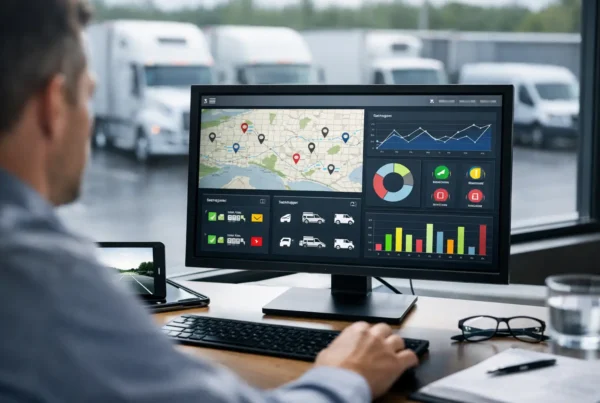
A tracking device is fitted to the vehicle. This device collects information such as GPS position, speed, ignition status and movement. That data is transmitted to a software platform, where fleet managers and operational teams can view live maps, alerts and reports.
Most modern systems also pull in additional information from the vehicle or connected tools, depending on the hardware and integration options chosen. That might include idling time, harsh braking, battery status, dash cam footage, driver ID, mileage logs or geofence activity.
The software is where the commercial value is created. Raw location points on their own do not improve a fleet. What matters is how the platform turns that information into something usable – clear dashboards, exception alerts, scheduled reporting and data that different departments can act on.
For example, operations may want live vehicle visibility and route history. Fleet and transport teams may focus on utilisation, maintenance patterns and driving style. Health and safety may need camera footage and incident context. Finance may want cleaner mileage capture and evidence for reducing avoidable cost.
What data does a fleet tracking system collect?
This varies by device type and how advanced the solution is, but most systems collect a core set of operational data. That usually includes vehicle location, routes taken, start and finish times, stop durations and speed. Many also capture idling, unauthorised use, harsh acceleration, harsh braking and cornering events.
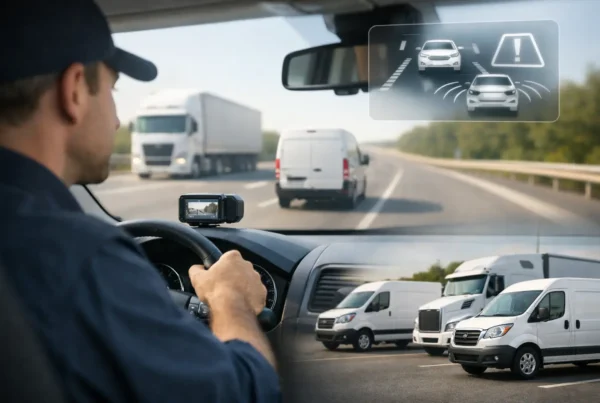
Where camera systems are involved, the fleet may also have access to road-facing or driver-facing footage, live streaming options or event-based clips triggered by incidents. If grey fleet management or mileage capture is part of the requirement, the system may also support app-based journey logging for employees using their own vehicles for work.
This is where businesses need to be realistic. More data is not always better. If reports are too technical or alerts are too frequent, teams stop using them. A good fleet tracking system should be configured around decisions the business actually needs to make.
The business benefits behind the technology
The strongest case for fleet tracking is usually not the map. It is the operational control that sits behind it.
When dispatchers can see the nearest available vehicle, response times improve and unnecessary calls reduce. When managers can review idling and route patterns, fuel waste becomes easier to tackle. When driving events are visible, coaching can be more objective and less confrontational. When a complaint comes in, there is a factual record rather than guesswork.
There is also a strong risk management case. Vehicle tracking and camera footage can help defend insurance claims, support incident investigation and provide a clearer picture of what happened before, during and after an event. In some fleets, this can influence claims costs, excess exposure and insurer confidence over time.
Another benefit is service quality. Customers increasingly expect accurate arrival windows and quicker updates. If your team cannot see where vehicles are or whether a job has overrun, the office ends up reacting late. Tracking data gives customer-facing teams better information, which improves communication without adding more admin.
What is fleet tracking system software not?
It is not just a tool for watching drivers. If that is how it is introduced internally, adoption can become difficult very quickly.
Used properly, it is a management tool for improving planning, protecting staff, reducing avoidable cost and creating a reliable record of vehicle activity. That distinction matters. Drivers are more likely to accept the system when the business is clear about why it is being used, how data will be handled and what outcomes it is trying to improve.
It is also not one standard product. A courier fleet operating in urban areas will need something different from a utilities contractor managing vans, plant and lone workers across several regions. The term fleet tracking system covers a wide range of hardware, software and camera combinations.
Choosing the right fleet tracking setup
The right system depends on the operational problem you are trying to solve.
If the priority is basic visibility, a straightforward vehicle tracking installation may be enough. If the business is dealing with disputed incidents, camera integration may be more valuable than deeper route analysis. If grey fleet use is a concern, mileage capture and driver compliance records may matter more than live vehicle maps. If expensive equipment is regularly moved between sites, asset or plant tracking may need to sit alongside vehicle tracking.
This is where many buying decisions go wrong. Businesses often compare systems on headline features instead of fit. Two platforms can both offer live tracking, but one may have far better reporting, easier dashboard configuration or stronger support for mixed devices and camera options. Those details affect long-term value more than a feature list does.
Support also matters. A system that produces useful alerts, practical reports and tailored views for each team will be used. A system that generates noise and adds admin will not. The best results usually come when the provider helps shape the rollout, the reporting structure and the measures that prove return on investment.
Common concerns and trade-offs
Some fleet operators worry about cost, driver pushback or the time needed to implement a system. Those are sensible concerns.
The cost question should be weighed against what poor visibility is already costing the business in fuel, overtime, missed appointments, unsupported claims or underused vehicles. In many fleets, the hidden operational loss is greater than expected.
Driver acceptance depends heavily on communication. If the system is presented purely as surveillance, resistance is more likely. If it is positioned around safety, fairer incident review, reduced paperwork and better planning, the conversation changes.
As for implementation, it does take planning. Vehicles need fitting. Teams need training. Reports need to be configured properly. But that is also why a consultative approach matters. Fleet Software Solutions, for example, works with businesses to match the setup to the operation rather than force the operation into a fixed template.
What to look for in a fleet tracking provider
Look beyond the tracker itself. The quality of the software platform, the flexibility of the hardware, the availability of camera options and the level of practical support will have more impact than a low entry price.
A good provider should be able to explain what data will be captured, how it will be presented and what measurable improvement you should expect. They should also be comfortable discussing device compatibility, installation logistics, alert configuration and reporting for different stakeholders.
Most importantly, they should understand your operation. A fleet system only delivers value when it reflects how your drivers, vehicles and assets actually work in the field.
If you are asking what is fleet tracking system technology really for, the shortest answer is this: it helps you run a safer, more efficient and more accountable fleet with evidence rather than assumption. The businesses that get the most from it are not necessarily the ones with the most vehicles. They are the ones that use the data to make better decisions every day.